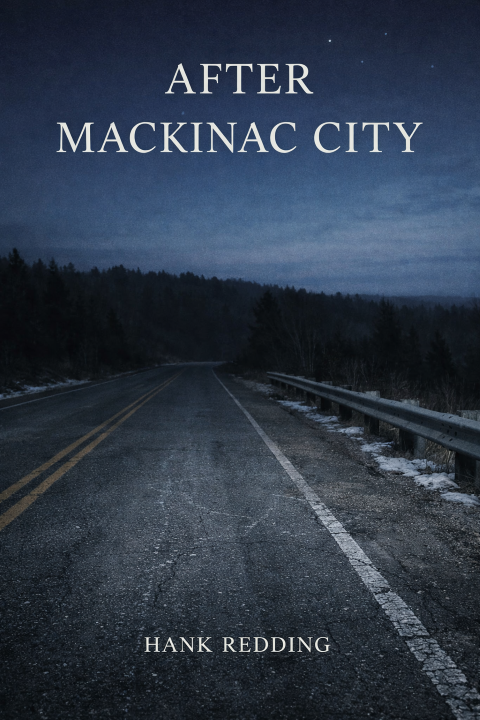
CHAPTER I — WESTBOUND
He saw the westbound road the way you see a bruise in a mirror—sudden, unmistakable, and already old.
It startled him not because it was new, but because it had clearly been there for a while, waiting. The recognition carried a faint shame with it, like realizing you’ve been limping longer than you’ve admitted.
It wasn’t a dramatic highway. No sweeping vista. Just two lanes of winter-grayed asphalt cutting through scrub and low pine, the shoulders salted and scarred from plows. A line of power poles marched along the right side like someone had decided the horizon needed to be measured. The sky was the color of a dishpan, flat and without argument.
The light didn’t flatter anything. It showed things exactly as they were and refused to apologize for it.
He pulled off at a turnout that looked like it had been built for tourists who no longer came. The signboard was faded, its map peeled at the corners. Someone had scratched initials into the wood long ago, now softened by weather. Somewhere beyond the trees, water moved in a sound too big to be seen. He stood with his hands in his coat pockets and let the cold settle into his joints.
The cold worked patiently. It didn’t rush. It found the old injuries first—the knee that clicked, the knuckle that never bent quite right—and claimed them like overdue debts.
He didn’t tell himself he was leaving.
He didn’t say: I’m done.
He didn’t say: I can’t.
He didn’t say: I have to.
Those sentences existed, somewhere nearby, but he refused to give them the dignity of speech. Naming things had always been dangerous. Once named, they demanded follow-through.
The words in his head had been loud for years, but lately the volume had turned into a kind of constant static—his own voice, repeating the same arguments and counterarguments until he couldn’t tell which side he was on. Some mornings he woke up already exhausted from having tried to convince himself, in his sleep, that things were fine.
Fine had become a word he distrusted. People used it when they meant not yet broken enough to justify leaving.
He looked down the westbound lane again.
The road stretched out clean and indifferent. No traffic. No urgency. Just distance.
Right away, he made a choice.
It surprised him how little ceremony it required. No tightening in the chest. No dramatic release. Just a quiet alignment, like something clicking into place after being slightly off for a long time.
He didn’t mark it. No vow. No internal speech. It was more like his body moved ahead of his thoughts, and his mind—tired, relieved—followed after.
Relief came first. Guilt arrived later, but softer than expected.
The bike was where it always was, under the lean-to behind his rented place. He hadn’t planned this far, not consciously, but the machine had been kept ready the way men keep a coat by the door. Habit. Insurance. A quiet, continuous permission to go.
The lean-to creaked when he pulled the tarp loose. The sound echoed more than it should have in the small yard, and he paused, half-expecting a neighbor to look out a window. No one did. He lived among people who minded their own business because they had learned how little it mattered.
The tarp came off with a dry rasp. Dust rose. The bike smelled of cold metal and old fuel. He ran a hand over the tank without thinking, as if to reassure it—or himself—that it was real. The tires were firm. The chain had oil. The saddlebags were empty.
Empty felt important.
Inside, he moved through his rooms with a blunt efficiency, selecting without sentiment. A change of clothes. A spare pair of gloves. A small toiletry kit. A thin notebook he never wrote in. Two envelopes of cash he’d been stuffing away in increments small enough to pretend it wasn’t happening.
The cash had been a lie he told himself gently: just in case. Just in case of what, he’d never specified. Now it knew what it was for.
He stood in the kitchen and looked at the counter. The coffee mug. The chipped bowl. The fruit that had gone soft at the bottom of the paper bag. A calendar with last month still showing.
He thought briefly about crossing the date off, the way people do when they want to prove they were present for their own lives. He didn’t.
He didn’t tear anything down. He didn’t take a keepsake. If anything mattered, it would survive without him. If it didn’t survive, it didn’t matter.
That thought felt harsh, but also clean.
Outside, the air had the bite of near-snow, not snow itself—just the promise. He strapped his bag down, checked the buckles twice, then swung a leg over.
The bike felt heavier than usual for half a second, then settled. The weight became familiar. Predictable. Honest.
The first ignition was reluctant, like a throat clearing. The second caught. The engine settled into its low, steady idle and the sound cut clean through everything else.
The noise didn’t fill the silence so much as replace it with something workable.
He pulled out, turned onto the main road, and rolled west.
The town fell behind fast—gas station, diner, small church, the last stoplight blinking red over empty lanes. He didn’t slow for the light. There was no one coming.
Past that, there was only the long, thinning world.
He took a bead on the northern plains and just rolled the power on.
The bike smoothed out at speed. The vibration settled into his hands and feet, a constant reminder that he was connected to something that would respond if he asked it to. That alone felt like a small kindness.
Hours unwound. The land opened. Trees thinned into ragged lines. Farm fields spread out under pale light, stripped down to stubble and frozen dirt. Here and there, a barn leaned at a tired angle, paint long surrendered to weather. He passed a tractor half-buried in weeds, its tires sunk into the earth like it had tried to leave once and given up. He passed a billboard advertising a casino and, later, a different billboard warning about the dangers of gambling.
The contradiction seemed honest.
The wind came at him from the side, then from the front, then from nowhere at all. It tested his shoulders. It worked into the seams of his jacket. He tucked in slightly and let the bike hold its line.
His body adjusted faster than his mind. His shoulders dropped. His jaw unclenched. His breathing found a rhythm that matched the engine.
His own thoughts tried to catch up.
They came in fragments—faces without names, snippets of conversation stripped of context, a door shutting too hard one night, the sound of his phone vibrating on a table when he didn’t want to answer. A laugh that had been real once, before it turned into something used for patching over awkwardness. He remembered a woman’s hand on his arm in a grocery store aisle, light as if to claim him, and how he had stood there feeling only the weight of it.
He remembered thinking, even then, I shouldn’t feel this tired.
But the road took the edges off. The engine made a single, continuous note. The landscape refused to change quickly. The monotony became a kind of mercy.
He began to understand why people kept moving even when it solved nothing. Motion didn’t heal. But it dulled.
Twelve hours out of Mackinac City, he stopped.
It wasn’t planned. He didn’t pick the place for meaning. It was simply where his body said enough, and the next exit offered light.
The bar sat alone beside a two-lane feeder road, a squat building with a neon sign that buzzed faintly. The parking lot was gravel. A pickup truck idled near the far side with its headlights on, pointing nowhere.
He killed the engine and for a moment the silence felt too big, like stepping off a moving platform and realizing your legs still expect motion.
Inside, the air was warm and smelled of fryer grease and stale beer and the lemon cleaner they used on the tables. A game played on a TV above the bar, but no one watched it with devotion. The bartender was a woman in her fifties with a tight ponytail and eyes that had learned not to ask questions.
He sat and ordered a brew.
The first swallow was cold and clean. It brought his body back to itself—tongue, throat, stomach. It reminded him he was made of parts, not only thoughts.
That realization made him unexpectedly grateful.
He sat with his back to the wall because it felt natural. Habit again. From there he could see the door, the bar, the small stretch of window where the outside world pressed its face against the glass.
The girl was already there when he walked in, though he didn’t notice her right away. She sat at the corner of the bar where the light from the window fell in a dull stripe across the wood. She wasn’t drinking fast. She wasn’t looking for anyone. She held her glass with two hands like she was keeping it steady.
There was something careful about her stillness. Not guarded—just deliberate.
When she turned her head, it wasn’t coy. It was simply the way people look when they sense a change in the room.
They made eye contact.
He didn’t smile. She didn’t either. But something in her face softened—recognition, not of him exactly, but of the shape he was in.
He ordered a second beer. She ordered another too, though she hadn’t finished her first.
He told himself he wouldn’t talk.
After a while, he did anyway.
“I’m heading west,” he said, and the sentence sounded odd in his mouth, like something borrowed.
She took a sip, then set the glass down carefully.
“Everyone’s heading somewhere,” she said.
He nodded, because that was true, but it wasn’t what he meant.
“Just… west,” he said. “No plan.”
She looked toward the window. Outside, his bike sat under the sodium lights, black and still. A long, long moment passed.
In that moment, he felt something close to happiness—not joy, not excitement, but the relief of being seen without being examined.
Then she looked into his eyes.
She didn’t have to say a thing.
He knew what she was thinking because it was what he was thinking too, just with fewer words: You can’t stay where you are. You’re already gone. You just haven’t admitted it.
He finished his beer. The bartender wiped the counter as if the act itself was a boundary.
He stood. He waited for himself to hesitate.
He didn’t.
The girl slid off her stool, dropped cash on the bar without counting, and followed him outside.
The cold slapped them both when the door opened. Their breath made brief ghosts.
At the bike, she paused. She didn’t ask where they were going. She didn’t ask his name.
He didn’t ask hers.
They never even said a word.
She swung a leg over and settled behind him with an ease that suggested she had done it before, maybe with someone else, maybe with this version of someone else. Her hands found his waist and rested there, not gripping, just present.
The contact was steady. Unafraid.
He started the engine.
And they rolled.
The bar’s neon sign shrank behind them until it was only a smear of color in the black. Then it was gone entirely, swallowed by the plains.
They rolled clean out of sight.
CHAPTER II — HIGH PLAINS
The first hour with her on the back was like riding with a shadow—something present but not demanding. Her weight changed his center slightly, made the bike feel steadier in the crosswind. When he leaned into a curve, she leaned with him. No flinching. No unnecessary clutching. She understood the language of motion.
He noticed it the way you notice competence—not with relief exactly, but with the easing of a muscle you didn’t realize you’d been holding tight. He didn’t have to accommodate her. He didn’t have to protect her from the bike or the road or himself. She rode like she trusted the world to behave as it had been behaving all along.
That trust felt borrowed. He carried it carefully.
Night thickened over the plains.
It came on gradually, not as a curtain but as a deepening. The sky darkened from gray to indigo, then toward black, the stars tentative at first. The road ahead narrowed into a cone of light cast by the headlamp, everything beyond it implied rather than known.
The road was bordered by low grass and occasional fences, most of them sagging. The land out there didn’t look owned. It looked endured. There were long stretches with no houses, no lights, no trees tall enough to matter. When a town appeared, it was only a cluster—three or four lit windows, a grain elevator, a closed gas station, the suggestion of a main street.
Each town felt provisional, as if it had been assembled quickly and never quite finished. He imagined the people inside those lit windows—eating late dinners, watching television, talking about weather. He wondered, briefly, what it would feel like to stop somewhere like that and decide to stay.
The thought passed.
At a red light in one of those towns, they stopped behind a single car. Its brake lights glowed like coals. For a moment, with the engine idling, he could feel her breathing against his back through the layers of clothing. Slow. Even. Not anxious.
The light hummed faintly above them. A stray dog crossed the empty street without looking either way.
When the light turned green, the car went one way, they went another, and it felt like a choice made by gravity rather than intention.
He didn’t signal. There was no one to warn.
They didn’t talk much.
The road seemed to encourage silence. The engine spoke enough. Wind pressed against them, carried away anything fragile or unnecessary.
Once, at a stretch of road that rose and fell gently like the surface of a sleeping animal, she leaned close enough for him to hear her through the wind.
“What are you running from?” she asked.
The question wasn’t sharp. It wasn’t accusatory. It was asked the way you ask about the weather—curious, not demanding.
He didn’t answer right away because he couldn’t pick one thing without lying.
There were so many options, and each one felt incomplete. He could say a name. He could say a job. He could say a room, a habit, a silence that had grown too large.
“Noise,” he said finally.
She was quiet a beat.
“Yours?” she asked.
“Yes,” he said.
The word felt accurate. Satisfying, even.
That was the end of it. No prying. No offering a solution.
He appreciated that more than he would have admitted. People were too quick to fix things they didn’t understand. She let the question sit where it belonged.
Later, they stopped for gas at a lonely station with one pump working and the other wrapped in yellow caution tape. The fluorescent light above the pay window flickered. The clerk inside watched them with blank interest and then went back to his phone.
The pump handle was cold in his hand. The smell of gasoline was sharp and grounding. Numbers ticked upward with mechanical indifference. He watched them climb and thought about how easily money moved when it had a clear purpose.
She walked a few steps away and looked at the horizon as if she could see something beyond the dark.
When he turned, she was smiling faintly—not happy, not flirtatious. Just… amused by the fact that she was here at all.
“You got a cigarette?” she asked.
He shook his head.
“Good,” she said. “I should stop.”
She didn’t sound like she believed it. But she said it anyway, like placing a small stone on a pile you may never return to.
He finished filling the tank and replaced the nozzle carefully, listening for the click. The bike felt ready again. Reliable. Waiting.
They rode until the sky started to lighten at the edge, turning the black into a bruised blue. The cold sharpened. The bike’s headlight carved a narrow tunnel in the road.
His eyes burned. His shoulders ached. He began to notice how tired he was, not only in his body but in his bones. The kind of tired that doesn’t come from exertion alone, but from staying put too long.
At a rest area, they pulled off. A picnic table sat under a metal awning, its paint peeling. A vending machine hummed, stocked with snacks that tasted like old paper. The bathrooms were concrete-block, the fluorescent lights too bright, revealing every flaw in the mirror without mercy.
She sat on the bench, pulled her knees up, and watched him drink coffee from a plastic cup. The coffee was terrible. It didn’t matter.
The warmth spread anyway.
“You got people?” she asked.
He understood what she meant: someone who would notice. Someone who would call. Someone who would say his name out loud if he didn’t come back.
“Yes,” he said, though the word felt complicated.
She nodded. She didn’t ask if he’d told them.
That restraint mattered. It felt like respect.
“What about you?” he asked.
She stared at the middle distance, at nothing in particular.
“Some,” she said. “Not the kind who’d come looking.”
The sentence landed softly but stayed where it fell.
When he finished the coffee, he expected her to say she was done—that she’d caught a ride with him for the story, for the night, for the brief relief of being someone else, and now she’d go back to whatever she’d left. That was the usual rhythm of things. People took what they needed and returned to their lives.
He’d been that person before. He recognized the pattern.
Instead, she stood and stretched her arms, joints popping faintly, then looked at the bike like it was a door.
“Let’s keep going,” she said.
The words carried no bravado. Just momentum.
He didn’t ask why.
They went.
Day found them on the open plains, wind scouring the fields, sky a pale bowl overhead. The sun didn’t warm much. It only revealed.
Everything looked stripped down and honest in daylight—the land, the road, themselves. There was no romance in it, and that felt right.
They rolled across the high plains, deep into the mountains—or toward them, at least, the faint dark smudge on the horizon that grew slowly, hour by hour, until it became undeniable: a line of rising land, jagged at the top, like teeth.
As they rode, his mind tried to build stories about her. It wanted a reason. It wanted a neat narrative: she’d been trapped, she’d needed saving, she’d been waiting for a bike and a man with sad eyes.
He refused it.
She wasn’t a symbol. She was a person with her own weight and her own silence. Whatever she’d left behind was hers.
That refusal felt like another small act of respect.
At midday they stopped at a diner with a cracked sign that promised breakfast all day. Inside, the booths were torn and patched with duct tape. A waitress with a tired face took their order without writing it down. Eggs, toast, hash browns.
The food came fast, tasted of salt and grease and the unglamorous kindness of sustenance.
They ate like people who hadn’t eaten enough in a long time.
At one point she laughed—not loudly, not performatively—at something the waitress said about the weather. The sound startled him. It was brief, genuine, and gone almost as soon as it appeared.
For a moment, happiness brushed past him—not the kind you build plans around, but the kind that says this moment is sufficient.
In the reflection of the diner window, he saw them together—his shoulders, her hair tucked into her jacket collar, both of them looking outward rather than at each other. They looked like a couple from a distance. Up close, they were two separate storms moving in the same direction for reasons neither wanted to explain.
After they paid, she touched his sleeve lightly.
The contact was nothing. It felt like everything.
“Can we stop somewhere tonight?” she asked.
He nodded.
They found a motel outside a small town where the mountains finally began to shoulder into view. The motel was a strip of doors under a long overhang, each room identical. The office smelled like old carpet. The man behind the counter slid a key across without smiling.
In the room, there were two beds. A TV bolted to the wall. A lamp with a shade that had been repaired with tape.
The room felt temporary in a way that matched them.
She stood by the window and looked out at the bike parked under the overhang. The mountains loomed in the distance, dark and indifferent.
“You ever been out here?” she asked.
He shook his head.
She nodded slowly, as if she’d expected that. As if that information fit into something she already knew.
They sat on the edge of one bed, boots still on. The silence between them was not awkward. It was shared.
When she finally spoke, her voice was quiet.
“I don’t want to go back,” she said.
He didn’t ask where back was.
He didn’t say: You’ll be okay.
He didn’t say: Come with me.
He didn’t say anything that would turn her into a decision he made.
Instead, he reached into his pocket and pulled out the thin notebook, the one he never wrote in. He set it on the bed between them like an offering of emptiness.
“Write something,” he said.
She stared at it, then at him.
“Why?” she asked.
He swallowed.
“Because if you don’t,” he said, “you’ll start thinking none of it happened.”
Her face tightened—not in pain exactly, but in recognition. She let out a breath that might’ve been a laugh, or might’ve been the beginning of a cry that she refused to finish.
She took the notebook, opened it, and wrote one line.
He didn’t read it.
They lay down separately, each in their own bed, fully clothed.
In the middle of the night he woke to the sound of her breathing, uneven now, as if she’d been running in her sleep. He stared at the ceiling until his eyes blurred. He listened to the wind move around the building.
In the dark, he realized something he hadn’t wanted to admit: the road didn’t fix anything. It only made the wounds quiet enough that you could pretend they weren’t bleeding.
Morning came pale and cold.
They left without a word to the man at the counter.
They rode into the mountains.
CHAPTER III — THE AIR TURNED COLD
The mountains weren’t dramatic at first. They rose gradually, like a thought forming slowly enough you don’t notice it until it’s finished. The road began to climb. Pines returned. Rock faces appeared beside the shoulder, rough and gray. Snow lingered in dirty patches where the sun couldn’t reach.
It happened subtly, the way change usually does. One mile looked like the last. Then another. Then suddenly the plains were gone behind them, folded away without ceremony, and the land had decided to rise.
The bike worked harder. He felt it in the pitch of the engine, the slight insistence it took to maintain speed. Gravity announced itself not as resistance, but as fact.
The wind changed.
On the plains, the wind was constant and straightforward, pushing and pulling like an animal testing a fence. In the mountains, the air was more precise. It cut. It found gaps. It made every exposed piece of skin feel like a mistake.
Cold wasn’t just temperature here—it was placement. It arrived where it was least welcome. It settled into the hollow of his throat, the crease behind his knees, the thin space at the small of his back.
They rode along a high road that curved around ridges and dipped through narrow valleys. The sky above was brighter but offered no warmth. Clouds moved slowly, indifferent to the tiny line of asphalt below.
Everything felt suspended. As if the land itself was holding its breath.
She held on tighter now—not from fear, but from cold.
The pressure of her arms changed. Less casual. More intentional. He adjusted his posture to block the wind where he could. It was a small, unspoken courtesy. One of the last.
At a turnout overlooking a wide drop, they stopped. Below them, the land fell away in layers: ridges fading into one another, the farthest ones turning blue with distance. A river threaded through the bottom like a dull ribbon. Somewhere out there, the world continued doing what it did, regardless of them.
The view demanded attention but offered nothing in return.
He turned off the engine. The sudden quiet rang in his ears.
The silence wasn’t empty. It was full—of wind, of unseen water, of distance. His ears searched for the engine and found only themselves.
She climbed off and walked to the guardrail. She rested her hands on the cold metal and stared down as if the depth could answer something.
He stood beside her without touching her.
There were moments when touch would have been easy. This wasn’t one of them.
For a while, neither spoke.
The quiet stretched without strain. He could hear his own breathing again. He could hear hers.
Then she said, “I used to think leaving was the hardest part.”
He watched her profile—sharp nose, mouth set in a line that had learned to hold. She wasn’t asking him to agree. She was reporting a conclusion she’d arrived at alone.
“And now?” he asked.
She swallowed.
“Now I think it’s… deciding what you’re allowed to miss.”
The pause before miss carried more weight than the word itself.
He didn’t respond because he understood too well. Missing wasn’t proof you’d made the wrong choice. It was proof you’d been there.
He thought of all the things he had missed without realizing he was doing it—conversations half-listened to, mornings slept through, chances he’d declined because they felt like work.
They got back on the bike and kept going.
The road climbed higher. Curves tightened. Guardrails appeared more frequently, scarred and dented. Signs warned of falling rock, sharp turns, reduced visibility. The language of caution increased, as if the road itself had begun to doubt the wisdom of passage.
As the day wore on, she grew quieter. Not withdrawn exactly—just inward. When they stopped for gas in a mountain town with a single main street and a mural of elk painted on the side of a hardware store, she moved as if underwater. Slow. Careful. Looking at everything but seeing none of it.
He noticed how she lingered at the edge of spaces—the doorway, the curb, the pump—as if already practicing how to leave. He paid for the gas. He held the door. None of it mattered.
Back on the road, she leaned close.
“I miss my home,” she said.
The words came out plain, without drama. Like reporting the weather.
He felt something tighten in his chest. It wasn’t jealousy. It wasn’t resentment. It was the simple ache of realizing you are not what someone is missing.
He didn’t know what to say that wouldn’t insult her intelligence.
“Yeah,” he said finally. “I figured you would.”
She nodded against his back.
The contact lingered a second longer than necessary, as if she were memorizing the shape of it.
A few miles later, she spoke again.
“I don’t think I can do this,” she said.
The road ahead curved out of sight. The sky dimmed slightly, clouds thickening. He didn’t slow.
He didn’t ask what she meant—this, the riding, the running, the borrowed freedom. He knew. The road was easy when it was new. Harder when it became a life.
He pulled off at the next turnout—another small paved space carved out of rock, with a sign warning about falling stones. Below, the mountains rolled away like a frozen sea.
She climbed off. She stood with her arms wrapped around herself.
The cold had found her now too.
He waited.
She looked at him, and for the first time there was something close to fear in her eyes—not of him, but of what she was about to do.
“I can’t keep going,” she said. “Not like this.”
He nodded once, because arguing would be cruel.
There was no version of persuasion here that wasn’t selfish.
“There’s a town back there,” she said, gesturing with her chin toward the road behind them. “It had a bus station. I saw the sign.”
He hadn’t noticed it, but he believed her.
Belief came easily with her. That felt important.
She took a step closer and, for the first time, touched his face—just her fingertips against his cheek, light and brief. It wasn’t romance. It was acknowledgment.
The cold burned where she touched him.
“You helped,” she said.
He almost laughed, but it would’ve sounded wrong.
“I didn’t do anything,” he said.
She shook her head.
“You did,” she said. “You didn’t ask for explanations.”
That, he realized, might’ve been the most intimate thing anyone had ever given her.
She reached into her jacket pocket and pulled out the notebook—the one she’d written in—and handed it to him.
He took it without opening it.
“Don’t read it,” she said.
He looked at her.
“Why give it to me then?” he asked.
She smiled faintly. It didn’t reach her eyes.
“So you’ll know I was real,” she said. “And so I’ll know you won’t turn me into a story that makes you feel better.”
The sentence landed carefully, like a boundary placed with respect.
He swallowed.
“Okay,” he said.
She stepped back. The wind tugged at her hair. She looked over his shoulder toward the westbound road—the direction they’d been going. For a moment, he thought she might change her mind.
She didn’t.
She turned and walked toward the road behind them. Her boots scraped gravel. She didn’t wave. She didn’t look back.
He watched her until she was a smaller and smaller figure against the asphalt, then until she was simply part of the landscape, then until he couldn’t tell her from a shadow.
The absence hit immediately—not as grief, but as imbalance. The bike leaned slightly without her weight. The space behind him felt unfinished.
He sat on the bike a long time without turning it on.
The cold crept up through the seat, through his thighs, into his stomach. His breath made small clouds in front of him.
He thought about going back.
He thought about following her to the bus station and sitting beside her until the bus came, and then maybe… what? Going with her? Becoming part of her life? Becoming another temporary man in another temporary story?
He imagined himself standing in that town, holding a paper cup of bad coffee, waiting for a bus he didn’t intend to board.
He thought about turning east, returning to the place he’d left behind, pretending he’d simply taken a long ride to clear his head. Pretending the choice hadn’t been a choice at all.
That lie felt heavier than the cold.
He stared at the road.
West and east. Both directions meant something, even if he didn’t name it.
Finally, he turned the key.
The engine caught.
The sound felt louder without her.
He pulled back onto the highway and headed west.
He rode alone now, the bike lighter beneath him, his body readjusting to the missing weight. The absence behind him felt louder than the engine. Every time he stopped at a light, he expected to feel her shift, expected to hear her voice.
Nothing.
As the afternoon faded, the mountains grew steeper. The road narrowed. The sky began to bruise toward evening.
He kept riding.
The cold settled deeper. He stopped once to put on his heavier gloves, and his hands shook slightly as he did it. Not from temperature alone.
He noticed he’d begun to grip the bars harder than necessary. He forced himself to loosen his hands, to trust the bike again.
He rode until the sun sank low and turned the ridgelines black against a fading orange.
Somewhere along a high road, the air turned cold in a way that felt permanent.
Not passing. Not temporary. A condition.
He realized he didn’t know where he was anymore, not exactly. The signs had become less frequent. The towns more sparse. He’d crossed a state line at some point without noticing.
He passed a sign:
GREAT DIVIDE — 12 MILES
The words landed in his chest with an odd weight, like something from a book he’d never finished.
He kept going.
CHAPTER IV — THE GREAT DIVIDE
The mountain top came without ceremony.
There was no sense of arrival beyond the simple fact of being there. No shift in the air that announced importance. No clearing of the throat from the land itself.
There was no grand overlook, no gift shop, no crowd of tourists taking photos. Just a widening in the road, a patch of gravel, and a wooden sign that had been repaired so many times it looked like it might be held together by memory alone.
The wood was scarred. Nails had been replaced. Someone had carved initials into one corner decades ago and weather had nearly erased them.
CONTINENTAL DIVIDE, it read.
Underneath, smaller letters: ELEV. 8,321 FT.
He pulled in and shut off the engine.
The silence was immediate and heavy, like stepping into a cathedral after a lifetime of noise. The wind moved through the pines with a low hiss. Somewhere below, water ran unseen, making its decision to go one direction or another, east or west, without needing to justify it.
The engine ticked softly as it cooled, then stopped altogether.
He got off the bike and stood with his hands on his hips, looking out.
The land fell away on both sides. To the east, the mountains rolled back toward the plains he’d crossed, toward the towns and bars and old arguments. Toward kitchens with calendars and counters that still remembered his hands. Toward roads that led back into routines that pretended not to notice how tired he was.
To the west, the ridges stacked into distance, darker, unknown. No lights. No landmarks. Just the suggestion of continuation.
It was all up to him to decide.
That thought should have felt empowering. It didn’t. It felt like being asked to choose which hand to lose.
He took a few steps away from the bike until the gravel gave way to packed dirt and snow. His boots crunched softly. The cold bit through the soles, reminding him his body was not immune to the world.
He felt it now—how thin he really was out here. How exposed. How temporary.
He looked up at the sky.
The last light was draining out of it. The first stars were faint, cautious, as if they weren’t sure they were allowed. The blue thinned toward black. The air smelled of pine and stone.
Just then he saw a young hawk flying.
It came from the east, low over the treetops, wings beating hard at first, then lifted on a current and rose in a slow spiral until it was a dark shape against the fading sky. It didn’t fight the wind. It let the wind hold it.
He watched it until his eyes watered.
And his soul—if he still believed in having one—began to rise with it.
Not because the hawk was a sign, or because the universe was sending him anything.
But because in that moment he remembered something simple: there are creatures that live by motion alone, and they do not apologize for it. They do not explain. They do not ask permission from anyone’s idea of right or wrong.
They move because moving is what they are built to do.
He felt, briefly, something close to relief.
Not hope. Not peace. Just relief—like loosening a grip you didn’t realize had been hurting you.
He walked back to the bike and leaned his forearms on the handlebars. The metal was cold enough to sting. He stared at the headlight casing, at his own distorted face reflected faintly in it.
His face looked older this way. Narrower. Reduced to planes of light and shadow.
He thought about the girl. Her quiet hands. The way she’d said home like it was a weight and a comfort at once. The way she’d walked away without looking back, as if she understood that looking back was the thing that made leaving dangerous.
He thought about the place he’d left behind. The kitchen counter. The calendar. The mug. The phone that hadn’t rung because he hadn’t turned it on.
He wondered, briefly, whether anyone had noticed yet.
He reached into his bag and pulled out the notebook.
He held it for a long moment, feeling the thinness of the cover, the smallness of it compared to everything else. It felt inadequate. It felt essential.
He could read it.
He could break the one request she’d made.
The thought sat there, waiting.
He didn’t.
Instead, he opened it to the first page—carefully, like handling something fragile—and stared at her single line of writing without focusing on the words. He let it be ink and shape, proof of a hand, nothing more.
He closed it again.
He set it on the bike seat.
The vinyl was cold. The notebook didn’t slide.
He looked at the road.
The darkness deepened. The wind sharpened. The last strip of sunset thinned like a closing eyelid.
He spoke to the faintest first starlight—not to God, not to fate, not to anyone who might answer. Just to the quiet itself.
“Next time,” he said.
His voice sounded small in the open air.
“Next time we’ll get it right.”
The words drifted and disappeared. No echo returned.
He didn’t know who we was.
That was the point.
He swung a leg over the bike.
The seat was colder now. The shape of it familiar in a way that felt almost intimate.
He hesitated, just long enough to feel the cold seep deeper.
Then he started the engine.
The headlight snapped on, cutting a bright wedge into the dark.
He rolled forward out of the turnout and onto the westbound lane.
For a while, the road felt good again—smooth under the tires, the bike steady, the world simplified down to line and speed and breath. The mountains pressed close on either side. The darkness swallowed detail. The headlight created its own reality ten yards at a time.
There was comfort in that narrowing. Less to consider. Less to remember.
He passed a sign warning of ELK CROSSING.
He slowed.
The road curved ahead, guardrail tight to the shoulder. He leaned into it, controlled, practiced. The guardrail was dented and scarred, as if something large had hit it once and kept going anyway.
His mind drifted—not into thoughts, exactly, but into a soft blankness, the place he’d been chasing since the beginning. The place where nothing demanded an explanation.
A gust came hard from the left, sudden and cold as a slap.
The bike twitched.
He corrected automatically, a small movement of the bars, the way you do without thinking.
The road curved again.
There was a dark shape at the edge of the headlight’s reach—too late to identify, too early to be sure. It could have been rock. It could have been shadow. It could have been nothing.
He did not swear. He did not cry out.
The headlight jumped briefly, painting the trees at a strange angle, then returned to the asphalt.
The bike’s engine tone changed for half a second, then smoothed out again.
He kept riding.
Farther down, the road straightened. The wind eased. The darkness returned to its normal shape.
The world pretended nothing had happened.
He rode until he saw another turnout, unmarked, just gravel and snow and a break in the guardrail. He pulled in, shut off the engine, and sat.
He did not get off.
He sat with his hands on the grips, shoulders rising and falling with his breath.
His breathing took longer to settle than it should have.
He stayed there long enough that the ticking of the cooling engine became the loudest thing in the world.
Then he reached down and turned the key again.
Nothing.
He tried once more.
Nothing.
He sat very still.
The wind moved through the pines. The stars brightened.
He took his hands off the grips and looked down at the bike as if it had betrayed him, as if it had made a decision of its own.
Then he looked up at the road ahead—black, empty, continuing west.
He looked back at the road behind—black, empty, leading east.
Neither direction offered an answer.
He swung a leg over and stood on the gravel.
The cold hit harder now that he was still. It crawled under his jacket, into the spaces between ribs. His breath fogged thickly in front of him.
He walked to the edge of the turnout and stared into the darkness beyond the guardrail.
The drop was there, but you couldn’t see it. You could only feel it—the absence of ground, the sense that the world fell away.
It felt vast. Final. Patient.
He stood a long time.
Somewhere below, something moved—wind, water, maybe an animal. A sound too soft to name.
He went back to the bike and picked up the notebook from the seat.
He held it against his chest for a moment, like a thing that mattered.
The warmth didn’t last.
Then he set it in the saddlebag and closed the latch.
He checked the straps as if he still had somewhere to go.
The habit was ingrained. Comforting.
When he finally stepped away from the bike, he didn’t lock it. He didn’t take the key. He left it as it was, under the thin wash of starlight, a dark shape beside the road.
It looked smaller without him.
He walked toward the westbound lane.
He stopped at the edge of the asphalt and looked down it again, the way he had at the very beginning.
The road did not answer.
He stepped forward anyway.