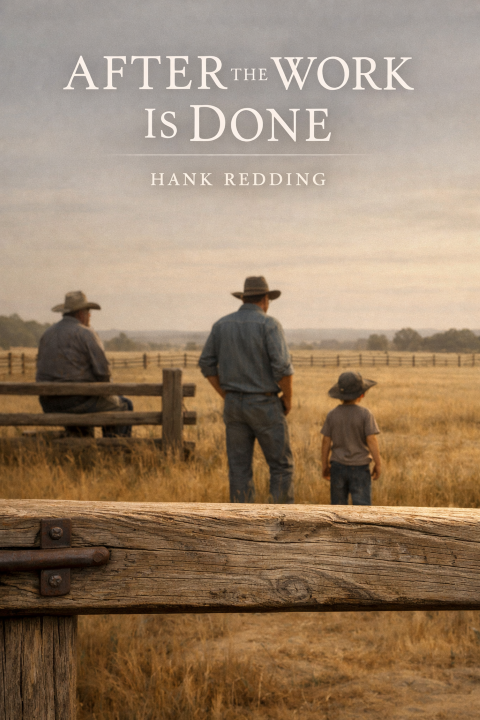
Chapter One — Proximity
My father never taught me anything the way people say they teach things.
He worked, and I watched.
That was the arrangement.
I was born into a place where work came first and names came later. The ranch sat where the land stopped pretending it wanted anything else from you. Fences ran straight because they had to. Gates swung the same way every time because habit was safer than thought. Horses knew where to stand. Cattle knew where to wait. Nothing argued.
My father moved through it all without hurry. Not fast, not slow. Just at the speed the day required. I don’t remember him resting unless something else was already finished. Even then, rest looked temporary, like something borrowed until the next task came due.
In the mornings, he was up before the house remembered itself. Boots on the floor. Coffee poured without ceremony. The screen door closed behind him with the same soft snap it always had. I learned that sound before I learned his voice.
When I was small, he let me follow. Not because I helped. Because I stayed out of the way.
I held posts while he set them. Carried tools I couldn’t use yet. Opened gates and closed them again when told. Sometimes I did it wrong. He didn’t correct me right away. He waited to see if I’d notice.
Most of the time, I did.
He spoke when it mattered. Instructions were short. Directions came once. If you missed them, you learned why repetition wasn’t guaranteed. He never raised his voice. He didn’t need to. The work was loud enough on its own.
At the kitchen table, he ate without commentary. My mother talked about weather and neighbors and things that needed attention later. He nodded when something required agreement. When it didn’t, he let it pass.
At night, he sat in the same chair every evening. Not to rest exactly — more to take inventory. The television stayed on low, usually something familiar enough not to demand attention. His hands rested on his knees, still shaped by the day. Calloused. Marked. Steady.
I used to think those hands would always look that way.
When I was young, he felt permanent. Not in the way buildings feel permanent — but in the way the land does. Unmoving because it didn’t consider leaving an option.
I measured myself against him without realizing it. How much I could lift. How long I could stay awake. How quietly I could move without being told. I wanted to match him without understanding what that meant.
He never praised me. He didn’t need to. If I was there the next morning, that was enough.
The first time I noticed him slow, I didn’t know what I was seeing.
A missed step at the gate. A pause before lifting something he’d lifted a hundred times before. A hand resting longer than necessary on the fence rail.
I assumed it was nothing. That assumption lasted years.
Work has a way of hiding change until it can’t.
By the time I understood what was happening, the rhythm had already shifted. Tasks were reassigned without discussion. Things I used to watch, I now did. Things he used to do without thinking, he now watched.
He didn’t say anything about it.
Neither did I.
That was the rule by then.
And I learned, slowly, that the work doesn’t end when the hands change — it just moves to whoever is still standing there when it needs doing.
Chapter Two — What He Let Me Do
There were things my father did not hand over all at once.
Some work stayed his long after I was capable of doing it. Not because he doubted me — because certain tasks required authority before they required strength. You didn’t step into them early. You waited until the work itself made room.
Feeding cattle was one of those things.
I followed him down the line with the bucket, counting heads the way he had taught me without ever explaining why it mattered. He stopped once, knelt in the dust, and checked a hoof with more care than urgency. I stood there holding the weight, unsure whether to set it down or wait.
“Hold,” he said.
I did.
When he stood, he nodded once, and we kept moving.
He let me start the tractor before he let me drive it. That came later. First, I learned how it sounded when it was right. How it hesitated when something wasn’t seated properly. How the engine complained in ways that meant stop now, not later.
He corrected me once when I reached for the ignition without checking the choke.
“Look first,” he said.
That was the whole lesson.
By the time he let me take the wheel, he’d already watched me enough to know I wouldn’t rush it. He stood off to the side, hands on his hips, letting me make a full pass before saying anything.
I did it too wide the first time. He didn’t mention it. The second pass was better.
That was how he taught.
Some work he never let go of entirely. Fence corners. Horses that hadn’t been broken cleanly. Negotiations that required silence more than talk. He handled those himself, even when his hands began to shake in ways he pretended not to notice.
I pretended too.
There came a time when I stopped asking what he needed help with and started asking what he wanted done. That was the change. Small, but decisive. The work shifted from following to anticipating.
At the end of the day, we stood at the gate together and watched the cattle settle. Dust hung low, caught in the light. He leaned more than he used to, weight resting into the post.
“You did alright,” he said.
It wasn’t praise. It was confirmation.
That night, he sat longer than usual. The television murmured. His hands rested open now, palms turned upward, the day leaving them slowly.
I noticed how often he looked at me when he thought I wasn’t paying attention.
Not to check my work.
To see if I was still there.
Chapter Three — When the Hands Change
It didn’t happen all at once.
There wasn’t a morning when he woke up different, no day you could circle and say this was it. The change came in small revisions. Adjustments you could ignore if you weren’t watching closely.
He switched hands more often. Paused longer before lifting. Let tools rest where they fell instead of setting them back in place. None of it stopped the work. It just slowed the space around it.
The first time I reached for something without asking and he didn’t stop me, I felt it immediately. Not relief. Weight.
He watched while I finished the task. Didn’t look away. Didn’t correct me. When I was done, he nodded and turned back to what he had been doing, as if the exchange had been settled without discussion.
Later that week, he handed me the wrench instead of taking it from me.
“Your turn,” he said.
It wasn’t a test. It was a decision.
I learned to listen differently after that. Not just to the machines, but to him. To the places where he chose not to step in. To the moments where silence replaced instruction.
He stopped whistling for the dogs. Not because he couldn’t — because I was closer. When they ran to me instead, he didn’t say anything. He watched them settle, then looked away.
At the fence line, he leaned more. At the barn door, he waited for me to open it. At the table, he asked fewer questions and listened longer than before.
Once, without looking up, he said, “You remember how this goes.”
I did.
That was the problem.
There were still things he insisted on doing himself. Small, stubborn rituals that belonged only to him. Checking the locks at night. Walking the perimeter before sunrise. Sitting in the same chair, hands folded, counting something I couldn’t see.
I didn’t interfere.
When his hands shook, he tucked them into his pockets. When he missed a step, he recovered quickly enough that I pretended not to notice. We both agreed to let dignity stand where speed once had.
One evening, after the work was done and the light had drained out of the yard, he stayed outside longer than usual. I joined him without speaking.
He looked out across the land as if he were seeing it from a distance for the first time.
“You’ll keep it straight,” he said.
It wasn’t a request.
“Yes,” I said.
That was all that needed saying.
The next morning, he slept later than I expected. Not late — just later. I had already started without him. When he came out, he didn’t apologize.
He watched for a while. Long enough to be certain.
Then he went back inside.
The work continued.
Chapter Four — What He Could No Longer Carry
There were things my father gave up without ever saying he had.
Not all at once. Not in ways that announced themselves. They left the way weight leaves a body—quietly, unevenly, until you noticed what was missing by the way something else strained to compensate.
He stopped carrying feed sacks before he stopped lifting them. He said nothing about it, just waited until I was closer and let the weight shift naturally. I took it without comment. Comment would have made it visible.
At the fence line, he no longer took the corner posts. He worked the stretches between, the parts that required patience more than force. When I offered to switch, he shook his head.
“I’ve got this,” he said.
And he did. Just not everything.
There were days when his hands betrayed him before the rest of him did. A bucket tipped too far. A bolt dropped into the dust. He bent to retrieve it more slowly than he meant to. Each time, he recovered his composure before I could step in.
I learned then that help is not always a kindness. Sometimes it’s a declaration.
He still walked the property in the evenings, but the circuit shortened. He skipped the far gate. Turned back before the low ground. When I asked if he wanted company, he said no, then waited until I followed anyway.
We stood together at the edge of the pasture one night, the cattle settled, the sky thinning toward dark. He rested his forearms on the fence and leaned in the way men do when they are listening to something internal.
“You ever notice how things don’t fall apart all at once?” he asked.
“Yes,” I said.
“They just stop holding,” he said. “Little by little.”
He didn’t look at me when he said it. He didn’t need to.
The next morning, he handed me the keys without explanation.
I took them and waited for him to say something else. He didn’t. He stood there long enough to watch me put them in my pocket, then turned back toward the house.
From then on, there were parts of the day he no longer entered. He stayed inside when the heat rose. Sat longer at the table after meals. Slept through tasks he once would have risen for without thinking.
He never apologized for it.
Once, I found him in the barn after dark, standing still, his hand resting on the side of the tractor as if it were something alive.
“Forgot something?” I asked.
“No,” he said. “Just remembering.”
I didn’t ask what.
That winter, he stopped fixing things unless they were already broken. Preventive work became reactive. Planning gave way to response. The work narrowed, focusing on what had to be done rather than what could be improved.
I noticed how often he watched me now. Not critically. Not with concern. With assessment.
He was taking stock.
One afternoon, he followed me out to the field and stood longer than usual, saying nothing. When I turned to ask if he needed something, he shook his head.
“You’ve got it,” he said.
I believed him.
Not because I was ready.
Because he was finished carrying what no longer belonged to him.
Chapter Five — When the Watching Changes
I didn’t notice it at first.
That was the trick of it. Watching looks the same whether you are the one doing it or the one being done.
He stood farther back now. Not in the way of someone giving space — in the way of someone making room. When I moved, he stayed where he was. When I finished, he didn’t follow. He let the distance hold.
At the fence line, he leaned and observed. At the barn, he paused at the door and waited for me to go in first. At the table, he asked fewer questions and answered more slowly, as if his role had shifted without being renegotiated.
Once, I caught him watching my hands instead of the work.
That stayed with me.
The first time my son followed me out, he was small enough that the ground still surprised him. He moved carefully, stopping to touch things that didn’t matter yet. Gravel. A post. The worn edge of the gate.
I told him where to stand.
He listened.
My father stayed on the porch that morning. Not seated — just standing, one hand on the railing, eyes steady. He didn’t call out. He didn’t correct either of us.
When my son handed me a tool he didn’t know the name of, I took it and nodded the way I had learned to. No explanation. No praise. Just confirmation.
Later, when the work was done, my father said, “He pays attention.”
I waited for more.
There wasn’t any.
After that, my son became part of the day in small ways. Opening gates. Carrying nothing important. Standing where he was told and staying there. He learned the sound of the place before he learned its names.
My father watched all of it without stepping in.
There were moments when I expected him to correct me — to reclaim something I had missed or prevent a mistake before it happened. He didn’t. He let the error exist long enough for it to teach what it needed to.
I understood then that watching was not passive.
It was work.
In the evenings, the three of us sat within sight of one another without speaking much. My son on the floor, absorbed in things that would not remember him. My father in his chair, hands folded, eyes open longer than necessary. Me at the table, already planning the next day without meaning to.
Once, my son climbed onto my father’s knee without asking. He fit there the way children do, trusting the structure beneath them.
My father’s hands rested on his back, careful, unsure at first — then steady.
I watched that, and felt the shift settle fully into place.
What had once been instruction had become witness.
And what had once been strength had become presence.
No one announced it.
The work didn’t pause.
But the watching had changed.
Chapter Six — After the Work Is Done
The day came when the work no longer arranged itself around him.
Not because he was gone. Because the order had already changed.
He stayed inside more now. Not sleeping — listening. The screen door opened less often. The sound I had learned first arrived later in the morning, sometimes not at all. When he did come out, it was without purpose, just presence, as if he were checking that the shape of things still held.
They did.
I worked without looking back. Not because I didn’t care — because looking back had become unnecessary. The gates opened when they should. The cattle moved when asked. The machines answered without complaint.
My son stayed close, watching the same way I had. Not asking questions yet. Learning the language before the grammar.
My father sat in the shade and observed without comment.
Once, after the last fence was mended and the tools were put away, I found him standing alone at the edge of the pasture. The sun was low enough to soften everything it touched. He leaned on the post, hands resting where strength used to live.
“All right,” he said.
It wasn’t approval.
It was conclusion.
That night, he did not take his chair.
He sat at the table instead, hands folded, eyes open. The television stayed off. The house held its breath in a way I hadn’t noticed before.
My son fell asleep where he sat, head against the wood, the day still moving through him.
I carried him inside.
When I returned, my father was still there, watching the space where the boy had been.
“You won’t rush him,” he said.
“No,” I said.
“Good.”
He stood carefully, slower than he meant to, and rested a hand on my shoulder — not to steady himself, but to mark the place.
After that, there was nothing left to say.
The work would continue. It always did. But the teaching had finished. The watching had shifted again.
What remained was not instruction or inheritance or even memory.
It was presence.
And the understanding that when the work is done, what stays behind is not the labor itself — but the way it was carried.