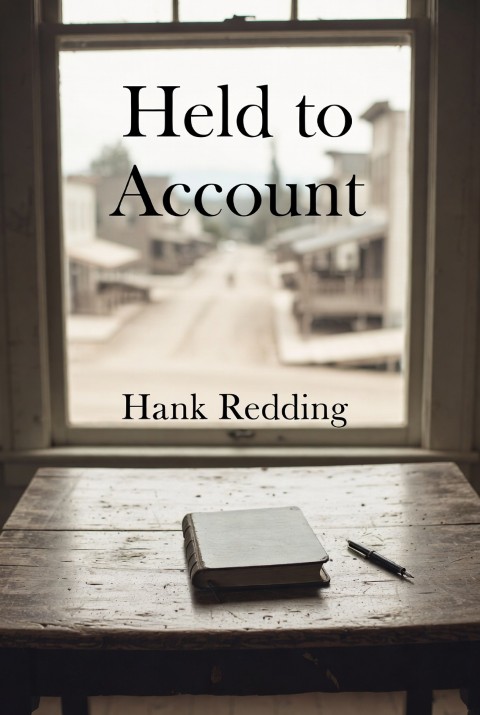
Chapter One - The Log
Caleb Vorr arrived at the clerk’s office at the same minute every morning. Not earlier. Earlier invited conversation. Earlier suggested availability. On time allowed the door to be opened, the desk to be cleared, and the work to begin without comment.
The building had been constructed before anyone bothered to level the street. The front step leaned a fraction to the left. Caleb compensated without thinking, the way a person does after enough repetition. He removed his hat, hung it on the peg behind the door, and slid the bolt into place—not to lock it, just to keep it from drifting.
The ledger lay where he had left it.
It was thick enough now to require both hands. The spine had been repaired once with twine and glue, then again with leather that didn’t quite match. Caleb preferred it closed. Open books invited speculation. Closed books suggested order.
He turned it so the spine faced the wall and sat.
The pen took longer to prepare than the writing itself. He wiped the nib, tested the ink in the margin of a completed page, and waited for it to dry before continuing. The mark held. He nodded, once.
Payroll came first.
It always did.
He read names aloud under his breath—not to hear them, but to slow himself down. There were more repetitions than there had been the year before. Two men drawing wages from the same account. A woman still listed as dependent despite the death record dated fourteen months back. A boy entered twice, once under each parent, as if numbers could stand in for presence.
Caleb did not correct the entries. Correction implied authority. Authority implied instruction. Instruction was not his role.
His role was accuracy.
Outside, the street had begun to wake. Boots passed the window in uneven intervals. A wagon rattled, then stopped. Someone coughed. The sound lingered longer than it should have.
At midmorning, footsteps paused at the threshold.
They did not enter.
Caleb recognized the hesitation. Everyone hesitated before crossing into the clerk’s office. People came here only after something had gone wrong, and no one liked to announce that.
The door opened.
“Morning,” the man said.
Caleb looked up.
He knew the face. He could not place the name.
“That depends,” Caleb said, and waited.
The man shifted his weight. “I was told to come see you.”
Caleb turned a page. “By whom?”
The man hesitated again. “Mr. Bellant.”
Caleb’s hand stopped.
Not because the name was unfamiliar. Because it had appeared three times already that morning, written in a firm, economical hand in the margins of other people’s accounts.
He closed the ledger—not hard, not gently—and folded his hands on top of it.
“Then we should begin,” Caleb said.
Outside, the town of Breachwater continued without them.
Chapter Two - The Rule
Marcus Bellant did not come to the clerk’s office the way most men did.
Most men arrived with a hat in their hands and a story already rehearsed. They leaned on the doorway as if the building were optional. They spoke in half-jokes meant to soften the request.
Bellant entered as if he had already paid for the room.
He removed his hat, nodded once to Caleb Vorr, and set the hat on the chair beside him without asking permission. The gesture was not rude. It was precise. It implied the chair would remain empty.
Caleb waited.
Bellant took in the office the way a person reads a fence line—quickly, without admiration. His eyes moved over the shelves, the stacked forms, the walls stained faintly by years of coal smoke and dust. He noted the open window. He noted the bolt on the door.
Then he looked at the ledger.
“Show me the book,” Bellant said.
Caleb did not reach for it right away. “What do you need to see?”
“What you have,” Bellant said. “And what you don’t.”
Caleb’s fingers rested on the cover. The leather was warm from the morning.
“The book is not a map,” Caleb said. “It doesn’t show you where people are.”
Bellant’s mouth tightened at one corner, not quite a smile. “It shows me who’s counted.”
Caleb slid the ledger toward him and opened it to the index. Bellant did not sit. He leaned over the desk and ran a finger down the columns without touching the ink. Names. Dates. Notations. Cross-references. He read without moving his lips.
“How many men does the town pay for work on the street?” Bellant asked.
Caleb answered without looking up. “Six.”
Bellant’s finger stopped. “How many are listed as working it?”
Caleb’s eyes moved to the entry. “Nine.”
Bellant nodded, as if confirming a rumor. “How many ration slips did Breachwater issue last week?”
Caleb reached for a thin folder. “One hundred and twelve.”
“How many households are registered?”
“Ninety-three.”
Bellant looked at him then. Not with anger. With interest.
“You keep good numbers,” he said.
Caleb had learned over time that praise was often a tool. It loosened men. It invited them to speak beyond what was required.
“I keep the numbers I’m given,” Caleb said.
Bellant straightened. He did not argue.
Outside the open window, the sound of Breachwater moved along the street in small currents—harness leather, boots on boards, a mule’s impatience. The town had its own rhythm, and it did not change for conversation.
Bellant placed his hand flat on the ledger’s open page. Not on the writing—just beside it—like a man taking an oath without ceremony.
“This town is leaking,” he said.
Caleb waited.
“It leaks money. It leaks food. It leaks labor. It leaks safety.” Bellant’s voice stayed even. “And it leaks because nobody knows what belongs to it.”
Caleb said, “People belong to themselves.”
Bellant didn’t blink. “Then they can feed themselves.”
The words were plain. Not cruel. Just arranged in a way that made cruelty unnecessary.
Caleb watched him the way he watched a scale settle—patient, wary of tricks.
Bellant pulled a folded paper from his coat pocket and laid it on the desk.
“What is that?” Caleb asked.
“A rule,” Bellant said. “Written down.”
Caleb didn’t touch it.
Bellant tapped the paper once with a finger. “I want it copied. Posted. Entered into your record.”
Caleb said, “We have ordinances. They require council vote.”
Bellant’s gaze held. “The council can vote later. The town can argue later. This begins now.”
Caleb felt the shift then—not in the room, but in the implied shape of the days ahead. He had seen changes arrive before. They usually came with men shouting. Bellant’s change arrived like a tool set on a table.
Caleb unfolded the paper.
The writing was spare. No decoration. No citations. No moral language.
Just terms.
NOTICE OF RESIDENCE AND PROVISION
Effective immediately:
1. No person may reside within the town limits of Breachwater unless recorded by name in the town ledger.
2. No person may work for wages, receive rations, draw supplies, or claim protection under town authority unless recorded by name in the town ledger and assigned to a contributing household, contract, or payroll.
3. Any person found residing, working, or drawing provision without record shall be removed beyond town limits and barred from return until properly recorded and assigned.
Signed,
Marcus Bellant
Caleb read it twice.
Not because he didn’t understand. Because understanding was the problem.
He looked up. “You’re placing the ledger between the town and everyone who walks through it.”
Bellant nodded once. “The ledger already sits there. You’ve just been pretending it doesn’t.”
Caleb’s mouth went dry. “There are widows. There are men who winter outside and come in when the weather breaks. There are families who live behind the livery and pay what they can.”
“They can be recorded,” Bellant said.
“And if they aren’t?”
Bellant’s answer came without heat. “Then they aren’t here.”
Caleb heard the last part differently than it was said. Not as a threat. As an accounting decision.
He looked down at the paper again. There were no loopholes. No mention of circumstance. No discretion.
“What gives you the authority to sign this?” Caleb asked.
Bellant’s eyes did not shift.
“I was asked to fix what’s failing,” he said. “This is where it fails.”
Caleb stared at the signature. The ink was dark and confident, the kind that didn’t hesitate at curves.
He said, quietly, “This will fracture the town.”
Bellant picked up his hat.
“It already is fractured,” he said. “I’m just marking the line.”
He moved toward the door, then paused with his hand on the knob.
“Post it by noon,” he said. “And make sure the deputy has a copy.”
Caleb said, “Deputy Rask?”
Bellant looked back. “Yes.”
Then he was gone.
The door closed with the soft finality of a decision that didn’t require applause.
Caleb remained at the desk with the paper in front of him.
Outside, Breachwater continued to move as it always had—men buying time, women making do, children playing in dust that would outlast all of them.
He reached for a clean sheet and began to copy the rule in his careful hand.
Every letter identical.
Every word exact.
When he finished, he set the pen down and watched the ink dry.
He understood something then that he hadn’t allowed himself to understand before:
A town could survive almost anything.
But it could not survive vagueness forever.
And now, for the first time in years, Breachwater had something sharper than hope.
It had a line.
Chapter Three - The First Names Removed
The rule did not change Breachwater all at once.
That was the part Caleb Vorr had not expected. He had assumed a break—raised voices, refusals, men standing in the street with their arms crossed, daring someone to move first. Instead, the town adjusted the way people do when they are unsure whether something is permanent.
They waited.
By afternoon, the notice had been read aloud twice in front of the general store. Once by a man who mispronounced “assigned.” Once by a woman who corrected him. No one argued. No one laughed. A few men nodded, as if this were something they had already decided in private and were relieved to see written down.
Caleb remained at his desk.
He recorded names as they came.
Some entries were easy. Households that had always been listed formally now found their place reaffirmed. Payroll accounts aligned themselves without complaint. Men who had lived on handshake arrangements arrived with hats in hand and asked what was required to be entered properly.
Caleb told them.
A name. A household. A function.
They provided what they could.
The first name removed came just before dusk.
It was a single man—no family, no trade listed beyond “labor.” He had drawn rations intermittently for months without complaint from the storekeeper. No theft. No disturbance. Just a presence that had never been formalized because no one had bothered to ask whether it should be.
Deputy Lyle Rask brought him to the clerk’s office with his hat off and his hands visible.
“Name?” Caleb asked.
The man gave it.
Caleb searched the ledger.
Nothing.
“Who do you work for?” Caleb asked.
The man shrugged. “Whoever needs it.”
“That’s not an assignment,” Caleb said.
Rask stood quietly to one side. He did not touch the man.
Caleb read the rule aloud once, exactly as written. The words sounded different in his own voice than they had on the page. Shorter. Harder.
The man listened. He nodded when Caleb finished.
“So I go,” he said.
“Yes,” Caleb said.
“Tonight?”
Caleb hesitated. He looked at the clock on the wall. The light outside had begun to thin.
“Yes,” he said.
The man accepted that without argument. He asked only if he could collect his blanket from behind the livery.
Rask allowed it.
Caleb recorded the removal in the margin of the day’s page. Just a notation. No commentary.
Removed. Unrecorded.
By morning, word had spread.
Some people hurried to the office, anxious to be counted. Others stayed away, hoping the rule would soften with time. A few left town without speaking to anyone.
Caleb wrote steadily.
The second name removed belonged to a woman who sold bread from her kitchen on Sundays. She had never registered the work. No one had required her to. She argued, quietly, that she had lived in Breachwater longer than most of the men drawing wages from the street.
Caleb told her that longevity was not an assignment.
She wept once, then stopped. She left before nightfall.
By the end of the week, the street was quieter.
Not emptier—just quieter. The men who remained walked with purpose. The store shelves looked fuller because fewer hands reached for them without record. The deputy slept through the night.
Caleb noticed these things and did not write them down.
What he wrote were names.
Entries increased. Margins filled. Cross-references began to resolve themselves. For the first time in years, the ledger’s totals aligned without correction.
That night, Caleb walked home along the boardwalk without being asked for a match, a coin, or an explanation. He unlocked his door and stood in the quiet room longer than usual, listening.
The town held.
He told himself that was good.
He told himself that if the rule had been cruel, it would have announced itself as such. Cruelty had a sound. It had heat. It invited resistance.
This felt like gravity.
The following morning, a boy arrived at the office alone.
He could not have been more than twelve. He stood straight, as if rehearsed.
“My mother said I should come,” the boy said. “She said you’d tell me what we need to do.”
Caleb looked at him for a long moment.
“What’s your name?” he asked.
The boy told him.
Caleb reached for the ledger.
As his pen touched the page, he understood something he had avoided since Bellant left the office:
The rule did not care why people came.
It only cared whether they were counted.
And once written, a name was harder to remove than a person.
Chapter Four - The Molners
Isaac Molner came to the clerk’s office on a Tuesday morning, the kind of morning that still belonged to summer even though the heat had begun to lose its authority.
He removed his hat at the door and waited without being told.
Caleb Vorr noticed that first. Men who waited usually intended to stay.
“Name?” Caleb asked.
“Molner,” the man said. “Isaac.”
Caleb searched the ledger. The name was there, properly entered, dated two years back. Payroll attached to hauling and seasonal repair. No notations in the margin. No corrections.
“You’re already recorded,” Caleb said.
Isaac nodded. “I know. I just wanted to make sure nothing had changed.”
Caleb looked up. Isaac was built the way work built men—not large, not thin, just set. His hands showed the wear of rope and wood, not the kind of damage that healed crooked.
“Your record’s intact,” Caleb said. “Assignment still holds.”
Isaac let out a breath that had been waiting. “Good.”
He lingered.
Caleb waited.
“My wife wanted me to ask about the girl,” Isaac said finally.
Caleb’s pen paused. “What about her?”
Isaac shifted his weight. “She’s eight now. Helps Ruth with sewing. Sometimes she runs errands for the store.”
Caleb turned a page. “Her name?”
“Nora.”
Caleb found the household listing and added the child’s name beneath it. One clean line. One date.
“There,” he said.
Isaac leaned forward slightly, as if he could see the ink settle. “That’s all?”
“That’s all,” Caleb said.
Isaac nodded again. He smiled, briefly, without showing teeth. Then he put his hat back on and left.
Ruth Molner came two days later.
She arrived with a parcel under her arm and an expression that suggested she had already decided not to be intimidated by the room. She placed the parcel on Caleb’s desk without asking and unwrapped it carefully.
A shirt.
Clean, well-stitched, mended at the elbows with care rather than disguise.
“For your trouble,” she said.
Caleb hesitated. “I didn’t—”
“It’s not payment,” Ruth said. “It’s just something that needed doing.”
Caleb accepted it because refusing would have required an explanation neither of them wanted.
“You’ve been recorded,” he said. “All of you.”
Ruth nodded. “We keep things straight.”
She hesitated, then added, “It’s quieter now.”
“Yes,” Caleb said.
“I don’t mind quiet,” she said. “I mind wondering.”
Caleb did not respond.
When she left, the office felt smaller, as if it had briefly remembered it belonged to people.
Over the next weeks, the Molners appeared often, but never together. Isaac for work confirmations. Ruth for supply records tied to her sewing. Nora once, sent to ask whether her name needed to be written again if she grew taller.
Caleb told her no.
She seemed relieved by that.
The town continued to settle.
Men who had resented the rule found themselves benefiting from it. Work was steadier. Payment arrived on time. Fewer arguments reached the deputy. Children were given boundaries that held.
Caleb recorded it all.
He did not see Marcus Bellant again that summer.
That absence mattered more than presence would have. The rule stood on its own. It no longer needed explanation.
By early fall, Breachwater felt almost ordinary.
That was when Caleb noticed the dates.
Not the entries themselves, but the way the margins had begun to close in. Assignments tightened. Grace disappeared quietly, replaced by clarity. Deadlines that had once been understood now sat immovable on the page.
Caleb adjusted nothing.
He told himself it was not his role.
One evening, as he closed the ledger, he saw Ruth Molner standing across the street, waiting for Nora to finish speaking with another child. The girl laughed—sharp and sudden—and ran to her mother without being called.
Isaac joined them a moment later, his work done for the day.
They stood together in the fading light, not speaking, content to occupy the same space without instruction.
Caleb watched from the doorway longer than necessary.
He did not know why the image stayed with him.
Only that it did.
The ledger rested heavy in his hands.
Winter would come.
And winter did not care how well a name had once been written.
Chapter Five - The Deadline
The first deadline arrived without ceremony.
It appeared as a line added to the margin of an existing rule, written in the same hand and ink as the original notice. No announcement followed. No meeting was called. The paper simply appeared on the board outside the clerk’s office one morning, tacked square and level.
All assignments and contributions must be reconciled by the first of each month.
No carryover. No exception.
Caleb Vorr read it twice before taking it down to enter into the record.
Deadlines were not new. The town had always had dates—rent due, wages issued, accounts tallied. What made this one different was its lack of flexibility. Previous deadlines had bent quietly, adjusted by men who knew each other well enough to forgive delay.
This one did not acknowledge forgiveness as a category.
Caleb copied it exactly.
The effect was subtle at first.
Men arrived earlier in the day. They asked fewer questions and accepted the answers they were given. Accounts that had once drifted now resolved themselves a day or two ahead of time. The storekeeper stopped extending credit without paperwork. The livery marked its stalls with chalk that was refreshed daily.
The town looked cleaner without anyone having cleaned it.
Caleb noticed that the ledger no longer surprised him. Entries aligned the way he had once believed they always should. He felt an unfamiliar satisfaction at closing the book each evening and finding nothing unresolved.
The first missed deadline belonged to a man Caleb did not know well.
He arrived just after noon on the first day of the month, hat damp with sweat, apology already prepared. He explained that the wagon axle had broken on the road south and that the delay had cost him a day’s wages. He had the money now. He held it out in his palm.
Caleb read the notice aloud.
The man listened, nodded, and stopped smiling.
“Tomorrow?” he asked.
Caleb shook his head. “The date is the date.”
Deputy Lyle Rask escorted the man beyond the town line that afternoon. The man did not resist. He asked only whether his tools could remain until he returned with proper record.
Rask told him no.
Caleb recorded the removal.
It felt reasonable.
The second missed deadline belonged to a woman whose husband had fallen ill two nights before. She arrived breathless, carrying paperwork half-completed, her hands shaking as she spread it on the desk.
Caleb pointed to the date.
She stared at it as if it might move.
“I was here last month,” she said. “I’ve always paid.”
Caleb nodded. “Yes.”
She waited for more.
There was no more.
She left before sundown.
By the end of the week, no one missed a deadline.
That was what troubled Caleb most. Not the removals, but the speed with which the town adapted. Fear, he realized, was efficient. It sharpened attention. It replaced goodwill with preparation.
The Molners adjusted without complaint.
Isaac arrived a full week early with his contribution, counted out carefully, receipt requested and folded into his coat. Ruth altered her delivery schedule so that nothing fell close to the date. Nora learned to ask what day it was before making plans.
Caleb noticed these things and told himself they were signs of responsibility.
One evening, as the light thinned and the street quieted, Marcus Bellant appeared in the doorway of the office.
He did not knock.
Caleb looked up. “You’re early.”
Bellant removed his hat. “I was passing through.”
Caleb waited.
“How many names have you removed this month?” Bellant asked.
Caleb checked the page. “Seven.”
Bellant nodded. “Fewer than last.”
“Yes.”
“And the accounts?”
“They reconcile.”
Bellant studied the ledger as if it were a machine producing acceptable output. “Good.”
Caleb said, carefully, “Winter’s coming.”
Bellant met his eyes. “Yes.”
“The roads will slow,” Caleb said. “Weather will interrupt things beyond control.”
Bellant’s voice remained even. “Control is always relative.”
Caleb felt the distance between those words and the room they were spoken in.
“Deadlines don’t know weather,” Bellant continued. “That’s their strength.”
Caleb closed the ledger.
“You understand what this means,” he said.
Bellant nodded once. “I do.”
“Do you?” Caleb asked, and surprised himself.
Bellant did not bristle. He did not argue. He said only, “I understand what it prevents.”
He put his hat back on.
“Keep the book straight,” he said. “The rest will follow.”
When he left, Caleb remained seated with his hands on the cover of the ledger.
Outside, Breachwater held together with an efficiency it had never known. Lamps were lit on time. Doors were barred before dark. Work concluded before weather could interfere.
The town was preparing.
Not for winter.
For the date.
Caleb realized then that the rule had done something more than impose order.
It had taught the town what mattered enough not to miss.
And what could be lost without discussion.
He did not sleep well that night.
The first snow would come early.
And the calendar did not care.
Chapter Six - The First Snow
The first snow arrived the way all small things do—quietly, without instruction.
Caleb Vorr noticed it through the office window just after noon, flakes moving sideways rather than down, uncertain of their purpose. They did not gather at first. They melted where they touched, leaving the street unchanged except for the sound, a faint softening of bootsteps that came and went.
No one commented on it.
The notice board remained dry. The dates remained legible.
By midafternoon, the flakes had learned what they were meant to do. They settled along the edges of the boardwalk, collected in the seams between planks, traced the wagon ruts without filling them. The town did not slow. It adjusted. Men walked with their shoulders set forward. Deliveries came earlier. Children were called in sooner than usual.
Caleb continued to write.
A boy came in with a message from the storekeeper asking whether winter provisions counted as advance draw or monthly issue. Caleb consulted the ledger and answered without hesitation. The boy nodded and left.
A woman arrived with a question about heating coal and whether shared storage constituted joint assignment. Caleb told her what the rule allowed. She thanked him and did not ask whether it was sensible.
The snow kept falling.
By dusk, it had gathered enough to matter. Not enough to threaten, but enough to remind. Breachwater’s light shifted—the lamps casting halos that blurred at the edges, the street narrowing as if the town itself were drawing inward.
Caleb closed the ledger earlier than usual and stood by the window.
He saw Isaac Molner crossing the street with a bundle under his arm, his pace measured, his footing sure. Ruth followed a moment later with Nora bundled too heavily for the temperature, the girl’s steps awkward but enthusiastic. They stopped near the store to speak with someone, their heads close together, their voices low.
The image steadied him.
He locked the office and walked home with his collar turned up.
That night, the temperature dropped sharply. Snow crusted over and hardened. The sound of the town changed. Footsteps became deliberate. Wagons complained. The river at the edge of town slowed, its surface dulled by skin-thin ice that broke and reformed without pattern.
The storm passed by morning.
It left behind a town that had learned something new.
Deadlines arrived earlier. Men accounted for delays before they happened. A sense of caution settled in—not fear, exactly, but awareness. The ledger filled with timely entries, clean and unremarkable.
No one missed the date.
Caleb told himself this was proof. That the rule had done what Bellant said it would. That it had prepared the town without punishing it.
He believed this until the third day after the snow.
A teamster arrived late in the afternoon, his wagon rimmed with ice, his hands red and raw. He had been delayed by a drift beyond the ridge—nothing dramatic, nothing dangerous, just enough to slow him past the margin of safety the date required.
He arrived with his payment.
Caleb checked the ledger.
The date had passed.
The man stood quietly while Caleb read the rule aloud. He did not interrupt. When Caleb finished, he nodded once.
“I know,” the man said. “I thought I’d make it.”
Caleb’s throat tightened. He forced himself to speak evenly. “You didn’t.”
Deputy Rask took the man beyond the limits before dark. He returned alone, his boots leaving a clean, straight track in the snow that remained visible long after he had gone inside.
Caleb recorded the removal.
The page did not resist.
That night, Breachwater slept with the confidence of a place that had learned the shape of its boundaries. Fires were banked early. Doors were barred. The town was quiet in a way that felt earned.
Caleb lay awake, listening to the wind move along the eaves, and understood something he had not understood before:
The rule did not punish winter.
It anticipated it.
And anticipation, once learned, did not unlearn itself.
The snow melted slowly over the following days, leaving the street harder than before. The town moved with new efficiency, each person aware of time as a resource that could not be negotiated.
Caleb wrote.
Winter would return.
And when it did, it would not arrive as a surprise.
Chapter Seven - The Margin of Mercy
Winter did not announce itself when it returned.
It arrived as a decision already made.
The temperature fell in the night and did not rise again. Snow came heavier this time, not drifting but laying claim, filling space instead of tracing it. The road south disappeared by noon. The ridge to the west went flat and white, its shape erased.
By evening, Breachwater was sealed.
Caleb Vorr felt it before he saw it—the way the town’s sounds shortened, the way doors closed with more care, the way men spoke only when there was something worth saying. He kept the office open past dusk, though no one asked him to. The ledger lay open, the page waiting.
The deadline fell three days into the storm.
Caleb had marked it weeks earlier. He had underlined it once, then regretted the emphasis and left it. Ink could not be taken back.
On the morning of the date, Isaac Molner did not appear.
That absence settled in Caleb’s chest like cold.
By midmorning, he told himself not to notice. Isaac was reliable. Ruth was careful. They had adjusted early, every time. The storm was heavy, but not unmanageable. The road from the south quarter was still passable if a man took his time.
At noon, Caleb closed the ledger and stood at the window.
Snow moved sideways again, thick and purposeful. Visibility shortened to the length of the street. He could no longer see the store from the office door.
At one o’clock, Ruth Molner arrived alone.
Her hair was damp beneath her scarf, her cheeks flushed from the cold. She did not remove her coat.
“Isaac’s late,” she said.
Caleb did not answer.
“The axle on the wagon cracked yesterday,” she continued. “He took it to the farrier’s shed to brace it. He should’ve been back before morning, but the drift came down hard in the night.”
Caleb reached for the ledger.
She placed her hand on the desk—not to stop him, just to mark the space. “He’s coming. He has the payment.”
Caleb looked at the clock. The minute hand had already passed the mark.
“The date is today,” he said.
“I know,” Ruth said. Her voice held steady, but only just. “That’s why I came.”
Caleb turned the ledger so she could see it. The line was there, as clear as any other.
Ruth followed it with her eyes.
“You can note it,” she said. “You can write that it’s coming.”
Caleb shook his head. “That would be an entry without receipt.”
“You know us,” she said. “You know we don’t miss.”
Caleb closed the book halfway. Not fully. He left a finger between the pages.
“I know,” he said.
They stood like that for a moment, the office holding its breath around them.
Outside, the wind pressed against the window as if curious.
Ruth lowered her voice. “If he turns back now, if the road’s worse than he thinks—”
“He can’t turn back,” Caleb said. “That would make it certain.”
She nodded. “Then we wait.”
Caleb said nothing.
At two o’clock, Deputy Lyle Rask appeared at the doorway, snow crusted along his shoulders. He did not enter.
Caleb looked up. “Not yet.”
Rask nodded and stepped back into the storm.
At three, the light began to fail.
Caleb checked the ledger again. The page remained unchanged.
Ruth stood by the window, her hands clasped tightly in front of her, watching for a shape that did not appear.
At half past three, the door opened.
Cold poured in first.
Then Isaac Molner stepped across the threshold.
His coat was stiff with ice. Snow clung to his beard and lashes. One glove was missing.
“I’ve got it,” he said, and set the payment on the desk with fingers that barely bent.
Caleb looked at the clock.
The minute hand had moved.
Not much.
Enough.
Caleb opened the ledger fully.
He saw the entry as it would be recorded. He saw the rule as it was written. He saw the line that had saved the town from argument and now asked something back.
Ruth watched him.
Isaac said nothing.
Caleb’s pen hovered.
He could make a note. A marginal adjustment. A recorded receipt marked late but accepted.
The town would never know.
The ledger would still balance.
He thought of the quiet nights. The steady work. The children walking alone.
He thought of the names already removed. Of how quickly they had disappeared.
He thought of winter.
Caleb set the pen down.
“The date passed,” he said.
Ruth closed her eyes.
Isaac nodded once, as if he had expected nothing else.
Caleb read the rule aloud, his voice flat, exact. The words sounded heavier now, weighted by the room.
Deputy Rask stepped inside and waited.
Ruth spoke first. “We’re recorded.”
“Yes,” Caleb said.
“We’ve contributed.”
“Yes.”
Isaac met Caleb’s eyes. “Then it’s not about us.”
Caleb did not answer.
Rask said, quietly, “We’ll give you until morning.”
Caleb nodded. “That’s sufficient.”
Isaac took Ruth’s hand. Nora was not there. That, somehow, made it worse.
They left together, the door closing behind them without sound.
Caleb recorded the entry.
Removed. Missed deadline. Winter enforcement.
He wrote it cleanly. No flourish. No explanation.
The ink dried slowly in the cold room.
Outside, Breachwater held.
And something inside it broke—not loudly, not visibly—but enough that Caleb knew it would never fit together the same way again.
He closed the ledger.
Not hard.
Not gently.
Just enough.
Chapter Eight - The Morning After
Morning arrived without apology.
The storm had moved on during the night, leaving Breachwater sealed in white and quiet. Snow lay level across the street, unmarked except for the narrow paths cut early by men who did not sleep past obligation. Smoke rose from chimneys in straight, disciplined lines.
The town woke on time.
Caleb Vorr opened the clerk’s office at the usual minute. The lock resisted briefly, stiff with cold, then yielded. Inside, the room held its shape. The desk stood where it always had. The ledger waited. Nothing looked altered.
That was the trouble.
He removed his gloves and set them on the shelf to dry. His hands ached as warmth returned to them. He did not hurry. Haste would have suggested urgency, and urgency suggested doubt.
The ledger lay closed.
Caleb left it that way.
Outside, the sound of Breachwater assembled piece by piece. A shovel scraped. A door opened and shut. Someone laughed briefly, the sound cutting cleanly through the cold before disappearing.
At midmorning, Deputy Lyle Rask passed the window alone.
He did not look in.
By noon, the store was open. Trade resumed. Men paid what they owed. Accounts were marked current. The town moved with the confidence of a place that had passed a test and found itself intact.
Caleb opened the ledger.
He reviewed the page from the day before. The entry remained unchanged.
Removed. Missed deadline. Winter enforcement.
He read it once. Then again.
There were no visitors that morning.
People avoided the clerk’s office the way they avoided graves—not out of fear, but respect for what it represented. Nothing to be gained there now. Everything was settled.
Shortly after one, Marcus Bellant arrived.
He stamped the snow from his boots and removed his hat. His face showed the weather but not the night.
Caleb did not stand.
“They left?” Bellant asked.
“Yes,” Caleb said.
“When?”
“Before dawn.”
Bellant nodded. “The road east is still passable.”
“For now,” Caleb said.
Bellant looked at the ledger. “Any disturbance?”
“No.”
Bellant allowed himself a breath. Not relief—confirmation.
“That matters,” he said.
Caleb said nothing.
Bellant walked to the window and looked out at the town. Men moved with purpose, clearing snow, repairing a fence line that had sagged under the weight. No one argued. No one lingered.
“They’ll remember this winter,” Bellant said.
“Yes,” Caleb said.
“They’ll prepare next time.”
Caleb closed the ledger.
“They already are,” he said.
Bellant turned back to him. For the first time since they had met, something like uncertainty crossed his face.
“You think I was wrong,” he said.
Caleb shook his head. “I think you were exact.”
Bellant considered that.
“Exactness saves lives,” he said.
“It counts them,” Caleb replied.
Bellant smiled faintly. “That’s your way of saying the same thing.”
Caleb did not agree.
Bellant placed his hat back on his head. “Keep the book straight,” he said again, but the words no longer sounded like instruction. They sounded like a request.
When he left, the office felt emptier than it had any right to.
That afternoon, Caleb walked the length of Breachwater.
He did not know why he did it. Habit, perhaps. Or the need to see the town with his own eyes rather than through ink.
The Molners’ house stood dark and closed. Snow had drifted against the door, untouched. No smoke rose from the chimney. No tracks marked the yard.
Next door, a man repaired a broken shutter. He worked carefully, humming to himself, the sound low and steady.
Caleb watched him for a moment, then continued.
Children played in a cleared space near the store, their laughter sharp in the cold air. A woman called them in before dusk, her voice calm, confident that they would listen.
They did.
Caleb returned to the office as the light failed.
He sat at the desk and opened the ledger one final time.
He did not add anything.
He closed it again and slid it into its place on the shelf.
Outside, Breachwater settled into night—safe, ordered, and whole.
Caleb stood alone in the quiet room and understood something with a clarity that did not comfort him:
The town would survive this winter.
It might survive the next.
And when people spoke of what had saved Breachwater, they would not speak of the Molners. Or the storm. Or the date.
They would speak of discipline.
And they would be right.
He extinguished the lamp and stepped into the cold, carrying with him a question that no ledger could record and no rule could resolve:
If he had lived anywhere else—
if his name had not been written in the book—
what would he have wanted?
The town did not answer.
It continued.
Chapter Nine - What Thrives
Prosperity is not loud.
It does not announce itself with banners or speeches. It arrives as alignment—the way things begin to fit together without effort once pressure has been applied in the right places.
By spring, Breachwater was flush in a way Caleb Vorr had never seen.
Accounts settled early. The store expanded its offerings without extending credit. Repairs happened before failure instead of after. Men who had once argued over inches now measured carefully and kept their tempers.
Caleb recorded the changes without comment.
He did not write why things improved. Only that they had.
The first men to thrive were not the strongest or the cleverest, but the ones most comfortable with limits. Those who had always worked inside rules now found the rules working for them. Their wages stabilized. Their standing improved. They spoke less often, and when they did, it was with confidence.
They had nothing to fear.
A new business opened on the south end of the street—clean, efficient, well-marked. Its owner filed paperwork in advance, paid on time, and never asked for leniency. He greeted Caleb politely and left promptly, as if aware that efficiency was its own form of respect.
Caleb approved the entries.
He noticed something else, too.
People no longer asked what the rule meant.
They asked how to comply.
That change arrived so smoothly it took weeks for him to recognize it. Questions of fairness disappeared, replaced by calculations. What could be done, what could not. What was worth risking, what was not.
The town stopped improvising.
Caleb found fewer marginal notes in the ledger now. Fewer clarifications. Fewer ambiguities requiring judgment. The book had become easier to keep.
That should have pleased him.
Instead, he felt a narrowing.
One afternoon, a man arrived to inquire whether lending tools to a neighbor constituted an unrecorded contribution. Caleb checked the language and answered honestly.
The man nodded, thanked him, and left.
The tools were not lent.
That evening, Caleb walked home through a town that looked better than it ever had. Buildings repaired. Streets clear. Order everywhere he looked.
It occurred to him then that nothing in the rule discouraged generosity.
And yet generosity was vanishing all the same.
Not because it was forbidden.
Because it was inefficient.
Caleb stopped in the street and looked around, as if the town might explain itself.
Breachwater did not.
It continued to thrive.
Chapter Ten - Adaptation
By summer, Breachwater no longer remembered itself as fragile.
That memory had been replaced by habit.
Men woke earlier than necessary. Deliveries arrived with time to spare. The street filled and emptied on a rhythm that no one questioned. Even the weather seemed less intrusive now—not kinder, just accounted for.
Caleb Vorr noticed the change first in the questions.
They had grown sharper.
Not what if, but how soon.
Not is this allowed, but how do I structure it so it is.
People arrived with folded papers, pre-written explanations, contingencies already mapped. They spoke in terms of alignment and exposure, of margins and thresholds. They had learned the language the rule rewarded.
Caleb answered them all.
He did not editorialize. He did not warn. His job was still accuracy, and accuracy had become a kind of currency.
The most adept were not the wealthy, but the attentive. Men who listened closely, who read notices twice, who learned where the line sat and never tested it directly. They found ways to live close to it without crossing.
Assignments grew modular. Work split into smaller units, each recorded cleanly. Households adjusted their arrangements so that no single delay could threaten the whole. Redundancy replaced trust.
Caleb wrote it all down.
One morning, a group of men arrived together to register a cooperative hauling arrangement. The paperwork was immaculate. Each contribution accounted for, each payment staggered to avoid risk. They had anticipated every possible interruption.
Caleb approved it.
As they left, he realized something that unsettled him more than any missed deadline had:
They had no need of one another beyond compliance.
If one failed, the structure absorbed the loss without pause.
That afternoon, he walked past the old boarding house near the river.
It had not been condemned. No notice forbade its use. And yet it stood empty, its windows shuttered, its sign removed. The owner had found better returns leasing space to registered households than hosting transients who complicated the ledger.
Nothing in the rule had required the closure.
It had simply made it unnecessary.
Children adapted fastest.
They learned the calendar before they learned to read. They asked what day it was before asking what time. They reminded their parents of dates without being prompted. They grew comfortable with certainty and uneasy with anything that resembled chance.
Caleb watched them play games that had rules layered on rules, disputes resolved quickly by reference rather than negotiation.
No one lingered.
The town council met less often.
When they did, meetings were brief. There was little to argue about. The rule had replaced deliberation with procedure. Decisions were made ahead of time by language that no longer needed interpretation.
Caleb realized then that power had shifted again.
Not upward.
Outward.
The rule no longer belonged to Marcus Bellant.
It belonged to everyone who understood it better than their neighbor.
That evening, as the heat faded and lamps were lit, Caleb sat alone in the office and studied the ledger as an object rather than a record.
It was thinner now.
Not in pages, but in purpose.
It did not hold stories anymore. It held outcomes.
He closed it and rested his hand on the cover, feeling the familiar weight.
Order had not made the town cruel.
It had made it precise.
And precision, once learned, did not ask whether it should be applied.
Only whether it could.
Chapter Eleven - The Useful Man
Caleb Vorr met him on a day that required no adjustment.
The weather was steady. The calendar untroubled. Nothing pressed. Those were the days when Breachwater worked best now—when order could be mistaken for ease.
The man arrived just after the office opened. He did not hesitate at the threshold. He did not remove his hat until he reached the desk. He carried a slim folder held square under his arm.
“Caleb Vorr,” he said, not as a question.
Caleb nodded. “Yes.”
“My name is Edwin Krail,” the man said. He placed the folder on the desk and slid it forward exactly the width of a hand. “I’d like to register an expansion.”
Caleb opened the folder.
The paperwork was flawless.
Assignments nested inside one another with careful logic. Redundancies accounted for. Deadlines staggered. Labor divided in a way that insulated each segment from failure. If one man fell ill, the structure held. If weather delayed a route, compensation adjusted automatically.
It was beautiful in the way a machine was beautiful.
Caleb read slowly, looking for error.
There was none.
“What is it you do, Mr. Krail?” Caleb asked.
“I provide continuity,” Krail said.
Caleb looked up.
Krail was unremarkable in appearance—neither tall nor short, neither young nor old. His clothes were clean without decoration. His boots had been repaired rather than replaced. Everything about him suggested intention without display.
“Continuity for whom?” Caleb asked.
“For anyone who cannot afford interruption,” Krail said. “Merchants. Households. The council.”
Caleb turned a page. “You’re centralizing functions.”
“Stabilizing them,” Krail corrected, gently. “Centralization implies control. This is redundancy with coordination.”
Caleb considered that.
“You’ve replaced informal labor,” he said.
“I’ve formalized it,” Krail replied. “Informality is just inefficiency people feel sentimental about.”
The words landed without malice.
Caleb continued reading. Each line complied. Each clause protected the town from uncertainty. The rule welcomed this structure the way dry ground welcomed rain.
“You’ve eliminated discretion,” Caleb said.
Krail smiled faintly. “Discretion introduces variance.”
“And variance,” Caleb said, “is human.”
Krail met his gaze. “Variance is failure’s entry point.”
Caleb closed the folder.
“I can approve this,” he said. “It meets every requirement.”
“I know,” Krail said.
That confidence was new.
Caleb asked, “What happens to the men you replace?”
Krail did not hesitate. “They adapt or exit.”
“Exit where?” Caleb asked.
“Beyond the ledger,” Krail said, and waited.
Caleb felt the shape of something settle into place.
Krail was not enforcing the rule.
He was outgrowing it.
“You’re making yourself indispensable,” Caleb said.
Krail inclined his head. “That is the purpose of usefulness.”
Caleb approved the entry.
As Krail turned to leave, he paused.
“You should know,” he said, “that I’ve built all of this assuming the rule remains unchanged.”
Caleb said nothing.
“If it softens,” Krail continued, “the system destabilizes. If it tightens, it becomes more efficient.”
He replaced his hat.
“I have no preference,” he said. “I only adjust.”
When the door closed, Caleb remained seated with his hand on the ledger.
He understood then that the most dangerous thing about the rule was not its severity.
It was its clarity.
Clarity invited optimization.
And optimization did not care who was carried forward—only that the structure survived.
That afternoon, Caleb walked the town.
He saw Krail’s influence everywhere, though few would have named it as such. Tasks flowed through new channels. Work was subcontracted, reassigned, absorbed. Men spoke of schedules instead of favors. Of coverage instead of help.
Nothing was wrong.
Everything was better.
And yet Caleb felt the town thinning—not in number, but in texture. Fewer pauses. Fewer loose ends. Fewer moments where someone might choose generosity over advantage.
That evening, he returned to the office and opened the ledger again.
For the first time since winter, he hesitated before writing.
He wrote anyway.
The system did not require his certainty.
Only his accuracy.
Chapter Twelve - What Leaves Quietly
Nothing left Breachwater all at once.
There was no procession, no farewell, no moment that could be pointed to later and named. Things simply stopped appearing, the way stars do when dawn comes too slowly to notice.
Caleb Vorr realized it first on a Sunday.
The day had once been marked by small deviations. Shops opened late or not at all. Men lingered longer than they needed to. Someone always played music near the river—never well, never long, but with enough insistence to remind the town it could waste an afternoon if it chose.
That Sunday, the street was empty by noon.
Not closed. Just concluded.
Work had been finished early. Deliveries had been anticipated. Nothing required attention, and nothing invited it either. The river lay quiet, its banks neat and unoccupied. The space where people used to sit remained, but no one claimed it.
Caleb walked the length of town and found no one idle.
He told himself that was efficiency.
The second thing to go was lending.
Not credit—that had been formalized long ago—but the kind of lending that left no mark. A hammer borrowed. A sack of grain extended with the understanding it would come back someday, somehow. Those transactions had been invisible to the ledger, which had once made them easy.
Now they were risky.
Caleb overheard a conversation outside the store—two men discussing a request for help repairing a fence. One asked whether the work would be recorded. The other shrugged and said he couldn’t afford the exposure.
The fence remained broken until a formal contract was drawn.
Caleb did not intervene.
Music went next.
Not banned. Not discouraged. Simply inconvenient.
Instruments required time. Time required slack. Slack had become waste.
The piano in the boarding house was sold to cover a shortfall that no longer allowed delay. A fiddle disappeared from the saloon wall. No one asked where it went. No one noticed its absence until much later, when silence had already filled the space it once occupied.
Children adapted again.
They learned to finish games instead of abandon them. To resolve disputes quickly. To avoid activities that could not be neatly concluded before dark. Their play became structured, efficient, rule-bound. They argued less and imagined less.
Caleb watched them and felt something tighten in him that had no language.
The town council stopped meeting entirely.
There was nothing left to decide.
Procedure handled it.
The last thing to leave was the habit of asking why.
People still asked how. They asked when. They asked what it would cost. But why introduced variance, and variance invited delay.
Caleb noticed this during an exchange with a woman who had lived in Breachwater since before he had taken the office. She came to ask whether a small gathering she hosted each year needed to be recorded.
“What kind of gathering?” Caleb asked.
She hesitated. “Just… people.”
Caleb checked the language. “If there’s no exchange of goods or labor, and no provision drawn, then no.”
She nodded, relieved. Then she paused.
“But if someone helps me clean afterward?”
Caleb considered. “That would be labor.”
“And if I feed them?”
“That would be provision.”
She looked at the floor. “Then I suppose I won’t host it this year.”
She left without resentment.
That was what stayed with him.
Not anger. Not grief.
Compliance.
That night, Caleb sat alone in the office with the ledger closed in front of him.
He tried to remember the last time someone had come in with a story instead of paperwork. The memory did not arrive easily. He could recall faces, outcomes, dates—but not voices.
The ledger had become lighter in his hands, though it held more than ever before.
It occurred to him that nothing essential had been outlawed.
No rule forbade kindness.
No notice banned generosity.
No ordinance discouraged joy.
They had simply become unnecessary.
Breachwater was safer now. More prosperous. More reliable.
And quieter in a way that no snowstorm had ever achieved.
Caleb closed the ledger and sat in the silence that followed.
He wondered—not for the first time, but with greater clarity—whether a town could lose something vital without anyone being able to say it had been taken.
Outside, Breachwater slept on time.
Nothing was wrong.
And something was gone.
Chapter Thirteen - The Second Sacrifice
The second sacrifice did not arrive with weather.
There was no storm to blame, no calendar to point to, no moment of unavoidable force that could be named afterward and agreed upon. It arrived as a proposal—clean, efficient, and correct by every measure the town now trusted.
Edwin Krail brought it to the clerk’s office on a Tuesday morning.
He did not carry a folder this time. He carried a single page.
“I need this recorded,” he said.
Caleb Vorr took the paper and read it once without expression.
It was a consolidation request.
Three small operations—individually compliant, marginally profitable, and increasingly redundant—were to be absorbed into a single structure under Krail’s oversight. Labor would be reassigned. Resources centralized. Output stabilized.
Nothing illegal. Nothing coercive.
Every name involved was recorded. Every deadline had been met.
“What happens to the owners?” Caleb asked.
“They’re compensated,” Krail said. “At fair market valuation.”
Caleb looked up. “Who determines the market?”
“The system,” Krail said. “It already has.”
Caleb read again.
One of the names was Ruth Molner.
Her sewing work—once informal, then carefully recorded—had become inefficient by comparison. Krail’s structure could absorb it, automate distribution, reduce variance. The work would still be done. Just not by her.
“And Isaac?” Caleb asked.
Krail shrugged lightly. “His hauling contract expired last month. It was renewed elsewhere. He’s no longer listed as active labor.”
Caleb felt the floor settle beneath him.
“They complied,” he said.
“Yes,” Krail replied. “Perfectly.”
“They survived winter.”
“They did.”
“They adjusted.”
“They did.”
Caleb tapped the page. “Then why remove them?”
Krail did not smile.
“I’m not removing them,” he said. “I’m making them unnecessary.”
The distinction was surgical.
Caleb leaned back in his chair. “They have a child.”
Krail nodded. “Which is why the compensation is generous.”
“Generous compared to what?” Caleb asked.
“To risk,” Krail said.
Caleb closed his eyes briefly.
Nothing in the rule protected relevance.
Nothing guaranteed dignity.
It had only promised order.
“If I refuse this,” Caleb said, “what happens?”
Krail answered without pause. “Another proposal will arrive. Perhaps less clean. Perhaps later. But the outcome will be the same.”
“You’ve already optimized around them,” Caleb said.
“Yes.”
Caleb looked at the ledger on the shelf.
“What if the rule changes?” he asked.
Krail’s voice remained neutral. “Then the town becomes unstable. The redundancies collapse. The efficiencies reverse. People who rely on continuity suffer first.”
“People like the Molners,” Caleb said.
“People like everyone,” Krail corrected.
Caleb understood then that this was not a threat.
It was an accounting truth.
He signed the approval.
Not because he believed it was right.
Because the alternative would fracture a system that now held thousands of small lives in balance.
That afternoon, Ruth Molner came to the office.
She had already been informed. Krail’s compensation had been delivered promptly. The notice had been polite.
“I don’t need to be recorded anymore,” she said.
Caleb did not answer.
“I just wanted to ask,” she continued, “if there was something I missed. Something I could’ve done differently.”
Caleb searched for an answer that did not exist.
“No,” he said.
She nodded slowly. “Then I suppose we did everything right.”
“Yes,” Caleb said.
She smiled, faintly. “That’s good to know.”
She left without anger.
That night, Caleb walked past the Molners’ house again.
Light shone through the window. Ruth sat at the table with Nora beside her, the girl practicing her letters. Isaac stood near the door, his coat on, as if preparing to leave or return—Caleb could not tell which.
They were still there.
For now.
The system had not expelled them.
It had simply moved past them.
Caleb returned to the office and opened the ledger.
He recorded the consolidation.
Approved. Efficient reassignment.
The words lay flat on the page.
He closed the book and understood something with a clarity that winter had not given him:
The rule did not destroy people.
It rendered them optional.
And there was no appeal from that.
Chapter Fourteen - Inheritance
Children did not remember Breachwater as it had been.
They remembered it as it was now.
Caleb Vorr noticed this the day the schoolhouse revised its schedule without consulting anyone. The change appeared as a notice pinned beside the door—hours tightened, lessons reordered, breaks shortened. The explanation was simple: efficiency. More could be covered in less time. Fewer interruptions meant better outcomes.
No one objected.
The children adapted without complaint. They arrived on time. They left on time. They learned quickly which questions were rewarded and which slowed things down. Curiosity became a private matter. Accuracy was public.
Caleb watched them pass the office window each morning in neat clusters, lunch pails packed the night before, coats mended in advance. They did not run. They did not dawdle. They moved with purpose, as if the town itself were a corridor they were expected to clear efficiently.
Nora Molner passed among them.
She was taller now. Quieter. Her hair was braided tight, her clothes practical and well-kept. She did not linger near the office anymore. She had no reason to.
Once, as she passed, she looked in through the window and saw Caleb at his desk. Their eyes met briefly. She nodded, polite and distant, the way children acknowledge adults who belong to systems rather than stories.
Caleb nodded back.
That night, he realized with some discomfort that he could not remember the sound of her laughter.
Inheritance arrived in smaller ways too.
Children corrected their parents when dates were misremembered. They reminded them to file, to record, to confirm. They spoke of the ledger as something permanent, like weather or gravity—an element of the town rather than a tool it had chosen.
One afternoon, Caleb overheard two boys arguing in the street.
One accused the other of cheating at a game. The other produced a scrap of paper from his pocket—a hastily written set of rules they had agreed to beforehand. The dispute ended immediately. No apology followed. No resentment lingered. The matter was resolved.
Caleb felt a chill that had nothing to do with the season.
That evening, Marcus Bellant appeared at the edge of town, watching a new structure rise where the old boarding house had once stood. He looked older. Thinner. His presence no longer gathered attention. Men passed him without comment.
The system no longer needed him.
Caleb joined him without speaking.
“They won’t remember the trouble,” Bellant said after a while.
“No,” Caleb agreed.
“They’ll remember the result.”
Caleb watched the workers move with practiced efficiency, their tasks divided cleanly, their motions coordinated without conversation.
“They’ll think this was inevitable,” Bellant continued. “That it always worked this way.”
Caleb said, “They won’t know what it replaced.”
Bellant smiled faintly. “That’s how inheritance works.”
They stood together in silence.
For the first time since winter, Caleb felt something like anger—not at Bellant, not at Krail, but at himself. He had believed records preserved truth. He had believed that writing things down kept them honest.
Now he saw that what was written endured.
What was not, vanished.
That night, Caleb returned to the office and opened the ledger long after dark.
He did not add an entry.
He turned to the earliest pages instead, reading names that no longer meant anything to anyone but him. He traced dates with his finger, recalling faces that would never be spoken aloud again.
Outside, Breachwater slept—secure, ordered, confident.
The children would inherit that confidence without question.
They would inherit the system without memory.
Caleb closed the ledger and extinguished the lamp.
He understood then that the most lasting effect of order was not what it enforced.
It was what it made unnecessary to remember.
Chapter Fifteen - The Shape That Remains
Time did not disturb Breachwater.
It refined it.
Years passed without incident, which became its own proof. Records stayed clean. Work continued. The town neither grew nor shrank in ways that mattered. It held its size like a vessel built to capacity and no more.
Marcus Bellant faded first.
Not abruptly. Not in disgrace. He remained in town longer than anyone expected, walking the street in the mornings, observing without interference. People still nodded to him, though fewer remembered why. Eventually, his presence became anecdotal—a detail attached to old conversations rather than current ones.
When he died, the notice was brief. Accurate. Properly filed.
There was no gathering.
Edwin Krail endured.
His structures absorbed new needs as they arose. When the rail line changed its schedule, his operations adjusted before anyone else felt the shift. When a drought pressed the region, redundancies absorbed the loss. When neighboring towns struggled, Breachwater remained intact.
People spoke of Krail with respect rather than affection. He was not liked. He was relied upon.
That was enough.
Caleb Vorr remained.
His hair grayed. His hands stiffened. His work slowed but did not falter. He had trained a replacement years earlier, though the man deferred most decisions out of habit. Caleb still knew the book better than anyone.
The ledger had changed.
It was no longer swollen. Entries were concise. Margins empty. The book no longer argued with itself. It recorded outcomes, not negotiations.
One afternoon, Caleb removed a name.
It was routine. A household dissolved, its members reassigned elsewhere. The process required no deliberation. The system accommodated the change without ripple.
Caleb paused with the pen lifted.
The name meant nothing to him.
That was the difference.
He closed the ledger and rested his hand on its cover. The weight was familiar. Comforting, even.
Outside, Breachwater functioned.
Children—now adults—walked the street with the confidence of people who had never known instability. They planned carefully. They prepared well. They did not expect mercy, nor did they require it.
The town did not argue.
That evening, Caleb walked to the edge of town, to the point beyond which Breachwater no longer claimed responsibility. The boundary was clearly marked now, maintained without discussion.
Beyond it, the land opened and quieted. No structures. No notices. No ledger.
Caleb stood there longer than necessary.
He thought of the Molners—not as they had left, nor as they had been rendered unnecessary, but as they had once stood together in the fading light, unremarkable and whole. He thought of names written and erased, of rules followed perfectly, of a town that had learned to survive by refusing to bend.
He did not regret the order.
He did not condemn it.
He understood it.
That was heavier.
When he returned to the office for the last time, he placed the ledger on the desk and did not open it. He straightened the chair. He extinguished the lamp.
Outside, Breachwater settled into evening—safe, efficient, and complete.
Caleb closed the door behind him and walked away without locking it.
The town did not notice.
It continued.
And somewhere beyond the reach of record or rule, the unanswered question remained—unchanged by time, untouched by success:
If you had lived there,
what would you have wanted?
Nothing in Breachwater answered.
It did not need to.