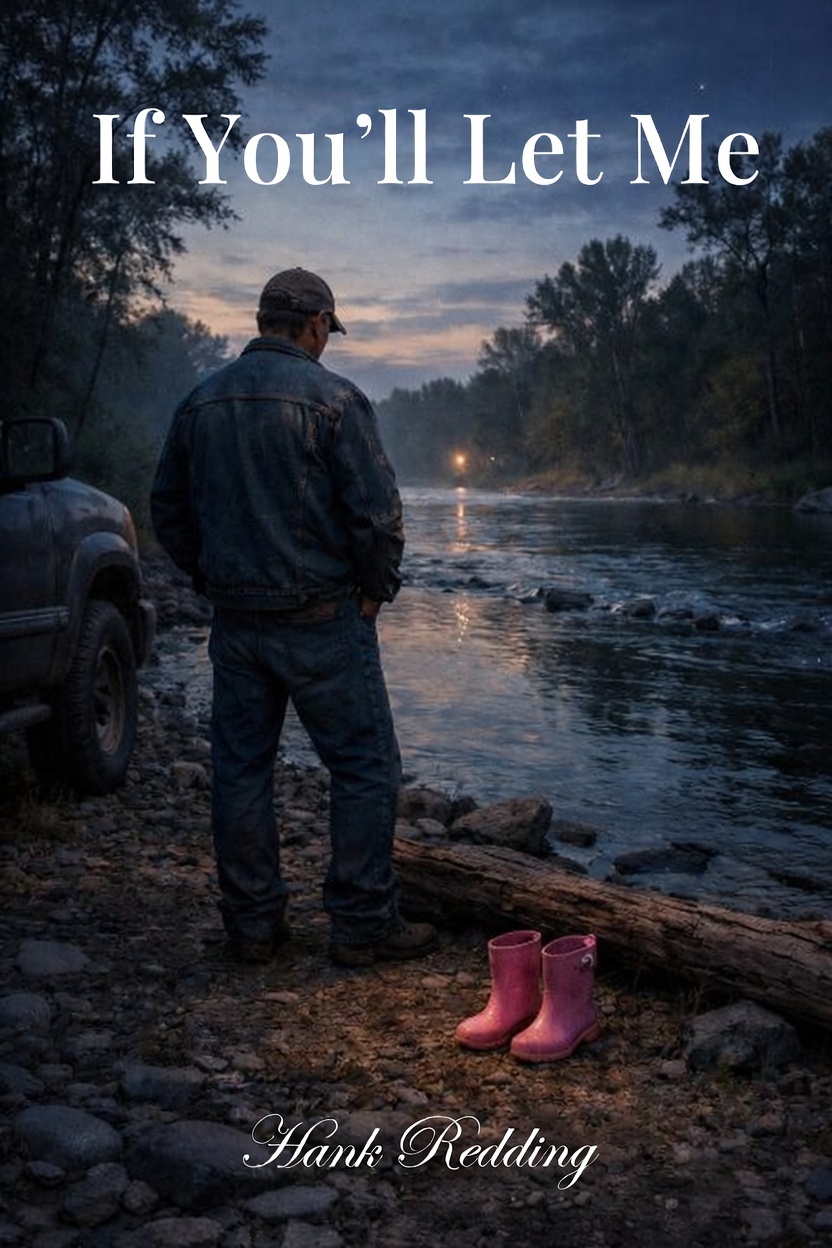
Chapter One — Clear as a Bell
He hadn’t meant to come back to the river.
That was the lie he told himself as he pulled off the road and killed the engine, dust settling slow around the truck like it was thinking about whether to stay. The place hadn’t changed much. Same bend. Same gravel bar widening where the water got tired and spread itself thin. Same cottonwoods leaning just enough to look like they were listening.
He stood for a while before getting out. Hands on the wheel. Breath shallow. Sober breath. That still felt new—like wearing someone else’s boots and hoping they didn’t notice.
“Heavens to Betsy,” he said, the words slipping out before he decided to say them.
They hung there. Didn’t echo. Didn’t disappear either.
He stepped down onto the bank, boots crunching through old stone and newer mud. The river was higher than he remembered, or maybe he was just lower now. It moved fast but not angry, carrying leaves, foam, a cracked stick that spun once and then figured itself out.
“I don’t know if you can hear me,” he said.
He didn’t look up when he said it. Never had. Talking upward felt presumptuous. Like assuming he’d earned that kind of attention. Instead, he watched the water, the way it broke around the rocks and stitched itself back together downstream.
“But if you can,” he added, quieter, “you’re coming in clear as a bell.”
That surprised him—the certainty of it. Not faith exactly. More like recognition. The way you recognize a voice before you remember where you’ve heard it.
The river sounded the same as it always had. Constant. Uneven. Never asking permission to keep going.
He crouched and picked up a stone, smooth enough to fit the pad of his thumb. He turned it once, twice, then skipped it out across the surface. It hit three times before sinking. Not bad. Not great.
She’d been better at it than him.
The thought came without warning, and for a moment his chest tightened hard enough to make him brace a hand against his knee. He stayed there until it passed. He’d learned how to do that now—how to let things move through without chasing them down or drowning them out.
“That’s new,” he said. “The staying.”
The wind shifted, pushing through the trees, rattling dry leaves against each other. It didn’t answer. It didn’t need to.
He didn’t say her name yet. That felt like something you worked up to. Something you didn’t rush, the way he’d rushed too many other things.
Instead, he stayed by the river and listened, letting the sound settle him, letting the place remember for him until he was ready to do it himself.
Chapter Two — The Things He Quit Too Late
He didn’t say it right away.
Some truths need to be set down carefully, like glass that’s already cracked. He stood and walked a little downstream, following the bank where the ground dipped and the grass gave up trying to grow. The river narrowed there, shouldering itself between stones worn dull by years of being told no.
“I finally quit,” he said at last.
The words sounded strange outside his head. Smaller than he’d expected. Not a declaration. Not an apology. Just a fact, late in arriving.
He rubbed his hands together, felt the dry skin, the small scars that hadn’t healed clean. He remembered how his hands used to shake in the mornings, how he’d blamed the cold even in August. How he’d learned to hold a coffee cup with both hands so no one would notice.
“I should’ve done it sooner,” he said. “That part I know.”
The river didn’t argue.
He thought about the nights he couldn’t quite remember and the mornings he couldn’t forget. About the way the house had gone quiet when he came in late, like even the walls knew better than to speak. About promises made with a sincerity that never survived daylight.
“I hated what it put you through,” he said, voice tightening just enough to notice. “The way you learned to watch me instead of trust me.”
He stopped walking. Stood where the water bent around a half-buried log, frothing white for a few seconds before smoothing itself out again.
“My demons were loud,” he said. “And they didn’t care who was listening.”
That felt accurate. He’d never blamed the drinking itself. It was just the tool. The real damage had come from what he’d been trying not to feel, what he’d handed off to the bottle and let it handle badly.
“I don’t expect anything for quitting,” he said. “I know it doesn’t work like that.”
He looked down at the water then, really looked, watched his reflection break apart and reassemble with each small movement of the current.
“But I needed you to know,” he added. “In case it matters. In case it changes anything.”
The wind lifted again, cool against his face. He breathed it in and let it out slow, the way he’d been taught, the way that kept him from reaching for something that wasn’t there anymore.
He stayed a while longer, sober and standing, letting the river hear what it would, knowing some things couldn’t be fixed—only carried.
Chapter Three — Pink Rain Boots
He hadn’t thought about the boots in years.
Not directly. They’d been there, sure—lodged somewhere behind the bigger things, the louder regrets—but they hadn’t asked to be remembered. Not until now.
He bent and picked up another stone, heavier than the last, its surface chipped in a way that caught his thumb. He smiled despite himself. She’d have liked that one. Too much weight. Too much confidence. It would’ve sunk on the first try.
“You never picked the easy ones,” he said.
The river widened here, slowing just enough to invite play. He could see her in it if he let himself—knee-high to a stump, dress hitched up without concern, hair already damp from leaning too far over the bank. She’d thrown rocks with her whole arm, stepping into it like she meant to win.
They’d skipped stones until the light went flat and the bugs came out, until she’d grown tired of counting and started naming the ripples instead.
That was before the boots.
Pink, loud, impossible to miss. Rubber scuffed at the toes, one strap always half-twisted like she’d never bothered to fix it. She wore them even when it hadn’t rained, just because she could. Because they made her faster.
He saw them now, sitting in the driveway, set just inside the edge of the concrete. One upright. One tipped over, holding a little water in its mouth.
The truck idling. His hand on the door.
“What kind of man drives away from that?” he asked the river.
He hadn’t been angry. That was the part that bothered him most. He’d been tired. Convinced he was doing everyone a favor by leaving before things got worse. Before he said something he couldn’t take back.
He told himself he’d be back before dark.
He never was.
“I just…gave up,” he said, the words catching on something sharp. “Just ran.”
The river carried the sound downstream, folded it into itself, let it go without comment.
He skipped the stone. It hit once. Twice. Then disappeared.
“That one counts,” he said. “Even if it didn’t finish right.”
He stood there longer than he meant to, the image of the boots settling heavy and exact in his chest. Not tragic. Not dramatic. Just there. Just waiting.
Somewhere behind him, the road hummed faintly with a passing car. He didn’t turn to look.
Chapter Four — A Sinner Like Me
The light had started to go thin.
Not gone—just pulled tighter, stretched across the water until everything looked flatter, more honest. Evening did that. Took away the excuses shadows gave you earlier in the day.
He sat on a drifted log and watched the river darken in places, the current cutting narrow lanes of black between lighter seams. It looked organized, almost intentional, like someone had drawn it that way and then left it alone.
“They never taught me how to talk to you,” he said, and this time he did look up.
Sky first. Then higher, or at least what felt higher. He didn’t expect an answer. He just needed to know where to aim the words.
“And I bet you’re just as surprised as I am,” he went on, “they’d ever let a sinner like me in.”
He smiled at that—small, humorless. He’d never kept score the right way. Always thought good intentions counted more than good follow-through. Turns out they don’t hold much weight when you’re the one being counted on.
“I don’t assume anything,” he said. “About heaven. Or mercy. Or whatever comes next.”
The river moved on, unbothered by the theology of it.
“But if you’re there,” he added, voice steady now, “I hope it’s somewhere good.”
He pictured her older—not the way she might’ve aged, but the way people look when they’re finally unburdened. Upright. Certain. Not waiting for anyone to show up.
“I know I didn’t do enough,” he said. “Didn’t watch over you the way I should have.”
That one landed harder. Not because it was new, but because it was complete. No qualifiers. No explanations attached.
He leaned forward, elbows on his knees, hands laced together like he was trying to keep them from drifting apart.
“But I will,” he said. “I will from here on out. However that works.”
The promise felt strange—making it where it might never be heard. But also right. Like something that should’ve been said a long time ago.
The sky dimmed another shade. A bird crossed low over the water and vanished into the trees.
He stayed where he was, letting the river hold the space between what he’d been and what he still might be allowed to be.
Chapter Five — If You’ll Let Me
He didn’t know how long he’d been there when the cold finally reached him.
Not the sharp kind. The slow kind that works its way in once everything else has gone quiet. The river had darkened almost completely now, its surface catching only thin threads of light where the sky hadn’t quite let go.
“Heavens to Betsy,” he said again.
This time it sounded less like a saying and more like a name.
He stood, joints stiff, and walked back toward where he’d started. The path was uneven, worn down by years of feet choosing the same safe route. He knew it by feel. Could’ve walked it with his eyes closed.
“If you’re listening,” he said, stopping at the edge of the bank, “I’m not asking for anything back.”
That felt important to say. To make clear.
“I know how time works,” he went on. “I know what doesn’t get fixed.”
The river kept moving. It always would.
“But I’m here now,” he said. “And I’ll keep showing up.”
He finally said her name then. Not loud. Not careful either. Just once, like placing something where it belonged.
“I’ll watch over you,” he promised. “However that looks. However far it reaches.”
The wind lifted, light but steady, brushing past him like a hand that didn’t need to hold on.
He closed his eyes.
“Until I see you again,” he said.
He waited—not for an answer, not for a sign. Just long enough to let the words settle into the place where all the others had gone. The place that kept score without shouting about it.
Then, softer still, almost to himself:
“If you’ll let me.”
The river took that too. Didn’t hurry it. Didn’t keep it either. Just carried it forward, the way it always had—faithful, indifferent, present.
When he turned back toward the truck, the night was fully set. The road waited. The river stayed.
And somewhere between what he’d lost and what he still owed, something remained open.