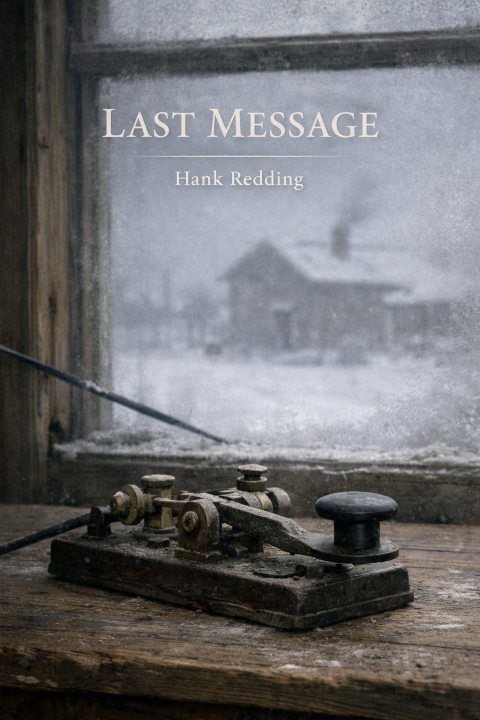
Part I - Morning Without Relief
Silver Gulch did not wake so much as loosen its grip.
The storm still owned the valley, but it had eased enough to let shapes exist again. Rooflines reappeared. Chimneys exhaled. The street between the mine office and the saloon emerged as a narrow, trampled corridor cut through white, bordered by drifts that leaned inward like eavesdroppers.
Elara rose before the clock struck six.
She had slept in her chair, coat still on, scarf loosened just enough to breathe. Dreams had come in fragments—clicks without sound, wire slipping through her hands like water, a voice saying her name from behind her own mouth. When she woke, the stove had burned low, and the office felt watched in the quiet way of places where something had already happened.
She stood, rolled her shoulders once to work life back into them, and went to the window.
The pole stood where it always had.
That steadiness angered her more than any movement would have.
She turned back to the desk. The message pad lay exactly where she’d left it. The last words stared up at her in graphite certainty:
ELARA KNOWS SHADOWS.
She closed the pad and tied it with twine. Not because it needed securing—but because she needed the small ritual of deciding what stayed loose and what did not.
Then she reached into her coat and unfolded the scrap of paper she’d taken from the wall.
BETRAYER
INSIDE
The ink had bled slightly overnight, feathering the letters, making them look less like accusation and more like rot. She folded it again and tucked it back into her pocket.
If someone wanted her afraid, they’d succeeded.
But fear, she knew, could be shaped.
She put the kettle on the stove and drank coffee that tasted like burned iron. Then she pulled on her boots and stepped out into the morning.
Part II - Old Man Grady and the Ghost Wire
Grady lived where men went when they no longer expected visitors.
His shack sat uphill from the telegraph office, close enough to the line that Elara could see his stovepipe from her window on clear days, far enough that no one mistook him for part of town. The snow around his place was drifted high, wind-carved into ribs that made walking feel like trespass.
Elara did not announce herself.
She followed the path the storm had spared, lantern unlit now, daylight thin but sufficient. The air carried the smell of pitch and old smoke. Somewhere nearby, something metallic clinked—loose tin worrying itself against wood.
Grady was outside, as he often was in the morning, bent over a crate with his back to her. His coat hung off him like it had once belonged to a larger man. His beard was frost-threaded and tangled, the kind that grew wild when mirrors stopped mattering.
He straightened when she was still five steps off.
“You walk quiet,” he said, not turning.
“Snow teaches it,” Elara replied.
He turned then, squinting at her as if fitting her into the day. His eyes were sharp despite everything else—blue and unblinking, like they’d learned a long time ago not to waste effort on surprise.
“Wire talk you out of bed early?” he asked.
That stopped her.
Elara kept her face neutral. “Why would you say that?”
Grady shrugged. “Wire’s been singing all night. Not right, though. Not the way it sings when it’s carrying something real.”
Elara felt the words settle between them.
“You hear the wire from here?” she asked.
He smiled, a thin, crooked thing. “You don’t?”
She let that pass.
Instead, she said, “You were near the pole yesterday.”
“Most days,” Grady replied. “Pole don’t move itself.”
“Someone shaved bark.”
Grady’s gaze flicked past her, just once, toward the slope where the pole stood. When he looked back, something guarded had come up behind his eyes.
“Lots of reasons bark gets shaved,” he said. “Men mark lines. Men mark luck. Men mark places they think belong to them.”
“Any reason to mount a second key?”
That landed.
Grady laughed, but there was no humor in it. “You been thinking too long without company, Operator.”
“Have you spliced the line?” she asked.
He shook his head. “No.”
Not haven’t. Not wouldn’t.
Just no.
She watched his hands. They were scarred, strong despite the tremor that came and went in the right one. The nails were rimmed with black, ingrained. A man who worked with metal and dirt and didn’t apologize for either.
“Someone has,” she said.
Grady leaned back against the crate. “Wire carries voices. Sometimes they don’t belong to anyone you can see.”
“Sometimes they do.”
He studied her a long moment, then said quietly, “Careful, Elara. Ghost wires don’t like being named.”
She turned to leave, then stopped.
“If you hear it again,” she said, “you come to me.”
Grady’s smile faded. “If I hear it again,” he said, “I’ll be too busy remembering why I learned not to answer.”
She walked back downhill with the wind pressing cold fingers between her shoulders.
Grady had heard the wire.
That much was certain.
Whether he’d answered it was another matter.
Part III - Dr. Crowe’s Hands
The clinic smelled of laudanum and boiled cloth.
Dr. Elias Crowe moved through it with the practiced grace of a man who believed order was something you imposed, not something that happened naturally. He had rolled his sleeves to the elbow, hands bare despite the cold, and was washing them when Elara entered.
“Mrs. Thorne,” he said, smiling into the basin. “Early for frostbite.”
“Early for everything,” she replied.
He dried his hands and turned, eyes flicking briefly to the door behind her before settling back on her face. He always looked at people like he was checking their pulse from across the room.
“What brings you?”
She didn’t answer immediately. Instead, she let her gaze drift—to the shelves of instruments, to the medical bag resting half-open on the chair, to the thin coil of insulated wire peeking from beneath a folded cloth.
Crowe noticed.
“That’s for the lamp,” he said lightly. “Old wire shorts when the wind picks up.”
“Does it?” she asked.
“Everything shorts eventually.”
She stepped closer, lowering her voice. “The telegraph line was tapped last night.”
Crowe’s smile didn’t falter. “You don’t say.”
“No sender code. Messages knew my name.”
“That’s… unsettling.”
“You have steady hands,” she said.
“So I’m told.”
“You have reason to want the town afraid.”
Crowe’s eyes sharpened then—not angry, not defensive, but attentive. “Fear makes people reckless,” he said. “Reckless people get hurt. Hurt people need doctors.”
“And smugglers,” Elara said softly.
The smile slipped, just a fraction.
Crowe replaced it smoothly. “Rumors are a poor substitute for proof.”
“Proof cuts both ways.”
He leaned closer, voice dropping. “Be careful where you point suspicion, Elara. Silver Gulch is cold enough without you setting men at one another’s throats.”
She met his gaze, steady. “Then tell me who was on the wire.”
Crowe straightened. “If I knew,” he said, “I would advise you to stop listening.”
She left the clinic with the sense that she’d brushed against something slick and poisonous—but not the hand holding the key.
Part IV - Sheriff Wade
Sheriff Harlan Wade’s office was warm in the way authority always was.
The stove burned hot. The desk was clean. His badge lay beside his hat like a claim no one bothered to question. He looked up when Elara entered, expression open, easy.
“Morning,” he said. “Storm treat you kindly?”
“It spoke,” she replied.
That earned her a look.
“You’re worried,” Wade said, standing. He was broad through the shoulders, solid, a man built for occupying space. “People are. Storm does that.”
“The wire was tapped.”
He frowned. “By who?”
“That’s what I’m asking.”
Wade leaned back against the desk, arms folded. His shotgun rested in the corner, untouched.
“You hear stories when things get quiet,” he said. “Men invent danger to feel useful.”
“The messages mentioned Blackthorn.”
That did it.
Just a tightening at the corner of his mouth. Just enough.
Wade nodded slowly. “I’ve heard that name.”
“So have you,” Elara said.
“Yes.”
“And you don’t believe it?”
“I believe men use names like that to excuse what they were already planning.”
She watched him then—really watched. His posture. His breathing. The way his eyes tracked hers not like a suspect’s, but like a man measuring an equal.
“Who do you trust?” she asked.
He smiled, thin this time. “In winter? Whoever doesn’t lie to me.”
The words echoed unpleasantly.
“Elara,” he said, softening, “you’ve been alone with that wire too long. Let me handle this.”
“Handle what?”
“The fear.”
She stepped back, the floorboard creaking under her heel.
As she turned to go, Wade spoke again.
“Storms pass,” he said. “Shadows don’t.”
She stopped.
Then she left without looking back.
Part V - What People Do With Fear
By noon, Silver Gulch had decided it was tired of not knowing.
The storm had loosened enough to let men move without feeling like they were being tested by something larger than themselves, and that alone was dangerous. When weather stopped being the enemy, people looked for another.
The saloon filled early.
It always did when work stalled. Miners came in with snow still crusted on their cuffs, stamping boots, knocking ice from hats. Someone lit the lamps even though daylight lingered thinly at the windows. Cards were laid out without enthusiasm. Whiskey poured faster than usual.
Elara did not intend to be there.
She passed the open door on her way back from the supply shed and heard her name spoken—not loud, not angry. Just said. Tried out.
That was enough.
She stepped inside.
The room smelled of wet wool, tobacco, and the sour edge of liquor stretched too far. Voices ebbed as she crossed to the bar. A few men nodded. A few didn’t. The bartender, Amos, slid her a cup of coffee without being asked.
She took it and leaned against the bar, back straight, eyes open.
The talk resumed, quieter now, shaped by her presence.
“…telling you, it don’t come from outside,” someone said. “Lines are down past the pass. Has to be local.”
“Could be the sheriff,” another voice offered, half a joke.
That one died quickly.
Elara watched Wade’s deputy—young, red-faced—shift his weight near the wall, unsure whether to pretend he hadn’t heard or make a note of it later.
“No,” a third voice said. “Sheriff’s been here every night. Ain’t gone nowhere.”
“Then who?”
Silence answered.
Not empty silence. A waiting one.
Grady came in while they waited.
He moved slower than most, boots worn smooth, coat patched so often it had become its own map. The room adjusted to him the way it did to weather—no welcome, no challenge. Just a narrowing of space.
Someone muttered, “There he is.”
Grady stopped two steps in.
He took in the room with one long look, then nodded once to Amos and moved toward the stove.
“Cold got tired of you yet?” Amos asked, too casually.
Grady shrugged. “Cold don’t get tired. Men do.”
That was when someone—Elara never knew who—said it clearly enough to land.
“He lives closest to the wire.”
Grady turned.
His eyes moved through the crowd until they found Elara.
She felt it like a hand at her throat—not accusation, exactly, but expectation.
“That so?” Grady said mildly.
“You were at the pole,” another man said. “Saw you.”
“Most days,” Grady replied.
“And you talk about ghost wires,” someone else added. “That ain’t normal.”
Grady smiled then. “Neither is hanging men in winter, but I’ve seen it done.”
A chair scraped back.
Fear shifted shape.
Elara set her coffee down.
“Stop,” she said.
The word cut clean. Not loud. Not pleading.
She stepped forward, putting herself between Grady and the nearest man, a miner named Pike whose knuckles were still split from the last ration argument.
“This doesn’t belong to you,” she said. “Any of you.”
Pike sneered. “Wire belongs to the town.”
“No,” Elara said. “It belongs to whoever’s listening closest.”
A ripple moved through the room.
She turned, slow, making sure to meet eyes—not challenging, just present.
“The line was tapped,” she said. “That’s true. But tapping a wire doesn’t make you a traitor. It makes you curious.”
“Blackthorn’s not curious,” someone spat.
“No,” Elara agreed. “Blackthorn is a story men tell when they don’t want to admit they’re afraid.”
That didn’t help.
The scrap of paper burned against her chest like a coal. She hadn’t planned to use it—but plans changed when rooms turned.
Someone shoved Grady.
Not hard. Just enough.
Grady stumbled, caught himself on a table. Cards scattered. Whiskey sloshed.
“Say you didn’t do it,” Pike said. “Say it.”
Grady straightened, dignity pulled tight around him like a coat.
“I didn’t tap your precious wire,” he said. “And if I had, I wouldn’t be stupid enough to warn you.”
That was the wrong thing to say.
Hands closed. Voices rose.
The word rope appeared—not shouted, but offered, the way men offered tools when work needed doing.
Elara moved without thinking.
She stepped back, then forward again, this time loud enough to force attention.
“There’s a forged note,” she said.
The room stalled.
She reached into her coat and pulled out the paper. Held it up between two fingers.
“Found this at the office,” she continued. “Not on the wire. Placed. That means someone wanted it seen.”
She looked around.
“You want a traitor?” she asked. “Find the man who benefits from you tearing each other apart.”
Silence fell heavy now.
For a moment, it might have held.
Then the deputy shifted again—nervous, young, eager to be useful—and said, “Sheriff’ll want to see that.”
A dozen heads turned.
Authority rushed back into the room like heat.
Someone grabbed Grady’s arm.
Someone else grabbed the other.
Grady didn’t fight—not at first. He just looked at Elara again, something unreadable passing between them.
“You should’ve listened,” he said quietly.
Elara felt the floor tilt.
“Let him go,” she said.
No one did.
The door burst open then, wind and snow and Sheriff Wade filling the space together.
“What’s this?” Wade demanded.
Voices overlapped. Words tangled. Accusations flew.
Wade’s eyes went to Grady, then to Elara, then to the paper in her hand.
For just a moment—no more than a breath—something like satisfaction crossed his face.
Then it was gone.
“Enough,” he said.
The room obeyed him. Mostly.
“We don’t hang men on rumor,” Wade continued. “Not in my town.”
Relief tried to rise.
“But,” he added, “we also don’t ignore warnings.”
He took the paper from Elara without asking. Studied it. Folded it.
“Grady,” he said, “you’ll come with me. For your own protection.”
Grady laughed once, short and sharp. “That what you call it?”
Wade’s jaw tightened.
Two men hauled Grady toward the door.
As they passed Elara, Grady leaned close enough that only she could hear.
“Shadows fall twice,” he whispered. “First on the wire. Then on the neck.”
The door slammed.
Snow rushed in and was shut out again.
The saloon exhaled—relieved, ashamed, hungry for justification.
Elara stood very still.
Across the room, Dr. Crowe watched her over the rim of his glass, expression thoughtful.
At the bar, Amos wiped a clean patch into the wood again and again, as if trying to erase something that wouldn’t lift.
Outside, the wire hummed.
And somewhere between the office and the jail, a man who knew too much was being made safe.
Part VI - The Shape of the Trap
The jail was quiet in the way rooms became after they had finished being useful.
Elara stood outside it long enough to count her breath, then turned away without knocking. Seeing Grady now would only give the town another story to tell. Concern could be twisted as easily as cruelty.
She went back to the telegraph office.
The walk felt longer than it should have. Snow caught at her boots and released again. The pole stood ahead, unchanged, and she felt a sharp, irrational urge to strike it—to demand it explain itself.
Inside, the office greeted her with the steady smell of iron and ash.
Nothing had been disturbed.
The lantern hung where she’d left it. The key sat centered on the desk. The sounder’s iron armature rested open, innocent as a sleeping mouth.
Elara shut the door and slid the bolt.
She stood there, coat still on, listening.
Nothing.
She went to the window and peered out. The jail stood two buildings down, squat and solid, smoke lifting from its chimney. Someone had lit the stove for Grady. Someone had decided he would not freeze.
Not yet.
She turned back to the desk and unfolded the scrap of paper again.
BETRAYER
INSIDE
She set it beside the message pad and stared at it until the words lost shape.
Then she saw it—not in the letters, but in the timing.
The message last night. The note at the wall. The accusation in the saloon. The sheriff arriving at precisely the moment the crowd tipped.
None of it had asked her to act.
It had asked the town to.
The realization settled with a cold weight.
The wire hadn’t been warning her about Blackthorn.
It had been teaching the town how to hang someone.
Elara’s hand went to the drawer again.
This time she opened it.
The derringer lay inside, small and dull, wrapped in its cloth. She looked at it for a long moment, then closed the drawer again without touching it.
She didn’t need a gun.
She needed proof.
She sat and reached for the key.
Her fingers hovered.
If the voice on the wire wanted belief, it would answer confidence.
She tapped—not the station call, not protocol, but something older.
Dot dash.
Pause.
Dot dot.
A question, shaped in the grammar of the war.
WHO BENEFITS.
The sounder answered immediately.
Click.
Then another.
Then a cascade—clean now, practiced, almost relieved.
Y… O… U…
S… E… E…
Elara’s stomach turned.
The sounder continued, steady as a man who had rehearsed.
T… H… E… Y…
N… E… E… D…
P… R… O… O… F…
She felt suddenly, viscerally watched.
She rose and crossed the room, checking the wall gap again. Empty. No movement outside the window. The office felt sealed, but the wire pulsed with presence.
She returned to the desk and forced her hand steady.
PROOF OF WHAT, she tapped.
The answer came slower this time, as if considering how much to give.
C… O… M… P… L… I… C… I… T… Y…
The word landed like a verdict.
Elara swallowed. “No,” she said aloud, the sound thin in the room.
The sounder clicked once, sharply.
Then:
Y… O… U…
A… L… R… E… A… D… Y…
K… N… O… W…
Her pulse thundered.
She pressed the key harder than she needed to.
YOU WANTED A LYNCHING, she sent.
The reply came after a pause long enough to suggest satisfaction.
S… A… F… E… T… Y…
Elara barked a laugh, harsh and brittle.
“Safety,” she said. “That’s what you call it?”
The sounder answered without hurry.
T… O… W… N…
N… E… E… D… S…
A… N… E… N… E… M… Y…
She closed her eyes.
Grady had never been the point.
Any man would have done.
Any man close enough to the wire to be blamed.
Any man without friends.
Elara’s fingers shook as she tapped again.
YOU’RE STILL HERE, she sent.
The reply came with frightening calm.
S… O… A… R… E…
Y… O… U…
A chill crawled up her spine.
She stared at the key.
The realization came then, sharp and undeniable:
The voice didn’t need the raid.
Didn’t need Blackthorn.
It needed her.
Needed her attention. Her fear. Her credibility.
Needed her to become the town’s mouthpiece.
She stood, backing away from the desk as if the key might reach for her.
Outside, a shout went up—brief, distant. The sound of boots. The jail door opening and closing.
She went to the window.
Grady stood outside the jail now, flanked by two men. Not free—but moved. Repositioned. Put where more eyes could see him.
The town was not done with him.
The sounder clicked again behind her.
Not words.
Just rhythm.
Dot.
Dash.
Dot.
A pattern she knew too well.
A sender signature.
One she had not heard in twenty years.
One she had learned at a table lit by candlelight while men argued over maps and borders that no longer mattered.
Her husband’s hand.
Or something that had learned it.
Elara turned back to the desk, dread and resolve twisting together.
If the trap required her silence, she would not give it that.
If it required her complicity, she would deny it the one thing it couldn’t fake.
Truth—spoken out loud, where the wire could not edit it.
She reached for her coat.
The storm might own the valley.
But it did not own her voice.
Part VII - Saying It Where Everyone Can Hear
The bell over the saloon door rang wrong.
It always did when someone pushed through with purpose instead of thirst.
Elara felt the room register her before anyone spoke. Chairs shifted. A card game paused mid-hand. Amos looked up from the bar, surprise flickering across his face before he masked it with routine.
She didn’t wait for quiet.
She stepped into the center of the room, coat still on, cheeks raw from the cold, and said, clearly enough to land in every corner:
“They wanted you to hang a man.”
The room stilled—not because they agreed, but because the sentence had no obvious place to go.
Elara kept going.
“Not because he’s guilty,” she said. “Not because there’s a raid coming. Because fear needs a body before it eats itself.”
Someone scoffed. Someone else laughed, sharp and uneasy.
“That’s a fine story,” Pike said. “From the woman who hears voices on a wire.”
Elara turned to him.
“You ever seen a lynching stop anything?” she asked. “Ever seen it make a town safer?”
Pike opened his mouth. Closed it.
She didn’t give him time to recover.
“The messages didn’t warn me to do anything,” she said. “They warned me to watch you. The note wasn’t sent over the wire—it was planted. So you’d feel clever when you found it. So you’d feel justified when you acted.”
Murmurs now. Low, spreading.
Dr. Crowe leaned back in his chair, fingers steepled, eyes unreadable.
Elara scanned the room.
“You want proof?” she asked. “Here it is: the line is tapped locally. Whoever’s doing it replies too fast for distance. Knows my name. Knows a code phrase that hasn’t been used since the war.”
That earned looks. Real ones.
“The goal wasn’t Blackthorn,” she continued. “The goal was Grady. Or Pike. Or me. Anyone close enough to the wire and alone enough to blame.”
Someone near the back muttered, “Sheriff wouldn’t—”
Elara held up a hand. “I’m not naming names.”
That was deliberate. It unsettled them more than accusation would have.
“I’m telling you this,” she said, voice steady now, “because the wire spoke again after Grady was locked up. Which means whoever’s behind this wasn’t satisfied. They don’t want a prisoner. They want a spectacle.”
The word hung.
Outside, wind pressed at the windows. Inside, men shifted like cattle sensing a fence that wasn’t where it used to be.
“You’re being played,” Elara said. “And the next rope won’t stop swinging just because the first one did.”
Silence followed—not empty, but strained.
Then the door opened.
Sheriff Wade stepped inside, snow clinging to his coat like punctuation.
“What’s all this?” he asked mildly.
No one answered at first. Eyes darted. Calculations flickered.
Elara turned to face him.
“I told them,” she said.
“Told them what?”
“That the lynching was the point.”
A muscle jumped in Wade’s jaw.
“You accusing me of something, Elara?”
“No,” she said. “I’m accusing whoever’s on the wire.”
She held his gaze.
“You want to prove it’s not you?” she asked. “Come with me. Right now.”
A ripple went through the room.
“To the office,” she continued. “Let them all watch while the wire speaks. Let them hear how fast it answers.”
Wade smiled thinly. “You’re asking me to indulge hysteria.”
“I’m asking you to protect this town,” Elara said. “Unless protection only counts when it’s quiet.”
The room leaned forward, collectively. This was the moment they would remember later, whichever way it fell.
Wade hesitated.
Just a breath too long.
That was enough.
The sound came then—not from the saloon, but from outside.
A sharp, metallic snap, carried faintly through the wind.
Elara felt it in her bones before she understood it.
The wire.
She didn’t wait.
She turned and ran.
Part VIII - The Trap Springs
The telegraph office door was ajar.
Elara hit it shoulder-first, stumbling inside, heart hammering. The lantern had been knocked askew. Papers lay scattered. The stove door gaped open, heat bleeding uselessly into the room.
And the key—
The key was moving.
Not pressed.
Tapping itself.
The sounder clattered with controlled fury, the rhythm unmistakable now—confident, deliberate, mocking.
E… N… O… U… G… H…
Elara staggered back.
“You wanted witnesses,” she said aloud, voice shaking despite herself. “You’ve got them.”
The tapping didn’t slow.
T… O… O… L… A… T… E…
Footsteps crunched outside—boots, many of them. Voices shouted her name.
The door slammed open behind her.
Sheriff Wade filled the frame.
For a moment, no one moved.
The wire sang between them.
Elara turned slowly.
“It’s you,” she said—not as accusation, but as understanding.
Wade’s face didn’t change.
“Careful,” he said softly. “You say that out loud, there’s no taking it back.”
The key clicked again.
S… H… A… D… O… W… S…
Wade stepped inside and shut the door.
The sound of the bolt sliding home was louder than the storm.
“Step away from the desk,” he said.
Elara didn’t.
“You taught me the code,” she said. “You and my husband. You taught me how to hear what isn’t being said.”
Wade’s smile finally broke. Just a crack.
“And you taught yourself the rest,” he replied. “That’s what makes you dangerous.”
He reached—not for the shotgun, not for a gun at all—but for the loose coil of wire hanging by the wall.
The room tightened.
Outside, fists pounded the door.
Inside, the wire hummed, eager.
The storm leaned in.
And Elara Thorne understood, with terrifying clarity, that the wire had never been the weapon.
She had.
Part IX - The Work of Ending Things
The wire hummed low and constant, a sound that had nothing to do with sound.
It lived in the bones.
Elara did not move.
Neither did Wade.
The office had shrunk—not in size, but in permission. There were only so many places a body could be without touching something sharp, hot, or waiting to be used. The stove breathed. The coil of spare wire along the wall gleamed faintly, its cut ends bright as teeth. The telegraph key rested beneath the sounder, lever upright, patient.
Outside, fists struck the door again. Voices overlapped, muffled by wood and wind.
“Open up!”
“Sheriff?”
Elara felt the urge to answer rise and fall like a wave. She let it pass.
Wade’s eyes never left her.
“You’ve always been good at standing still,” he said. “That’s why they trusted you.”
“Who?” she asked.
“All of them.” He nodded toward the sounder. “Then. Now.”
The key clicked once.
A single dot.
Elara’s breath caught—not in fear, but recognition. It was the signal they had used to indicate readiness, years ago, when the room they worked in had smelled of candle wax and damp wool instead of ash and pine.
“You shouldn’t have come back,” Wade said quietly. “Some skills don’t belong to peacetime.”
“You brought them here,” Elara replied.
He smiled without warmth. “No. I recognized them.”
He reached for the wire.
Not fast.
Not violent.
He lifted the coil and let it unspool just enough to feel its weight. The wire whispered as it slid against itself, a dry, intimate sound.
Elara took one step back.
Her heel struck the stove’s iron lip.
Heat flared against her calf through wool. She hissed, involuntary.
Wade noticed.
“Still feel things too sharply,” he said. “That was always your problem.”
He advanced one careful step.
Elara reached—not for the drawer, not for the gun—but for the desk.
Her fingers brushed the telegraph key.
The wire sang louder, the hum rising, tightening, as if the line itself were listening.
“Don’t,” Wade warned.
She pressed the key down.
Just once.
The sounder snapped loud and bright, a clean report that cut through the room and carried through the walls.
Outside, voices surged.
Wade lunged.
Not to strike—to close distance.
The wire came up between his hands, looped and ready.
Elara twisted sideways, the movement awkward in her coat, and felt the wire graze her sleeve. It sliced through cloth like it wasn’t there.
She slammed her shoulder into him.
They staggered together, boots scraping on the plank floor, breath loud now, unhidden.
The wire slipped.
Wade recovered first. He hooked it around her forearm, yanked, and the pain came sharp and immediate, skin opening without resistance. Blood bloomed dark against wool.
Elara gasped—not screaming, not yet—and drove her knee forward, catching him hard in the thigh. He grunted, grip loosening just enough.
She tore free and stumbled back, breath ragged.
The wire bit again as it fell, kissing her palm. She felt it part skin like it remembered how.
“See?” Wade said, breath heavier now. “Still useful.”
He came again, slower this time, as if pacing a dance.
Elara backed toward the desk.
Her fingers found something solid.
The insulator.
She hadn’t noticed it before—one of the glass knobs removed during a repair and left there, clear and heavy, catching lantern light in its curved body.
She wrapped her hand around it.
Wade saw.
“Careful,” he said. “That’ll shatter.”
“So will you,” she replied.
She swung—not wild, not hard—but precise.
The glass struck his temple with a sound like a bell hit wrong.
It didn’t break.
Wade staggered, eyes flashing with surprise more than pain.
He lashed out blindly, wire flailing.
Elara ducked.
The wire caught her cheek instead, a hot, bright line that stole her breath and left the taste of iron in her mouth.
She fell back against the desk.
The key clattered.
The sounder went mad.
Click—click—click—click—
Uncontrolled. Screaming in its own small way.
Wade roared and surged forward, momentum overtaking caution.
Elara stepped aside.
His boot slipped on tracked-in snow near the door.
He went down hard, shoulder striking the stove with a dull, final sound. The wire tangled around him as he fell, cinching tight across his chest and arm.
He lay there, stunned, breath coming in wet pulls.
Elara stood over him, blood dripping from her hand to the floor, each drop loud in the sudden quiet.
The sounder clicked once more.
Then stopped.
The wire went slack.
The hum died.
Outside, the pounding paused.
“Elara?” someone called.
She looked down at Wade.
His eyes were open.
They searched her face, confused now, something like disbelief flickering through them.
“This wasn’t supposed to be you,” he said hoarsely.
“No,” she said. “It never is.”
She stepped back.
Wade shifted, tried to rise—
And slid.
His head struck the iron stove with a hollow sound that had no echo.
He did not move again.
Elara waited.
Counted her breath.
Waited for him to breathe.
He didn’t.
The door burst open then, wind and men and noise rushing in together.
Someone shouted.
Someone swore.
Hands caught Elara as her legs finally gave.
She let them.
She let everything.
Part X - What Remains When the Wire Is Quiet
They found the office torn but standing.
They found Elara alive.
They did not find the sheriff.
Not where he had fallen.
Not in the snow outside.
Not anywhere the daylight reached.
They said many things afterward.
That Wade must have come to his senses and fled.
That Blackthorn had taken him.
That Elara had saved them.
They rang glasses. They laughed too loudly.
They let Grady go before dusk.
No one apologized.
Elara sat alone that night, hands bandaged, cheek burning, the telegraph repaired just enough to hold silence.
She watched the key.
Waited.
Near midnight, when the wind eased just enough to be mistaken for mercy, the sounder moved.
Not a message.
Not a warning.
Just a single click.
Dot-dash.
A heartbeat restarting.
Elara did not write it down.
She only stared.
Outside, the wire hummed again—low, patient, unclaimed.
And the town slept, believing the danger had passed.