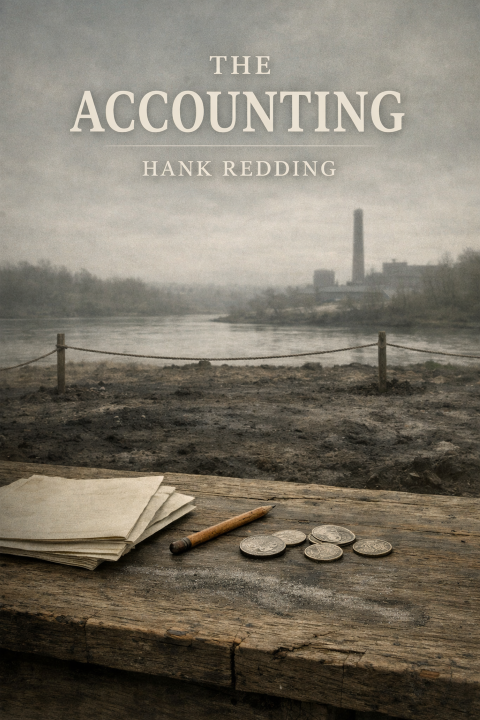
Chapter One — The Window
By the spring of 1922, the river no longer froze clean.
It used to lock itself solid by December—clear enough that boys could see their boots through the ice, dark shapes moving beneath like trapped things. That winter it skinned over thin and gray, never trusting itself enough to harden. By February it broke early, sending plates of ice scraping downstream, clattering against the pilings like thrown crockery.
People said it was the mill’s fault.
People said it had always been that way.
Both things were true.
The mill sat upriver where the banks narrowed and the trees grew reluctant. It had been built when men still believed a town could last on one thing if that thing was loud enough. It shook and groaned day and night, chewing logs into boards and leaving the water dark with runoff. Some mornings the river carried a faint sheen, like oil, and the smell of wet bark turned sour. On those days the town kept its windows shut even when it was warm.
I passed her house every morning on my way to work.
It sat just beyond the last row of proper homes, where the boards stopped lining up straight and the yards gave up trying to be yards. Her place leaned toward the road like it was listening. The paint had flaked off in patches the size of palms. The porch steps dipped at the center, worn by the same feet coming and going until there were fewer feet to do it.
One window on the front had been cracked for as long as I could remember—not shattered, not repaired. Just split through the center, the glass still holding on, a long crooked fracture like a fault line. Somebody had tried to patch it from the inside with cloth and paste. The fabric sagged when it rained and pulled tight when the wind changed direction. In winter it crusted with frost around the edges.
That was where I saw her most often.
Not standing. Not waving. Just moving behind it—slow shapes, partial gestures. A shoulder passing. A hand lifting. Sometimes her face, turned away, hair falling down one side. Once or twice she looked straight out into the street and it startled me like an animal suddenly turning its head.
It felt wrong to look, so I didn’t stop. But I noticed.
Everyone did.
The first time I learned her name, I was still young enough to think names mattered. A man in the shop said it while spitting tobacco into the sawdust box—said it like it tasted bitter.
“Etta,” he told another man. “That’s who that is.”
As if she were a job title.
I had seen her when she was a girl, though I wouldn’t have called her that to her face. She’d come into town with her father before the war, when the mill was still hiring and the river still pretended to be clean. He worked night shift and kept his hands close to his body like he didn’t want to touch anything that wasn’t his. A quiet man. A decent man. The kind of man the town respects most after he’s gone.
He died early, which made him respectable in a way men who linger never were.
After that, the house stayed. So did she.
No one remembered exactly when she stopped being a girl. There wasn’t a single moment. Just a narrowing. A tightening of her shoulders. A change in where she looked when people spoke to her. A way she learned to step around men instead of past them.
By the time the mill cut hours and the men started sleeping in their coats, she had taken work where she could get it—laundry, serving, watching other people’s children while their mothers worked longer than their bodies wanted. She did not complain.
That was the thing people admired most about her.
She kept her head lowered.
She kept her voice steady.
She did not ask for help.
That was how the town learned not to offer it.
—
On a Monday in late March, I brought flowers.
I don’t know why. There had been no announcement. No sickness spoken aloud. Just a sense, like the air before rain when the birds stop making noise.
They were wild ones, gathered near the tracks where the ground still remembered color—purple heads bent under their own weight, white petals already browning at the edges. I carried them in my left hand so my right could still work the latch if she opened the door.
I stood across the road longer than I meant to.
Her curtain was drawn back only partway. Through the broken glass and sagging cloth, I saw her at the table. She sat with her back curved inward, elbows resting like they were tired of holding her up. Her hair had been pulled back without care, and there was something wrong with the way her hands moved—too careful, like they hurt. She lifted one and pressed her thumb into the center of her palm, hard enough to leave a mark.
I thought of knocking.
Then I thought of the last time I’d seen her up close—months earlier, outside the general store. She’d been buying coffee and flour, small things, and a man had said something in a voice that wasn’t quite a joke. She’d smiled the way a person smiles when there are only two options and neither one is safe. When she walked away, her shoulders stayed high, as if the words had weight and she had to carry them.
I crossed the road anyway.
The porch boards flexed under my boots. I stepped where the nails looked newest, instinctive, like I was walking on ice. The screen door hung crooked. I knocked with my knuckles on the wood beside it, once, then again.
For a moment nothing happened.
Then a chair scraped faintly across the floor.
The door opened a few inches. She stood behind it with her hand on the edge, not on the knob, as if she didn’t trust the knob to hold. Her eyes went to the flowers first, then to my face. It took her a second to place me.
“Morning,” I said, because it was the only thing that came.
She nodded. “Morning.”
Her voice sounded like it had been used recently and for nothing good.
I held out the flowers. “I… brought these.”
The corner of her mouth moved, not quite a smile. “For what?”
“I don’t know,” I said honestly. “I just—”
She looked at them longer than a person should. Then she unlatched the screen and took them, careful with the stems.
“Come in,” she said, and stepped back.
The room smelled of damp wood and ash. The stove had been lit, but only low, a small practical heat. A pan sat on top of it with something dark inside, simmering down. The place was clean in the way poor places often are—clean because there isn’t much to dirty, because mess looks like defeat and people can’t afford to wear defeat inside their own walls.
She set the flowers in a chipped jar and put the jar on the table like she was placing it gently into a grave.
“Sit,” she said, and gestured to a chair that faced the window.
I sat. The chair creaked but held.
She didn’t sit right away. She stood near the stove, hands clasped, eyes moving over the room as if making sure everything was in order before she allowed herself to rest.
“Is something wrong?” I asked, and hated myself for saying it. It sounded like accusation. Like I was asking her to justify my being there.
She shrugged. “Things are as they are.”
A line like that could have been wisdom or surrender. In her mouth it was neither. It was a fact.
I tried another way. “I saw you this morning. You looked… tired.”
“I am tired,” she said, flat.
I nodded like that solved something. “Work?”
She looked at me then, not hostile, but sharp in a quiet way. “What work do you think I do?”
The question wasn’t meant to trap me. It was meant to end the conversation before it started.
My throat tightened. “I don’t know,” I said. “Any you can get.”
Her eyes softened, just a fraction. “That’s about right.”
She moved to the cupboard and poured coffee into two cups. One had a crack repaired with glue that had yellowed. She set it in front of me and sat across the table, keeping her hands on her own side as if the space between us mattered.
Outside, a wagon rolled past, wheels rattling. Someone shouted at a dog. Normal noise. Town noise. It seemed wrong that the world could keep making ordinary sounds with a woman sitting across from me like she was already disappearing.
“I shouldn’t have come,” I said.
“You already did,” she replied, and sipped her coffee.
The silence stretched. Not awkward. Heavy.
I watched her hands. The knuckles were dry, the skin around the nails bitten or torn. There was a faint bruise under her sleeve near the wrist, the color of old fruit. It might have been from work. It might have been from something else. In town, everything was from work if you wanted it to be.
“You got family?” I asked, because I needed something.
She shook her head. “Not anymore.”
“Friends?”
She gave a small laugh that didn’t rise to her eyes. “Friends cost.”
I didn’t know what to say to that. I believed it, though. In a place like this, people didn’t have spare energy for free kindness. They had children. They had debt. They had hunger. They had the ache in their backs from bending to things they didn’t own.
I set my cup down and heard my own voice before I decided to use it. “I remember you singing once.”
She stilled.
“Outside the church,” I continued, careful. “Summer. Years ago. You were… younger. Somebody had you up on the steps. It was one of those socials. You sang something folks knew.”
Her gaze dropped to the table. “People like to remember things that make them feel better.”
“I just meant—”
“No,” she said, not unkindly. “I know what you meant.”
Her fingers pressed into her palm again, hard enough to leave the little crescent marks. A habit. A grounding. Or a way to keep from shaking.
“What do you want from me?” she asked at last.
The question landed in my chest.
I hadn’t come for anything I could name. I hadn’t come to rescue her—who did I think I was? I didn’t have money. I didn’t have land. I didn’t have a car or a future mapped out in clean lines. I was a man who worked boards into shape and came home smelling like sap and sweat. If I promised her anything, it would have been a lie.
“I don’t know,” I said. “I just… I see you.”
She stared at me for a long moment, as if deciding whether that was mercy or insult.
Then she stood.
“Wait here,” she said.
She went down a short hallway. A door opened, then another. A faint cough, the kind that comes from deep in the chest. Something scraped against something else. A cabinet perhaps. A drawer.
When she returned she held a small tin box with a dented lid. She set it on the table, between us.
“What is that?” I asked.
She didn’t answer. She opened it.
Inside were papers folded into squares. A photograph with the corners curled. A lock of hair tied with string. Two coins that looked older than the rest—worn smooth by fingers.
She took out one paper and unfolded it slowly. Her hands trembled at the edges.
It was a letter. I could tell by the way the paper had been creased and re-creased like it had been opened too many times. There was a smudge of ink where someone’s thumb had rested.
“I used to keep these,” she said, voice quiet, almost ashamed. “Like they were proof I wasn’t… mistaken.”
She slid the letter toward me.
I didn’t touch it at first.
“You can read,” she said. Not a question.
“Yes.”
“Then read.”
I picked it up carefully.
The handwriting was clean. Better than most men around here wrote. It spoke of a future in another place, a promise of work, of a room with heat, of money sent back when it could be. It called her dear in a way that sounded practiced. It ended with a line about coming for her when things were settled.
There was no date on it, but the paper looked old.
“He never came,” she said, watching my face as I read. “I kept waiting like that meant something.”
I folded it back and set it down. “Who wrote it?”
“Does it matter?” she asked.
It did, and it didn’t. Names were easy. What happened after names was always harder.
She reached into the tin box and pulled out the photograph.
It was her, younger, standing beside a fence with the river behind her. The old river—the one that still looked like water. Her hair was loose. Her face open. She wasn’t smiling exactly, but she looked like she believed the next day would be different.
She held the photograph up for a moment, like she was showing it to someone else in the room.
Then she tore it in half.
The sound was small but final.
I flinched. “Etta—”
She tore it again. Then again. The pieces fell onto the table like dead leaves.
Her breathing had changed. Faster. Not panicked—determined.
“I’m not doing it anymore,” she said. “I’m not keeping things that aren’t true.”
I didn’t know whether she meant the letter, the photograph, the town, or herself.
She stood and walked to the stove. She opened the iron door and the heat breathed out. The fire inside was low and steady, mostly coals.
She fed the photograph pieces into it.
The paper curled, blackened, and collapsed inward. The ink vanished first.
Then she took the letter and held it over the opening.
I stood up. “Don’t—”
She looked back at me, and something in her eyes stopped me. Not anger. Not threat. A kind of calm that arrives when a person has already crossed a line in their mind.
“I have to,” she said.
She let go.
The letter took fire at the corner and the flame ran along the fold as if it had been waiting there for years. The paper brightened, then shrank. The words—those clean promises—turned to ash.
She watched until it was gone.
When she shut the stove door, the room felt colder.
For a while she said nothing. She returned to the table and sat again, as if the burning had used up what little strength she had.
“I’m sorry,” I said, because I couldn’t think of anything else.
She shook her head. “Don’t be.”
“What happens now?” I asked.
She looked toward the cracked window. The cloth patch moved slightly with the wind.
“Now,” she said, “people will tell a story.”
“What story?”
She glanced back at me. Her expression wasn’t bitter. It was tired, and strange, and almost amused.
“Whatever story keeps them from feeling responsible,” she said.
Outside, the river kept moving, carrying its dark water past the town like it had never agreed to stay clean forever.
I stood there with my hands empty, the smell of burned paper in my nose, and realized with a dull certainty that the flowers I’d brought were already dying in their jar.
And that I had come too late for something, though I still couldn’t name what it was.
She pushed the tin box away from her, toward the far edge of the table.
Then, very softly, she said, “If you’re going to do something, do it now.”
I stared at her. “Do what?”
Her gaze held steady.
“Stop looking,” she said. “Or stop pretending looking is enough.”
The words landed like a slap, but there was no cruelty in them—only honesty.
I opened my mouth and nothing came out.
She leaned back in her chair as if she had said the last thing she would ever say to me.
Outside, a train horn sounded in the distance—one long note, then silence again.
I left soon after. Not because she asked me to. Because there was nothing left in that room that I knew how to carry.
When I stepped back onto the porch, the boards flexed under my weight and I had the sudden thought that one day they would not. One day the porch would give way, the house would lean too far, and the cracked window would finally break.
Across the road, I paused.
Through the broken glass, I saw her still at the table, her face turned toward the stove as if she could feel the heat through the iron door. One hand rested on the wood near the tin box, not touching it—just near it, like a person resting a hand near a wound to remind themselves they’re still here.
Then she looked up.
For a brief moment she looked directly at me.
Not pleading. Not angry.
Just aware.
And then she reached up and pulled the sagging cloth across the cracked glass, shutting the room away from the street.
It was the smallest gesture in the world.
It felt like a door closing.
Chapter Two — What Was Promised
After I left her porch, I walked the long way to the mill.
Not because I needed more time. Because I didn’t know what to do with the time I already had.
The road along the river was softer in spring. Mud held the prints of wagon wheels and boots like a memory that didn’t want to let go. The air smelled of wet bark and old smoke. Up ahead, the mill’s roofline rose over the trees—low, dark, and busy, like an animal hunched over something it refused to share.
I kept hearing her voice the way it had sounded when she said it: Stop looking, or stop pretending looking is enough.
It wasn’t a plea. It wasn’t an insult. It was a kind of verdict.
Men at the mill liked to talk about women as if women were weather—something that happened, something that ruined, something to blame when a man felt weak. They said things about Etta the way they said things about the river: dark now, spoiled now, used up.
But no one ever said her name with their whole mouth.
Not like she was a person.
I hadn’t either, if I was honest. I had said it once on her porch, and it came out wrong.
________________________________________
That afternoon, after the whistle blew, I went down to the general store and stood by the counter where the coffee sacks were stacked. I didn’t need coffee. I didn’t need flour. I didn’t need anything.
I needed to hear someone speak.
Old Mrs. Gable was behind the counter, fingers blackened from handling coin and paper all day. She watched me the way she watched men who lingered: with suspicion disguised as politeness.
“You buying?” she asked.
“Not today.”
“Then don’t touch,” she said, and turned her head toward the back room like she could already hear trouble coming.
I moved to the window display where jars of penny candy sat under glass that had been cleaned so often it looked fogged. Children weren’t allowed to choose their own candy anymore. Too many sticky hands. Too many thefts that no one wanted to admit were thefts.
Behind me, two men in work coats spoke low.
“…used to sing,” one said. “You remember?”
“Yeah,” the other replied. “Like a little bird. Till she weren’t.”
“That’s how it goes.”
“That’s how it goes,” the other agreed, like it was a rule in a book.
I turned slightly, not enough to make it obvious, and listened.
“She still up there?” the first man asked.
“Where else she gonna be,” the second man said. “Ain’t got nobody. Ain’t got money. She’s got that house and whatever’s left inside it.”
“What’s left,” the first man repeated, and laughed once.
They both laughed like men laughing in a warm place keeps the cold out.
I left before they could notice I’d been listening.
________________________________________
When you live in a small town long enough, you learn that time doesn’t move the way it does on paper.
It doesn’t go in a straight line. It folds.
Things that happened five years ago sit next to things that happened last week. A man who drowned ten summers back is spoken of like he might still walk through the door any day. A woman’s childhood can be taken from her and no one can tell you exactly when it happened, only that one day she was different and the town adjusted its story accordingly.
Etta’s story had been told so many times it no longer resembled her.
People said she’d been pretty. People said she’d been proud. People said she’d been foolish. People said she’d been ruined.
No one said: She worked.
No one said: She tried.
The closest anyone came to sympathy was the kind that required distance—shame, but not our shame.
But I remembered her before the narrowing.
I remembered her at the creek, years back, when her father still lived.
The land behind their place wasn’t good land. It was cut up by water and stone, too damp in spring and too hard in summer. But it was theirs, in the way a poor man’s land is his: not profitable, just stubbornly claimed. A thin line of fence ran along the creek where someone had strung wire tight enough to keep cattle out, not tight enough to keep boys from climbing through.
That’s where she’d been, barefoot, skirt hitched at the knees, standing on a flat rock like it was a stage.
I’d been on the far bank with other boys, pretending not to watch.
She’d been singing something she’d heard on the radio from the barbershop window—one of those bright city songs that made you believe there was a place where people wore clean clothes and didn’t smell like labor.
She’d sung like she believed the words meant something. Not because she was foolish. Because she was young and that’s what young does—believes, hard, as if belief alone can change the shape of things.
Her father had called out once from the porch.
“Etta. Come down from there. You’ll slip.”
She’d laughed and kept singing anyway.
It was the last time I remember her laughing like she owned her own breath.
________________________________________
After her father died, the town didn’t do what towns claim they do.
They didn’t gather. They didn’t protect.
They dropped casseroles off and looked away.
They said, If she’s smart, she’ll leave.
They said, If she’s smart, she’ll marry.
They said, If she’s smart—
As if smartness were a ticket out. As if a woman could think her way free.
Etta didn’t leave. Not because she didn’t want to. Because leaving costs money, and money was the one thing the town never offered when it offered “help.”
She took work where she could.
First it was laundry for the boarding house, scrubbing sheets stiff with sweat and coal dust. Her hands cracked in winter, raw around the knuckles, red under the nails. She started wearing gloves when she could find them, but gloves wore out faster than pride did.
Then it was serving at a diner near the state road—one of those narrow places that smelled like grease and boiled coffee. Men came in loud and left louder. Some tipped. Some didn’t. Some left bruises in their wake without laying a hand, just with the way they spoke.
She endured.
After that, she cleaned rooms.
The respectable kind of rooms in the respectable kind of building where respectable men stayed when they came to town for mill business. She changed sheets that weren’t fully cooled. She wiped down mirrors with lipstick marks that didn’t belong to anyone’s wife. She learned which men would meet her eyes and which wouldn’t.
The town pretended that was better work because it happened behind doors.
But behind doors, things happen.
Behind doors, a person can be used quietly.
And quiet use is the easiest kind to deny.
She didn’t talk about it. Not openly. She learned early that if you name something, people make you carry the weight of it as if you created it by speaking.
The only place she ever spoke freely was to children.
Mothers would leave their young ones with her because she was “good with them.” That phrase sounded generous, but it meant something else: She’ll take the job no one wants.
She would sit on stoops with a toddler on her lap, humming under her breath, eyes on the road as if she expected something to arrive. Sometimes I saw her with a child’s ribbon tied around her wrist like it was an ornament. Sometimes I saw her staring at the river with a boy’s hand in hers, and I had the strange thought that she looked more like a ghost then than she did behind her broken window.
There were days she disappeared for a while. Weeks, sometimes. Then she’d return, thinner, quieter, with her hair pinned tighter and her sleeves pulled down even when it was warm.
People asked where she’d been, but not like they cared. Like they wanted a detail to fit into the story they were already telling.
She’d say, “Work,” and the conversation would end, because work is the only excuse a town respects.
________________________________________
Somewhere in the last year, another kind of work found her.
It wasn’t called work by the men who paid for it. It was called company, or kindness, or a good time, depending on who was speaking and how much they wanted to pretend.
It happened in the back of the Exchange—a low building off the county road where the lights always looked dim, even at noon. A place with a coin phonograph that skipped and a floor that never fully dried. A place men went when they wanted to forget they had families and futures.
Etta didn’t talk about the Exchange, but the town did. Quietly. With that tone of moral certainty that allows people to feel clean without doing anything clean.
“Sad,” they’d say.
“Waste,” they’d say.
“Had potential,” they’d say.
As if potential were a thing you could spend at the counter for bread.
Once, I saw her coming out of there in daylight.
It wasn’t dramatic. There was no stumble. No tears. She walked like a person walking home from a job that pays in small bills and heavy silence. Her coat was buttoned wrong, one button skipped. Her hair was pinned, but loose at the neck. Her face was set into something that wasn’t numbness exactly—more like carefulness, like she was trying not to spill herself on the street.
A man in a car slowed as he passed. Called something out.
She didn’t turn.
I watched from the other side of the road, and it shamed me how much my body wanted to stay still. How easy it felt to be a witness instead of a person.
That was what she’d meant.
Stop looking. Or stop pretending looking is enough.
________________________________________
The first time I noticed the marks on her arms, I tried to explain them away.
People get bruises. People hit their elbows on door frames. People lift heavy things, slip on wet boards, pinch skin in hinges. A town full of labor teaches you to accept damage like weather.
But these weren’t the kinds of marks that come from ordinary accidents. They were small, placed. Some old. Some new. Always hidden if she could manage it.
And there was something else, too—something in her eyes.
Not sadness exactly.
A kind of distance that had nothing to do with the room she was in.
Like she was listening to a sound the rest of us couldn’t hear.
That was the first true wrongness I felt. Not the Exchange. Not the gossip. Not the poverty.
The distance.
Because distance is where people go before they vanish.
________________________________________
Two weeks after I brought the flowers, the mill shut down for half a day.
A belt snapped in the saw room, sending a metal shard into a man’s thigh. Blood on boards. Screaming. The foreman cursing like language could reverse time. They hauled the man out on a door laid flat, because the mill had no stretcher and no one wanted to pay for one.
The ambulance wagon came late. It always did.
By the time I walked home, dusk had settled, and the wind carried the river’s sour smell hard enough to taste.
I passed Etta’s place and saw light in her kitchen.
The cloth patch on the broken window moved like something breathing.
I stopped on the road.
I don’t know how long I stood there. Long enough to feel foolish. Long enough to feel like if I walked away again I might never forgive myself, even if forgiveness didn’t change anything.
I crossed the road.
The porch boards were wetter than last time. The spring rain had warped them. I could feel the give under each step, the soft threat of collapse.
I knocked.
No movement.
I knocked again, harder.
A sound came from inside—faint, not a voice, something like a chair scraping, but slower. As if it took effort.
The door opened a crack.
Her face appeared in the narrow space, pale in the lamplight. Her eyes flicked to my hands, empty now.
“You shouldn’t be here,” she said.
“You said—” I started, then stopped. I didn’t want to throw her words at her like a weapon.
She looked past me, down the road, then back. “People will see.”
“I don’t care,” I said, and realized I meant it.
Her mouth tightened. Not approval. Not warmth. A kind of tired disbelief.
She opened the door wider and stepped back.
The room felt smaller than it had before. The stove was lit higher. The pan on top was empty now, blackened. There was a smell under the woodsmoke—sharp and medicinal, like the back room of the doctor’s office when you were a boy and didn’t yet know what men did to avoid pain.
She moved carefully, guarding her left side.
“Are you hurt?” I asked.
She shook her head, but it was a lie. You could see it in the way she held herself, in the shallow breath she took like deep breathing cost too much.
I stepped closer, then stopped, unsure where the line was.
She went to the table and sat, gripping the chair as if she needed it to keep from tipping. Her hands were shaking, not from cold.
“I don’t want anything,” I said quickly, because the air was thick with misunderstanding.
Etta stared at the table, at a dark knot in the wood.
“That’s what they all say,” she whispered.
The words hit me harder than I expected. Because she wasn’t accusing me. She was remembering.
“I’m not them,” I said.
She looked up then, and for a moment I saw something raw behind the distance—fear, maybe. Or hope. Or the kind of exhaustion that makes all emotions feel like the same color.
“No,” she said. “You’re not.”
Her gaze slid to the stove. The iron door glowed faintly at the seams.
“You burned them,” I said, thinking of the letter and the photograph.
She gave a small nod.
“Why?”
She pressed her thumb into her palm again until the skin whitened. “Because I don’t want to die holding somebody else’s promises.”
The sentence was so plain it took a moment to understand.
“Etta,” I said softly.
She didn’t respond.
Outside, the wind pushed the cloth patch against the cracked glass. It slapped once, twice, like a weak hand trying to get in.
She spoke again, barely audible. “It’s in me now.”
I froze. “What is?”
She didn’t answer directly. She turned her head and coughed into her sleeve—deep, wet. When she lowered her arm, there was a faint smear of dark on the fabric. Not bright. Not fresh. Old and wrong.
I stared at it and then looked away, because looking at it felt like seeing something I wasn’t supposed to see.
“You should go,” she said.
I didn’t move. “Do you need a doctor?”
Her mouth twitched like she almost laughed. “And tell him what?”
I had no words.
She leaned forward slowly and reached beneath the table. Her fingers found something and pulled it out—a small glass bottle wrapped in cloth.
She set it down between us.
The bottle wasn’t labeled.
Inside was a clear liquid.
My stomach tightened. “What is that?”
Etta stared at it as if it belonged to someone else. “Relief,” she said.
The word sat there, heavy.
“Where did you get it?”
Her eyes lifted to mine. “Does it matter?”
It mattered, and it didn’t. It mattered because I wanted to chase the chain of hands that put it here. It didn’t because in a place like this, there are always hands.
She drew the bottle closer, but didn’t open it.
“I don’t sleep,” she said. “When I do, I dream the same thing. I’m standing in the river and it’s rising, and my father is on the bank telling me to come out, but the water’s got my ankles and it’s thick like syrup and I can’t lift my feet.”
Her voice stayed level, but her knuckles were white against the glass.
“I wake up and I can still feel it,” she continued. “Like it’s on me.”
I swallowed. “Then don’t take it.”
She looked at me as if I’d suggested she stop breathing.
“I don’t take it to be happy,” she said. “I take it to be quiet.”
There was the horror, plain as a nail: not monsters, not curses, not anything you could shoot or pray away—just a person learning how to numb themselves so they could keep moving through a life that kept asking for more than it gave.
I reached out, not to grab it, just to touch the cloth around the bottle, and she flinched hard enough that the chair scraped.
I pulled my hand back immediately. “Sorry. I’m sorry.”
She exhaled through her nose, slow. “It’s fine.”
It wasn’t fine. But nothing ever was, not truly, and the town survived by calling things fine until they were buried.
She sat there with the bottle in front of her, and I understood something I hadn’t wanted to understand: she was showing it to me on purpose.
Not to ask permission.
To make me witness to what came next.
“I can’t keep doing it,” she said, and her voice broke on the last word, the first crack I’d heard in her.
“Then don’t,” I said, stupid with urgency. “Come with me. I—We can—”
She shook her head. “You don’t have enough.”
The truth of it burned.
“I could sell my truck,” I said. “I could—”
“You could sell everything you own,” she interrupted softly, “and you still wouldn’t buy me a new town.”
I stared at her.
“You don’t understand,” she said. “It’s not just me. It’s here.”
She tapped the table once with her finger. A small sound. Final.
“The way they look at you,” she continued. “The way they speak about you even when you’re not there. The way they decide what you are and then punish you for it.”
Her eyes moved toward the broken window.
“I could leave,” she said. “But I’d take it with me. And it would follow.”
I didn’t know what to say to that, because I’d never had to carry a town inside my skin.
Etta picked up the bottle.
The lamp light made the liquid inside shine like something clean, which was the cruelest part.
She held it in her palm and I watched her fingers tremble.
“I don’t want to die,” she whispered.
The sentence came out so small it nearly vanished.
My throat closed. “Then don’t,” I said again, softer now. “Please.”
She looked at me then—fully. No distance. No practiced calm.
“Sometimes,” she said, “relief is the only kind of mercy a person can afford.”
She set the bottle down again without opening it.
A long moment passed.
Then she pushed it away from herself—slowly, like she was moving a dangerous thing across a table between two people.
Toward me.
I stared at it.
“What are you doing?” I asked.
“I’m giving it to you,” she said.
My heart thudded. “No.”
“Yes,” she replied. “Because if it’s in my hand tonight, I’ll use it. And if I use it, I don’t know if I wake up. And if I do wake up, I’ll still be here.”
I didn’t move.
“Take it,” she said, voice tightening. “Or leave it. But stop looking at me like you can save me with your eyes.”
The room was so quiet I could hear the stove breathe.
I reached out and took the bottle.
It was heavier than it should have been. Cold through the cloth.
Etta’s shoulders dropped slightly, like a rope had been cut somewhere inside her.
She didn’t smile. She didn’t thank me.
She just sat back and closed her eyes, and for a moment she looked like a person resting—not sleeping, not safe, but resting.
“Will you bring it back?” I asked, because I couldn’t help myself.
Etta opened her eyes again.
Her gaze held mine, steady and strange.
“Maybe,” she said.
That was the first time she’d left an answer hanging like that—unfinished, unpromised.
It scared me more than if she’d said no.
Outside, something hit the side of the house—wind-driven debris, maybe. The cloth patch thumped against the glass again. The cracked window shivered but didn’t break.
I stood with the bottle in my hand and realized what I’d done.
I hadn’t saved her. I hadn’t fixed anything.
I had simply taken custody of her relief.
Which meant I had also taken custody of whatever came after the relief was gone.
When I stepped onto the porch, the night air felt sharp enough to cut.
I looked back once.
She was still at the table, hands empty, face turned toward the stove like she was listening to it. Like heat, at least, could be trusted to keep doing what it did.
Then she reached up and drew the cloth tighter across the broken glass.
Shutting herself away again.
I walked home with the bottle under my coat like contraband, the river moving black beside the road, and I couldn’t tell whether I’d done something good or simply postponed something that had already been decided.
All I knew was this:
Whatever story the town told later, my hands had been in it now.
And when a man’s hands touch a thing, he doesn’t get to claim he was only watching.
Chapter Three — The Burn
I did not sleep that night.
The bottle lay on the table beside my bed, wrapped in its cloth, the glass catching what little light the moon offered through the thin curtains. I did not touch it again after I set it down. I did not need to. Knowing it was there was enough to keep me awake.
Every sound in the house seemed louder than it should have been—the boards shifting as the temperature dropped, the faint tick of cooling metal, the river far off, moving without regard for who was listening. I kept thinking I heard footsteps on the road, a knock that never came.
At some point near dawn, the wind rose.
It worried the eaves and pushed at the door like a thing trying to get in without being invited. When I finally slept, it was shallow and broken, full of images that didn’t arrange themselves into dreams so much as impressions: the cracked window, the fire breathing behind iron, Etta’s hands empty on the table.
I woke before the mill whistle.
The first thing I did was check the bottle.
Still there.
Still sealed.
I told myself I would take it back to her that evening. I told myself that keeping it from her indefinitely would turn it into something else—control, perhaps, or punishment. Neither of those felt like mine to give.
But when I stepped outside, the air smelled wrong.
Not like smoke yet. Not fully.
Just a faint sharpness under the damp, the way wood smells before it burns.
________________________________________
The fire began midmorning.
Not with an alarm. Not with shouting.
With a change.
I was working in the yard behind the mill when someone paused mid-sentence and frowned. Then another man stopped. Heads lifted, noses tested the air without anyone saying why.
Smoke had a way of announcing itself before flames ever did. It carried the promise of disorder.
“Where’s that coming from?” someone asked.
A man pointed downriver.
The plume was thin at first, gray against the pale sky, rising from somewhere beyond the bend where the houses thinned and the land turned poor.
Someone laughed. “Probably the dump. Somebody burning rubbish.”
We all stood there longer than we should have.
It wasn’t until the wind shifted and brought the smell clean and unmistakable—dry wood, old paint, something acrid beneath—that the foreman swore and told us to get moving.
By the time we reached the road, people were already running.
Not toward the fire. Away from it. Women with aprons still tied. A man with no coat and his boots unlaced. Children half-dressed, faces pale with excitement and fear confused together.
“Which house?” someone shouted.
No one answered at first.
Then a woman said it, too quickly, like the word had been waiting on her tongue.
“Etta’s.”
The name moved through the crowd in a strange way—not like panic, not like grief. More like confirmation.
Of course.
The road toward her place had softened overnight, and boots sank into the mud as people hurried. I ran harder than I meant to, breath burning in my chest, the bottle’s weight suddenly heavy under my coat like a secret turning solid.
The smoke thickened as we got closer.
Flames were visible now—orange tongues licking at the roofline, bright enough to make the morning look false. The fire had taken the front of the house first, chewing through the porch boards that had been threatening collapse for years. The steps were gone already, a sagging ruin that flared and dropped inward with a sound like a sigh.
Someone screamed her name.
Someone else shouted for water.
Buckets appeared from nowhere and nowhere near enough. A man ran past me toward the river with two pails banging against his knees. Others formed a line without instruction, passing water hand to hand, most of it spilling uselessly into the mud before it reached the flames.
Fire is patient when it wants to be.
It took its time.
I pushed through the crowd until I was close enough to feel the heat on my face. The smoke stung my eyes, made them tear. I could see into the front room now through what had once been the door—a jagged opening framed by fire-blackened boards.
The table was visible for a moment, still standing, the jar of flowers tipped on its side, water hissing as it met heat.
The cracked window shattered with a sharp report, glass spraying outward, the cloth patch igniting instantly. The flames leapt through that opening like they had been waiting for it all along.
“Is she inside?” someone shouted.
No one answered.
I shouted her name once, then again. The sound of it vanished into the roar.
A man grabbed my arm. “You can’t go in there.”
“I have to,” I said, though I didn’t know what that meant.
I broke free and stepped forward, heat blasting against me, smoke thick enough to choke. The front room was already lost, ceiling collapsing in slow, deliberate sections. I could hear the fire moving—wood splitting, nails popping, the sound of something alive doing what it was meant to do.
I called her name again, my voice hoarse.
There was no answer.
Someone behind me shouted, “She ain’t there!”
Another voice replied, “How do you know?”
“She was seen down by the river last night.”
“No, she wasn’t.”
“Yes, she was.”
The town arguing itself into comfort.
I stumbled back as a beam fell inward, sending sparks skittering across the dirt. The heat forced me away, my skin prickling, lungs burning.
I stood there helpless, watching the place where she had sat at her table disappear.
The fire burned fast once it had its way.
The roof collapsed in on itself, sending up a rush of sparks that lifted and scattered like frightened birds. The crowd fell back as one, murmuring now—not shouting, not crying. Just that low sound people make when they want to be part of something but not responsible for it.
The fire wagon arrived late, wheels rattling, horses lathered and wild-eyed. The men who jumped down wore the practiced faces of those who fight fires knowing they don’t always win. They did what they could, soaking what remained, preventing the flames from spreading to the brush and the next house downwind.
By then, there was little left to save.
Someone said a prayer out loud, awkward and unfinished.
Someone else crossed themselves.
I stood with my hands empty at my sides and felt the bottle under my coat like an accusation.
________________________________________
They found her by the river.
Not immediately.
The fire had drawn everyone’s attention, pulled the town’s gaze upward and inward. It wasn’t until the flames were beaten down to steaming ruin and the crowd began to thin that a boy shouted from the bank.
“There’s someone here.”
We moved toward the sound in a slow, unwilling knot.
She lay near the edge where the water bent around a cluster of stones, the ground churned as if she had knelt there. Her dress was damp at the hem. Her hair had come loose, strands stuck to her face. One shoe lay a few feet away, turned on its side like it had been dropped without thought.
Her eyes were open.
That was the first thing I noticed, and the thing I could not forget.
Not staring. Not wild.
Just open.
As if she had been looking at something when the looking stopped.
A woman knelt and pressed two fingers to Etta’s neck, then drew back quickly, shaking her head. Someone covered Etta’s face with a coat, though it felt pointless—everyone there had already seen her.
“She drowned,” a man said with certainty that didn’t belong to him.
Another shook his head. “No water in her lungs. Look at her mouth.”
The doctor arrived after that, breathless and irritated, like he had been called away from something more important. He knelt, examined her briefly, lifted her eyelids with his thumb.
“She’s gone,” he said, which was all anyone really needed to hear.
“What happened?” someone asked.
The doctor stood, wiping his hands on his trousers. “Hard to say. Shock, perhaps. Exposure. Weak heart.”
His words floated, unanchored.
No one mentioned the bottle.
No one mentioned the cough, the dark smear on her sleeve, the way she’d spoken about relief like it was the only mercy left to her.
I felt the bottle’s weight like a stone in my chest.
A man gestured toward the smoking ruins of her house. “Fire might’ve driven her out. Panic does things to people.”
The explanation slid easily into place. Too easily.
“Poor girl,” someone murmured.
“She suffered,” another said, as if that settled something.
The river kept moving, dark and steady, brushing past the place where she lay as if it had always planned to be there.
________________________________________
They said the fire was an accident.
An ember from the stove. A spark carried the wrong way. Old boards, dry as tinder. Any of it could have been true.
They said she must have fled the flames and gone to the river to cool herself. Slipped. Lost her footing.
They said many things.
No one asked why the stove had been burning so high.
No one asked why the windows had been patched instead of repaired.
No one asked why a woman alone kept relief wrapped in cloth beneath her table.
The doctor signed a paper with a hand that shook more than he liked.
The town accepted it.
Acceptance is easier than understanding.
I went home alone.
I sat at my table and unwrapped the bottle.
The glass was warm now, as if it had absorbed heat from the fire through my body. I turned it in my hand, watching the liquid shift, clear and calm.
I imagined what it would have been like to return it to her that night.
I imagined setting it on the table, watching her fingers close around it, seeing relief cross her face—brief, dangerous.
I imagined her using it.
I imagined her not.
There was no version of the story where I felt clean.
I carried the bottle to the stove.
The fire inside was low, just coals and a faint glow.
I stood there for a long time, listening to the iron breathe.
Then I opened the stove door and set the bottle inside.
The glass did not shatter immediately. It clouded first, fine cracks spidering across its surface. Then it popped, sharp and sudden, spilling its contents into the fire with a hiss that sounded almost like a sigh.
The smell that rose was bitter, chemical, wrong.
I shut the door and stepped back.
The fire consumed it quickly.
When it was done, there was nothing left but heat.
________________________________________
By evening, the town had begun to rewrite.
People gathered in kitchens and on porches, voices lowered, stories adjusted to fit comfort. The fire became the center of it all—an act of fate, an accident, a tragedy no one could have prevented.
Etta herself grew smaller in the telling.
She became that girl.
She became troubled.
She became unfortunate.
She became everything except a mirror.
I walked past the ruins after dark.
The air still smelled of smoke and wet ash. The house was nothing but a blackened shape against the ground, the stove standing crooked and exposed like a rib.
I stopped where the window had been.
The glass was gone. The cloth patch was ash.
For the first time since I’d known the place, there was nothing between the inside and the street.
The wind moved through freely.
I stood there longer than I should have, imagining her at the table, hands empty, eyes closed, listening to the stove.
The fireflies had begun to come out along the riverbank, their small lights blinking on and off without pattern, indifferent to what had burned and what had been lost.
I realized then that the horror was not the fire.
The horror was how easily the town had let the fire speak for it.
How willingly it allowed flames to become explanation, absolution, ending.
I turned away before the night could make more shapes of things than I could bear.
Behind me, the river kept moving, carrying ash and memory alike, asking nothing, forgiving nothing.
Chapter Four — The Accounting
They buried her three days later.
Not because the ground was ready. Because the town was.
Spring had softened the top layer just enough for shovels to bite without complaint. Below that, the earth stayed stubborn and cold, like it always did this early, refusing to forget winter just because the calendar said it should. The men who dug took turns without speaking much, trading places when arms tired, wiping their hands on their trousers and looking anywhere but down.
There was no wake.
No one said this was unusual, but everyone understood why. Wakes are for families. For houses that still stand. For lives that leave behind something clean enough to gather around.
Instead, people arrived at the church in small clusters, as if by accident. Coats were worn, not formal. Hats were held, not tipped. A few women brought food anyway—because that is what women do when there is nowhere else to put the weight of a thing.
The pastor spoke carefully.
He talked about mercy without naming what might have required it. He talked about suffering without placing it anywhere specific. He talked about rest, which sounded good enough that no one questioned whether rest had been earned or simply taken.
I sat in the back.
The bottle was gone, but my hands still felt like they were holding it.
Etta lay in a plain coffin at the front, wood unfinished, grain visible. Someone had washed her face and combed her hair, pinned it neatly away from her eyes. The bruise at her wrist had been hidden beneath long sleeves. The cough marks, the tremor, the distance—all of it arranged into something acceptable.
She looked smaller.
Not peaceful.
Just contained.
The pastor never said her name more than once.
That struck me then, sharp as anything I’d felt since the fire. How quickly a name can become inconvenient. How easily a person turns into a subject, then into a lesson, then into silence.
When the service ended, no one lingered.
There were chores. There was work. There was a mill that did not care what had burned or who had been lost. The men who carried the coffin did so efficiently, shoulders squared, eyes forward. A task completed.
At the graveside, the wind came up again, pushing through coats and skirts, stirring the dry grass. The river was visible from there, dull and moving, doing what it had always done.
The doctor stood a little apart, hands folded, already elsewhere. The fire chief spoke briefly to a man from the county, gesturing back toward the blackened shape of what had been her house. Paperwork. Signatures. A cause settled enough to close a file.
When the coffin was lowered, the rope creaked.
Someone dropped a flower onto the lid—a rose, red and already losing petals. It landed off-center and stayed there, bright against the dull wood.
I watched until the first shovel of dirt struck the coffin, the sound hollow and unmistakable.
That was when it ended for most of them.
For me, it had already ended too many times to count.
________________________________________
After the burial, the town began its real work.
Not rebuilding. Not mourning.
Sorting.
Etta’s things were handled the way unclaimed things always are: carefully enough to avoid blame, quickly enough to avoid attachment. A cousin from two towns over arrived to sign papers and ask questions she didn’t really want answers to. A man from the bank came with a ledger and a look of mild regret that did not extend to his pen.
What little money Etta had owed was itemized.
What little she owned was measured against it.
The house, or what remained of it, was deemed unsalvageable. The land beneath it—thin, wet, stubborn—was assessed and found wanting. The cousin took a tin box of personal effects that had been found near the river: a comb, a ribbon, a coin worn smooth by fingers.
No letters.
No photographs.
Those had already been accounted for by fire.
The stove was hauled away two days later, iron groaning as it was lifted. Someone joked about it being the only thing to survive. The joke landed without laughter.
By the end of the week, the ruins were leveled.
Ash mixed with soil until it was impossible to tell where one ended and the other began. The ground was left bare, a dark scar beside the road where nothing would grow for a long time.
People passed it without slowing.
It is easier not to look once something has been flattened.
________________________________________
I kept waiting for something to follow.
A question.
An accusation.
A dream that would explain itself.
None came.
Instead, there were conversations.
At the store, men spoke about the fire like it had been weather.
“Wind took it,” someone said.
“Old boards,” another replied.
“Bound to happen sooner or later.”
Sooner or later covered a multitude of sins.
At the Exchange, the phonograph played louder than usual. Someone had fixed the skipping. The place smelled of spilled beer and old smoke, familiar and unchanged. A woman I didn’t recognize stood near the back wall, her dress too thin for the season, her eyes alert in the way of someone newly arrived and already learning.
The men noticed.
The town adjusted.
At the mill, production resumed as if nothing had been interrupted. The man who’d been injured weeks earlier returned with a limp and a bitterness that had nowhere to go. He cursed the machines louder now. The foreman pretended not to hear.
No one mentioned Etta.
Not by name.
Her story had been filed under unfortunate, then closed.
________________________________________
I went down to the river often after that.
Not because I wanted to. Because my feet carried me there when I wasn’t watching.
The spot where they’d found her had already changed. Water reshapes things quickly when it wants to. The churned earth smoothed. The stones shifted. The mark of her body’s weight faded until there was nothing left to indicate anyone had ever knelt there at all.
I stood on the bank and tried to remember exactly how she’d looked.
Not the distance. Not the marks. The earlier version—the girl on the flat rock, singing into a future she believed could hear her.
The memory felt thinner each time I reached for it.
That frightened me more than the fire.
I realized then that the town’s greatest talent was not cruelty.
It was erosion.
The way it wore things down without ever raising a hand.
________________________________________
One evening, weeks later, I saw a light where her house had been.
I stopped short, heart jumping foolishly, then forced myself closer.
It was only a lantern.
A man stood there with a stake and a length of rope, marking a boundary that would become something else—another yard, another fence, another forgetting. He nodded at me once, polite and uninterested.
“New owner,” he said. “County sold it cheap.”
I looked at the ground, dark and bare. “Already?”
He shrugged. “No sense letting it sit.”
No sense.
I watched him work for a while, hammer ringing dull against wood. Each strike sounded final, not violent—just firm.
When he finished, he lifted the lantern and walked away, leaving the rope stretched tight between stakes, a line drawn where a life had been.
I stood there alone.
The night air carried the smell of the river and something else beneath it—faint, chemical, familiar. It might have been my imagination. It might have been the last of the burned relief rising from soil that didn’t know what it held.
I knelt and pressed my palm to the ground.
It was cold.
It did not respond.
________________________________________
People began to speak of Etta again after a time.
Not often. Not kindly.
Mostly as a caution.
As an example.
As something that had happened, rather than something that had been done.
“She made choices,” a woman said to another, voice lowered but firm.
“What can you do?” the other replied. “You can’t save people from themselves.”
I stood behind them, unseen, and felt something settle inside me—not anger, not grief, but a clarity that did not comfort.
They were right.
You can’t save people from themselves.
But you can decide how much you take from them before you say it was their choice.
________________________________________
I stopped going by the river after that.
Not because the pull was gone. Because I understood it better.
Some things do not ask to be witnessed again.
Some things ask to be carried.
The bottle was gone. The fire was out. The ground was leveled.
The town had balanced its books.
And in that accounting, everything appeared to add up.
Chapter Five — Through the Ground
After a while, the town stopped saying her name altogether.
Not deliberately. Not with intention. Names simply lose their edges when they aren’t used. They soften, then thin, then slip free of memory the way smoke does when no one is watching it rise.
Spring moved on.
The river dropped and rose again. The mill changed shifts. The Exchange replaced its bulbs. The place where her house had stood grew a suggestion of green at the edges, stubborn weeds finding purchase where ash had settled deepest. By midsummer, someone would claim it had always looked that way.
I kept working.
That was the strangest part—not that life continued, but how little effort it took. Grief did not announce itself. Guilt did not demand performance. They simply became weight, distributed unevenly, felt most sharply when nothing else was happening.
At night, I sometimes dreamed of the stove.
Not the fire—never the fire.
The stove itself, standing alone in a field, iron door breathing, patient and intact, waiting for someone to decide what to feed it next. I would wake with the sensation that something had been placed inside me and sealed shut.
The dreams did not explain themselves.
They never do.
________________________________________
Late in the summer, the county sent men to dig where her grave lay.
No one called it that.
They said expansion.
They said necessity.
They said the ground was needed.
The cemetery sat higher than the river and closer to town than most liked to admit. Progress required space, and space had to come from somewhere. A list was made. Names were checked against dates. Decisions were signed.
Etta’s was among them.
She had no family nearby to object. No headstone to mark her place. Just a record in a book that did not care whether the ink it carried was permanent.
I found out the morning the digging began.
There were machines this time. No shovels. No pauses for breath or prayer. The earth gave way easily, as if it remembered what it had already taken in.
I stood at a distance and watched.
The men worked carefully, efficiently, respectful in the way men are when they have been told to be. The coffin came up in sections, the wood already giving, the grain no longer holding to itself. It did not look like something that had once carried a person. It looked like material returning to use.
One of the men crossed himself anyway.
Another wiped his hands on a rag and looked toward town, already thinking about lunch.
They placed what remained into a smaller box. Labeled it. Logged it. Moved on.
No one spoke her name.
There was no ceremony the second time.
There was no reason.
________________________________________
That evening, I walked down to the river for the first time in months.
The water was lower now, clearer at the edges where the current slowed. Stones I had never seen before lay exposed, pale and smooth, shaped by years of pressure without complaint.
I stood where she had been found.
Nothing marked the place.
I knelt and pressed my hand into the wet sand at the edge. The river seeped around my fingers, cool and indifferent. For a moment, I imagined the water rising again—not in a rush, not violent. Just steady. Unstoppable.
I wondered what she had seen, in the end.
Flames?
Water?
Nothing at all?
The town’s story allowed for panic, for accident, for weakness. It did not allow for clarity. It did not allow for choice that was not easily named.
I realized then that I would never know.
Not truly.
And that the not knowing was not a failure of memory or investigation.
It was the final shape of the thing.
________________________________________
On my way back, I stopped where her house had been.
The rope boundary was gone now. Posts pulled. The ground leveled again. Someone had laid fresh gravel, tamped it down until it looked like it had always belonged there.
I stood on it and felt the firmness under my boots.
Nothing gave.
I thought of the cloth patch on the broken window. The way it had moved with the wind, letting light in and keeping some things out. The way she had pulled it closed with such finality.
Not as a gesture of fear.
As a decision.
I bent and picked up a small stone from the edge of the road. It fit easily in my palm, worn smooth. I held it there for a long time, feeling its weight, its patience.
Then I placed it at the center of the gravel.
Not as a marker.
Not as a memorial.
Just as something placed with care.
________________________________________
Years later—how many did not matter—I would hear her name again.
Spoken by a man who hadn’t known her. Said wrong. Used as reference to something else entirely.
I did not correct him.
Some truths are not improved by accuracy.
I carried what I carried.
The town moved on, as towns do, confident in its own innocence. The river kept moving, dark and faithful, erasing and reshaping without malice. The ground took what it was given and asked for nothing more.
And somewhere beneath it all—under gravel, under soil, under the weight of explanations that never quite fit—something remained.
Not a lesson.
Not a warning.
Not a ghost.
Just the quiet fact of a life pressed into the earth, altered by fire, by water, by people who believed watching was the same as seeing.
I left town not long after.
Not in a dramatic way. No final look back. Just a job elsewhere, a road that kept going, a future that did not promise much but asked less.
Sometimes, when the night is very still, I think of her.
Not as she ended.
As she stood once on a flat rock by the creek, barefoot, singing toward something she believed could hear her.
The sound is gone.
But the ground remembers.
It always does.