Chapter I — Hands That Don’t Close
Thaddeus Kane knew winter was coming because his hands stopped closing all the way.
It came on without ceremony. One morning in late October, with the plains stretched flat and colorless under a sky the shade of tarnished tin, he was mending a sagging section of fence along the north line. The wire was cold and brittle, the kind that bit back if handled wrong. He gripped the pliers and leaned into the twist, expecting resistance.
Instead, his fingers locked halfway.
They curled inward, stiff and uncooperative, as if remembering the shape of a rifle stock—something they had held for years and then let go of without being told. He tried again, slower. The wire slipped loose, uncoiling with a sharp twang that carried too far in the quiet.
He paused and stared at his hands.
The skin was cracked and pale, crossed with scars that had lost their stories. Calluses thick as leather padded the palms. Veins stood blue and raised, close to the surface. He flexed his fingers once, then again, feeling the grind in the joints, the faint tremor that followed. The wire slid free a second time.
“Damn you,” he muttered.
He bent down, the cold bleeding through his knees, and finished the twist with his teeth. The metal tasted like old pennies. He felt the nick along his gum before he tasted blood. When he straightened, he spat into the dirt and watched the red fleck darken the frost-rimed soil.
He stood there longer than necessary, waiting for the ache to ease.
It didn’t.
By the time ice finally took the Territory, Thaddeus was already riding stiff-backed along the line, his knees locked straight because bending them hurt worse than leaving them wrong. The spread outside Blackthorn Gap was failing quietly. Cattle nosed through dead grass, ribs showing under stretched hides. Fences sagged everywhere, held together by habit and wire scabbed with rust that flaked at the touch.
The rancher paid late and paid light, but he paid. That was enough.
Thaddeus had drifted into Blackthorn Gap three years earlier after a winter in Colorado that cost him his last horse and whatever illusions he’d been carrying. The town was little more than a handful of buildings crouched against the wind—a saloon, a general store, a forge that smoked more than it rang. He kept to the edges, riding boundary lines where the land thinned into nothing and back again. It was work that asked little and gave less.
After the fence that morning, he rode back toward the bunkhouse under a sun that offered light without warmth. The bay gelding loaned from the ranch moved steady beneath him, hooves crunching through frost. Thaddeus’s breath fogged the air, rising and falling in time with the horse’s.
At the hitching rail, his hands fumbled the reins. The leather slipped once before he caught it. He rubbed his fingers together until the pins-and-needles sensation faded enough to work with.
Winter was coming.
He didn’t look east or west. He just stood there, hands half-curled at his sides, waiting for them to do what they used to—and knowing they wouldn’t.
Chapter II — The Shack That Leans East
The shack the ranch called housing leaned slightly east.
Not enough to notice at first. Just enough that anything left alone would drift that way over time. A tin cup would edge toward the table’s corner. A knife blade would slowly turn until gravity finished the decision. Thaddeus noticed it his first winter there and stopped correcting for it after that.
The place was four walls of rough pine, the gaps stuffed with mud and rags that whistled when the wind picked up. The roof was tin, patched twice, and loud during storms. It sat far enough from the main house that voices didn’t carry, close enough that the rancher’s lantern sometimes showed through the dark when nights ran long. No one else wanted it. That had been enough reason.
Inside, the air held the smell of old smoke and damp wool. A potbellied stove squatted in the corner, its iron sides warped from use. He fed it whatever burned—sage roots when he could find them, dried cow chips when he couldn’t. The bed was a pallet of straw-stuffed ticking with a thin quilt laid over it, traded years earlier in Cheyenne and faded now to dull bands of color. There was no mirror. Thaddeus hadn’t kept one since Denver, since catching his reflection by accident in broken glass and not recognizing the man looking back.
Evenings ended there. He shed his boots by the door, dust dropping to the floor in a soft spill, and sat until the quiet settled around him. The kerosene lamp smoked if turned too high. Years ago, trying to stretch fuel through a hard winter, he’d mixed what he shouldn’t have and ruined the wick. He never fixed it. Now he kept the light low and lived in the edges of things.
The scar along his throat itched when shadows crossed it the wrong way. He rubbed it without thinking, fingers tracing the uneven line, then stopped when he realized what he was doing.
He drank rye by the stove, poured into a dented tin cup. Not for warmth. Because it burned clean when he swallowed. If it didn’t sting, he set the cup aside. Some nights his hands shook when he lifted it. Some nights they didn’t. He made no note of which.
He told himself it was age.
The shack creaked as the wind pressed against it, easing and settling back into its lean. When the lamp flickered, memories slipped through without asking. Not whole scenes—just pieces. A woman’s laugh carried off by noise. Small feet crossing a porch. The sound of a door closing without being latched.
He did not follow those thoughts. He let them pass like drafts through the walls.
One evening, with the cup empty and the stove burning low, he watched a spoon inch its way toward the edge of the table. The movement was slow enough to miss if you weren’t looking. He waited.
When it fell, the sound was sharp in the quiet.
He poured another measure, felt the burn, and sat with his hands resting open on his thighs while the shack leaned east and held.
Chapter III — The Letter That Waited
The letter arrived on a day already misaligned.
The sky had been wrong since morning—flat, pale, offering neither snow nor rain. Thaddeus spent the early hours riding the north fence line, moving slower than usual. The gelding favored its left foreleg, and each jolt carried through the saddle and into Thaddeus’s spine. By noon the wind picked up, dust riding it with the taste of iron and dead grass. He turned back earlier than he meant to, telling himself it was for the horse.
Inside the bunkhouse, the rancher’s boy was already there, emptying the week’s mail onto the table. Circulars. Feed notices. A folded handbill for a medicine show that had passed through Cheyenne weeks earlier. Most of it belonged to men who no longer did. One envelope lay apart, its paper softened by travel, the corners worn thin.
Thaddeus’s name was written on the front in a careful hand.
Elmwood, Illinois.
The boy glanced at the envelope, then at Thaddeus, then looked away. He said nothing and left, boots scuffing the dirt floor, the door swinging shut behind him.
Thaddeus stood where he was. Coat still on. Hat still low. The envelope rested on the table, unmoving. He set his thumb against the flap and waited. He felt for something—anger, shame, urgency. Nothing came. Outside, the wind worried the fence wire until it sang thin and uneven.
After a while, he broke the seal.
The handwriting was neat but faded, the ink uneven as if the writer had paused often.
Father,
The fever has me now, same as it took Mother. The doctor says I have until the new year, if I’m lucky. I have three little ones—your grandchildren—who ask about the grandfather they’ve only heard stories of. I don’t blame you anymore for choosing the fight over us. Mother never forgave, but she kept your old locket hidden away until the day she passed. Come if there’s any part of you that remembers. Come before it’s too late.
Your daughter,
Abigail Kane
He read it once straight through.
Then again, slower.
He stopped at the same lines each time.
I don’t blame you anymore.
Your grandchildren.
Come before it’s too late.
He sat on the edge of the cot, elbows on his knees, the letter held between fingers that wouldn’t quite close. The lamp was unlit. Afternoon dimmed the room on its own, shadows collecting along the floorboards and in the corners. Outside, the gelding snorted once at the hitching rail.
Thaddeus folded the paper. He folded it wrong the first time and corrected it, smoothing the crease with care. He slipped it into the lining of his faded blue overcoat and pressed it flat against his ribs.
That night, he did not drink.
He sat by the cold stove with his hands resting open on his thighs. The wind ran steady along the roof, the tin answering in short, hollow taps. He did not lie down. When sleep failed to come, he did not argue with it.
Near morning, gray light edged under the door. He stood, joints sounding as they always did, and began gathering what little he owned.
The letter had waited long enough.
Chapter IV — What the War Required
Sleep came thin and uneven.
Thaddeus lay on the cot with his coat still buttoned and his boots on. The letter was folded inside the lining, pressed flat against his ribs. Wind pushed at the shack, timbers shifting in their sockets, each creak sounding closer than it was. He kept his eyes open, fixed on the ceiling where smoke had stained the boards black in irregular patches.
Closing them only sharpened things.
He was younger then. Twenty-three. A scout for the 4th Tennessee Infantry. Trusted to move ahead of the line, read the ground, decide what did not need to follow the company back. Men like him were expected to leave no trace. Quiet in, quiet out.
They found the Union courier near a shallow creek crossing outside Murfreesboro. Late summer. The boy had stopped to drink. His horse stood in the water with the reins trailing loose, head down, lips working the current. The courier knelt on one knee, canteen open, back turned to the trees.
Thaddeus came from behind. His knife was already in his hand. Long blade. Single edge. Wrapped handle dark from use. There was no struggle. The blade went under the ribs, angled up, quick and clean. The boy made a sound Thaddeus hadn’t expected—not pain, not fear. Surprise. A small, breathless “oh” that ended in a wet cough.
Thaddeus caught him before he fell. Lowered him to the stones. The canteen slipped free and rolled, water spreading thin across the creek bed and mixing with blood. He stepped back and wiped the blade on the boy’s coat.
Good, he thought. He didn’t scream.
Later, the body was weighted with river stones and eased into deeper water. Thaddeus stood on the bank and watched the ripples flatten. The horse wandered off downstream, reins dragging. He didn’t follow it.
Years passed before the sound returned to him in sleep.
Not as guilt. As a question.
Why had the boy sounded surprised?
The wind rattled the single windowpane. Thaddeus swallowed, the scar along his throat pulling tight, and tasted metal—not blood, just the memory of it.
There were others.
Mississippi. Early light. A barn he set burning himself. The structure was dry enough that the fire took quickly, climbing the walls before the smoke could settle. A woman came running barefoot across the yard, hair loose, shouting words he did not stop to translate. She beat at the door with her hands until he caught her by the arm and held her there while the roof collapsed inward.
She did not fight him.
She asked where she was supposed to go.
He said nothing. When he released her, he walked away without looking back.
Years later, eastern Tennessee. A farmer who believed in the same things Thaddeus did. Quiet. Careful. The kind of man who measured land by seasons instead of acres. Thaddeus was sent ahead to warn him that Union troops were moving through the gap.
The bluecoats arrived first.
A lieutenant asked questions. Polite ones. Where the roads ran. Who lived nearby. Thaddeus hesitated in the treeline. Not long. Long enough.
The farmer was taken. The noose went up without delay. The lieutenant thanked Thaddeus afterward for keeping things orderly. As the man was led away, he looked back once and nodded.
That night, alone, Thaddeus vomited until his ribs ached.
Now he lay in the dark shack outside Blackthorn Gap, the letter warm against his chest. The stove sat cold in the corner. His hands rested near his face, fingers half-curled, unmoving.
The letter did not ask him to explain himself.
It asked him to come.
Near morning, gray light found the edges of the window. Thaddeus turned onto his side. The cot creaked softly under the shift of weight.
He waited for the sky to finish lightening.
Chapter V — Leaving Blackthorn Gap
In the morning, Thaddeus told the rancher he was quitting.
He walked up to the main house while Harlan was still pouring coffee into a chipped enamel mug. Steam rose against the cold kitchen window. The rancher looked up, surprised more by the timing than the words.
“Headin’ out,” Thaddeus said.
Harlan set the pot down. “Trouble?”
“No trouble. Just done.”
The rancher studied him for a moment, then nodded. “Pay’s in the tin by the stove. Five months. Eighty-seven dollars. Scrip and coin.”
Thaddeus nodded once. He didn’t thank him.
He went back to the shack and packed what little he owned into the canvas war bag he’d carried since Vicksburg: a spare shirt, yellowed at the collar; a razor with a chipped blade; the dented tin cup; a bar of lye soap wrapped in oilcloth; the faded blue overcoat with the letter sewn into the lining. He left the borrowed blankets folded on the cot. The lamp was turned down to nothing.
The shack leaned east, unchanged.
Outside, he traded the last of his belongings—two knives, a coil of rawhide, the bay gelding—for a buckskin mare the rancher had been trying to sell. She was broad-chested and steady-eyed, with scars along her withers that spoke of wire and bad footing. She stood quiet while he cinched the saddle, ears flicking once at the wind.
He ran a hand along her neck, felt the warmth there, and mounted.
He named her Penance.
He made it a mile down the rutted track before he realized he’d left his spare gloves behind. He stopped and looked back. The buildings were already losing definition in the gray morning. Smoke lifted straight from the chimney.
He didn’t turn around.
The trail toward Laramie cut across open country glazed with frost. Sage rattled against his stirrups. A hawk circled high overhead, its shadow sliding once across the ground and then gone. Thaddeus kept his eyes forward.
By midafternoon he stopped at a half-frozen creek. He broke the ice with his boot heel and let the mare drink. She lifted her head when she finished, water dripping from her muzzle, and stood waiting. Thaddeus rested his hand on her neck a moment longer than necessary, then swung back into the saddle.
Dusk found him on the outskirts of Laramie. The town smelled of coal smoke and horses. Lanterns were already lit, spilling yellow light across frozen ruts. Men moved with purpose, as if night carried terms that needed meeting.
The Union Pacific depot sat at the end of the main drag, brick walls dark with soot, icicles hanging from the eaves. The ticket agent looked up when Thaddeus reached the window.
“Eastbound?”
“As far as Omaha.”
“Leaves at first light. Thirty-two dollars.”
Thaddeus paid without comment.
He took Penance to the livery behind the depot and paid extra for grain. The stable boy rubbed the mare’s blaze and led her inside. Thaddeus stood in the doorway long enough to watch her settle, then turned away.
Inside the depot, he found a bench near the wall. He sat with his coat collar turned up and his hands deep in his pockets, fingers curled halfway and no farther.
Dawn would come soon enough.
When it did, iron rails would carry him east toward a town on the Mississippi. Toward a door he might find closed.
Blackthorn Gap was already behind him.
Chapter VI — The Train East
The Union Pacific depot at Laramie smelled of coal smoke and wet wool. Thaddeus found a bench near the stove—close enough to feel the heat, far enough that no one would sit beside him. He set his war bag between his boots and sat with his coat buttoned to the throat, hat low over his eyes. The ticket rested in his pocket, stiff against the softer shape of the letter. He didn’t touch either.
Around him, people waited. A family with children bundled tight. Two drummers arguing in low voices. A woman dressed in black holding a carpetbag on her lap. The doors opened and closed, letting the cold push in before it was forced back out.
He did not sleep. He sat upright with his hands on his thighs, fingers half-curled, shoulders burning dully as the hours passed. When he shifted, the bench answered with a dry creak. He stopped moving.
At first light the whistle cut through the gray. Men stood and moved toward the platform. Thaddeus rose with them, joints sounding as they always did, and handed his ticket to the conductor without a word.
The coach was half full. He took a window seat near the rear and leaned his temple against the glass. Outside, the plains slid past in long, pale stretches—sage dusted white, low ridges blurred by cloud, a jackrabbit breaking across the snow and gone again.
Across the aisle, a father pointed things out to his son as they passed. The boy pressed his face to the window. Thaddeus turned his head away.
A young man farther up the car spoke loudly about heading west. Opportunity. Space. Someone laughed. Thaddeus kept his eyes on the glass.
A drummer in a checked vest leaned back over the seat in front of him. “Captain, you headed far?”
Thaddeus looked up. The word hung there, misplaced but respectful.
“Just east,” he said.
The man nodded and turned back to his paper.
The title stayed with him. Captain. He closed his eyes and let the rhythm of the rails carry it for a while, then set it aside. Not sleep. Just the movement.
Stations came and went. Names meant nothing. People boarded and left. A woman with a baby sat across from him for a time, the child quiet against her shoulder. Thaddeus kept his gaze on the window.
As the light faded, he took the letter out and unfolded it on his knee. The paper felt thinner than before. He read only part of it.
Your grandchildren.
Come before it’s too late.
He folded it again and pressed it back into his coat.
The whistle sounded long as the train crossed another river. Outside, the plains darkened. Omaha was still ahead. Beyond that, more miles.
The rails carried him east, steady and unyielding, and he went with them.
Chapter VII — What Belief Cost
The train rattled through the night, cutting across Nebraska’s dark. The coach had thinned after Omaha. Lamps burned low, their light shifting with the movement of the rails. Outside, snow fell fine and steady, streaking past the windows.
Thaddeus sat with his coat open, the letter pressed against his ribs. One hand rested on the war bag at his feet. The other lay palm-up on his thigh, fingers half-curled. The scar along his throat itched in the dry heat from the stove at the end of the car. He rubbed it without thinking and stopped when he noticed.
Mississippi. Late summer. The orders were clear: disrupt supply lines, leave nothing usable behind.
He lit the barn himself at first light. The structure was old and dry, hay stacked to the rafters, tools hung where hands could reach them. The flame caught quickly and climbed. He stepped back as the heat took hold.
A woman ran barefoot across the yard, hair loose, shouting words he did not stop to translate. She beat at the door until the heat forced her away. Thaddeus caught her by the arm and held her there while the roof groaned and fell inward.
She did not struggle.
She asked where she was supposed to go.
He said nothing. When the fire roared loud enough to swallow her voice, he released her and walked away. She remained standing where he left her, framed by flame.
Years later, eastern Tennessee. A narrow valley near the Cumberland Gap. A farmer who believed in the same things Thaddeus did. Quiet. Careful. He fed deserters, hid them when he could, sent them north with cornmeal and silence.
Thaddeus was sent ahead to warn him.
They spoke by lantern light on the porch. The farmer listened, nodded once, and said he would think on it. Thaddeus left before full dark.
Union troops arrived first.
A lieutenant asked questions in the yard. Polite ones. Thaddeus waited in the treeline, breath shallow. He did not step forward.
The farmer was taken. The noose went up without delay. Later, the lieutenant clapped Thaddeus on the shoulder and thanked him for keeping things orderly.
As the man was led away, he looked back once and nodded.
That night, Thaddeus vomited until his ribs ached.
Now the train carried him east. Snow filled the dark outside. Across the aisle, a woman slept with a child held close against her chest. Thaddeus did not look at them for long.
The whistle sounded as they crossed another river. He closed his eyes and let the motion continue.
The letter pressed warm against his ribs.
Chapter VIII — Miles That Take Their Due
The miles east of Omaha came harder than the rails.
Without the steady clack of the train to measure time, progress thinned out. Thaddeus rode behind Penance’s careful footing, her hooves breaking through crusted snow that gave way without warning. Winter had settled in fully. Blizzards came and went without ceremony, leaving the land flattened and pale, distance erased.
He rode wrapped in the faded blue overcoat, collar turned high against the wind. His hands, still half-curled, worked the reins through wool mittens bought with the last of his coin. The gloves he had left behind did not return to him. By midday his fingers went numb anyway.
The road followed the Platte for a time, frozen solid now, its surface cracked and dulled. Sod houses appeared and disappeared—low shapes pressed into the land, smoke lifting thin from their chimneys. Dogs barked. Doors stayed shut. Thaddeus did not stop unless the mare needed water.
He broke ice at creeks with his boot heel and stood while Penance drank, her head lowered, breath steaming. When she finished, she waited. He mounted again and rode on.
Snow came harder in the afternoons. Once, they waited out a storm in a shallow draw while drifts climbed around them. Thaddeus built a windbreak from dead sage and fed the mare the last of his grain. He sat with his back to the rock, the letter pressed flat against his ribs. He did not read it.
The words were already there.
During a lull near the Iowa line, he came upon a sod house with smoke rising steady from the chimney. A woman answered his knock and stepped aside without asking questions. Inside, the room was small and warm. Earth walls. A table worn smooth by use. A child’s boots by the door. A man’s coat hanging unused.
She ladled stew and set it in front of him.
“Headed far?” she asked.
“East. Illinois.”
She nodded. “Family?”
“Daughter.”
She studied him then—the scar, the gray in his beard, the way his hands worked at the spoon without quite closing around it.
“Been a while,” she said.
He nodded.
“My husband rode east two years ago,” she said. “Said he’d send for us.”
Thaddeus ate in silence. When he finished, he left a silver dollar on the table. She pushed it back once. He left it anyway.
Outside, the wind had picked up again. He rode until dark and made camp under a cottonwood, snow sifting through the branches. His hands stayed numb longer than before. By the fire’s low light, he took the letter out and unfolded it.
He tried to recite it from memory.
He missed a line.
When he read it again, the words no longer settled where he expected them to. The paper felt thinner. The creases didn’t hold.
He folded it carefully and put it away.
The miles went on. Penance’s gait shortened. His own aches sharpened. He rode toward Elmwood without guessing what waited there.
Snow fell and covered the road behind him.
What lay ahead remained uncovered.
Chapter IX — Elmwood
Elmwood stood along the Mississippi, brick sidewalks wet with thaw, voices carrying from the market, steamboat whistles cutting the morning fog. The town held itself together easily. Buildings leaned into one another. Smoke rose straight from chimneys. Bread cooled on open shelves.
Thaddeus rode in near midday. Penance’s hooves rang on the stone streets. The mare was spent, sides lathered despite the cold, ribs showing more plainly now. He dismounted at the livery and handed over the reins. The stableman took them without comment.
“Two bits,” he said. “Grain costs extra.”
Thaddeus paid and stood for a moment, breathing the river air. His coat hung heavy. He did not brush the trail dust from it.
Oak Avenue ran narrow and quiet. Bare trees arched overhead. Houses stood close together, their windows dressed in lace. A porch swing moved once in the breeze. Children played in a yard farther down the street, their laughter carrying cleanly.
He stopped in front of the house halfway down the block. Green shutters. A wreath, dried and faded. He stood at the bottom of the steps with his hat in his hands until his fingers began to ache. Then he climbed.
He knocked.
The door opened partway.
Three children stood there.
The boy in front was tall for his age, shoulders already set. A girl stood just behind him with one hand resting on the shoulder of the youngest, who hid his face in her skirt. They watched him without speaking.
Before Thaddeus could find a word, a woman stepped forward from the hallway. She wore a kerchief and an apron dusted with flour.
“You must be Mr. Kane.”
He nodded once. “Abigail—”
“Miss Abigail passed last week,” she said. “The fever took her quick. The burial was quiet. Family only. The children will go to their uncle in St. Louis once the thaw comes.”
Thaddeus stood with his hat held against his chest. The scar along his throat pulled tight. He did not speak.
He took the tobacco pouch from his pocket and placed it in the woman’s hand.
“For the children,” he said. “Tell them their granddad came.”
She closed her fingers around it. “I will.”
The boy stepped forward a half-step. “You’re him?” he asked. “From the stories?”
Thaddeus nodded.
The youngest pressed his face deeper into his sister’s skirt. She kept her hand on his back and watched Thaddeus closely.
He turned and went down the steps. The porch swing creaked once behind him.
He walked back through town without hurrying. The river moved as it always had. A steamboat unloaded crates at the dock. Someone laughed nearby.
At the livery, he mounted Penance and rode west.
He did not look back.
Chapter X — What Remains
He rode west into another storm.
The clouds had been building since he left Elmwood, low and bruised, rolling in from the northwest. Thaddeus pointed Penance toward the open road without looking back. The mare moved slower now, her gait shortened by the miles, her breath coming in labored puffs that froze in the air. He felt the same resistance in his own chest and did not stop.
The badlands closed around them—broken hills and shallow ravines choked with ice. The trail thinned, then vanished under fresh snow. Wind scoured the ground, driving flakes into his face until his beard crusted white. He kept the reins loose and let the mare choose her footing.
She stumbled once and recovered. Stumbled again.
The third time her front legs slid out on a shelf of ice hidden in the ravine. She went down hard. Thaddeus was thrown clear, landing wrong. Something inside him broke. The breath left his body in a short, wet gasp.
He lay where he fell while the cold pushed in.
Penance tried to rise once, then settled with a low sound. Her head lay twisted at an angle that needed no explanation. Thaddeus crawled to her through the drift, hands numb, scar burning. She lifted her head when he reached her, dark eyes steady.
“Easy,” he said.
He stroked her blaze until the warmth went out of it. When she stopped breathing, he stayed where he was.
After a time, he reached into the lining of his coat and found the letter folded wrong. He tried to smooth it against his knee. The paper tore along a crease, clean and final.
He could not remember where to begin reading.
He sat with his back against the mare’s cooling flank, the letter clutched in his half-curled hands. The cold settled in slowly, then all at once. Snow gathered along his shoulders and hat brim. He did not brush it away.
No words came. No prayer.
The storm worked through the night, covering horse and rider until they were only shapes beneath the white. By morning, the wind had dropped, leaving a silence without edge.
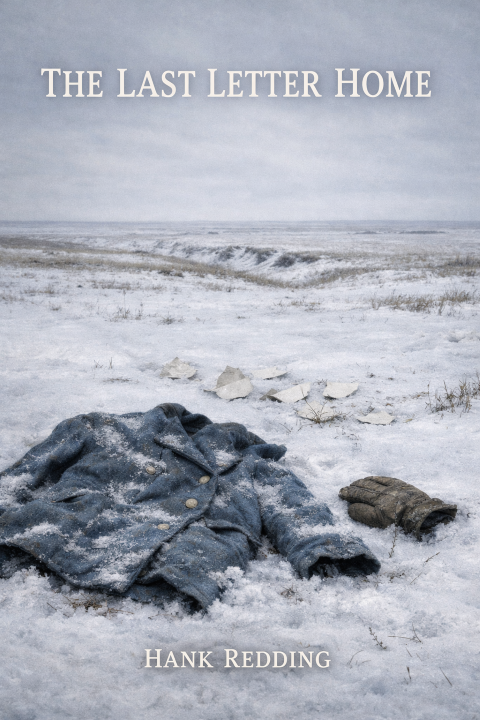
In the spring, a trapper found them near the edge of a draw not far from Blackthorn Gap. The bones lay close together. The coat was still buttoned. In the lining, he found a tarnished locket with two small portraits—one of a woman, one of an infant. The paper that had been folded beside it was gone.
The trapper built a low cairn from stones he gathered nearby. No marker. No name.
The letter did not vanish all at once.
The wind took it in pieces.
Not the words—
but the order of them.