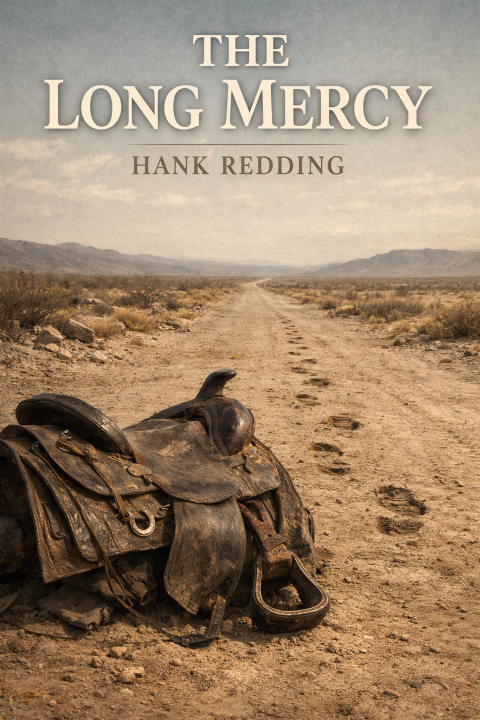
Chapter One — The Road Was Narrowing
They had been riding together long enough that the land no longer noticed them.
The road bent where it always bent, dipped where it had learned to, and stretched ahead in that dull, unpromising way that meant nothing was waiting except more distance. Dust lifted behind the horses and settled again without ceremony. The sun hadn’t decided whether it was going to be cruel or merely persistent.
The man who rode ahead did not look back.
He never did—not because he was careless, but because he believed movement itself was protection. If you kept going, things couldn’t gather around you. If you didn’t slow, nothing could catch hold long enough to matter.
The other man rode a few lengths behind. Not out of fear. Not out of respect. Simply because it made sense to see what was coming from more than one angle.
They had not started together. That was important. They had met the way men often did then—by accident, under conditions neither would have chosen if asked afterward. One had needed help. The other had needed quiet. The road offered both, temporarily.
At first, there had been rules.
They did not speak of names.
They did not ask about past work.
They did not ride at night unless forced to.
These were not principles. They were habits learned the hard way.
The man in front broke the rules first.
Not dramatically. Just a story told too easily at a campfire, the fire low enough not to draw attention. A town mentioned by name. A joke about a deputy who’d been slow to learn. Nothing that sounded like boasting. Nothing that sounded like warning either.
The man behind listened and said nothing. He was good at that. Listening had kept him fed longer than courage ever had.
They made money in small, forgettable ways. Enough to eat. Enough to move on. Never enough to stay. When something went wrong—and things always did—the man in front treated it like proof he was alive. The man behind treated it like information.
That difference had not mattered yet.
One evening, as the light drained out of the desert and left the ground holding its breath, they stopped near a dry wash. The horses drank what little they could. The wind moved through the grass and carried with it the sound of something distant—a wagon, maybe, or just the earth shifting the way it always had.
The man in front sat back on his heels and smiled.
“Feels wide out here,” he said. “Like you could keep going forever.”
The man behind looked at the horizon. He saw the same thing and something else.
“It’s narrowing,” he said.
The other man laughed. “You always say that.”
“Because it always does.”
They ate without hurry. The stars came out one by one, indifferent. Somewhere, a decision was already being made, though neither man could have pointed to it yet.
They slept with their boots on.
By morning, the road would be the same.
But the space around them would not.
Chapter Two — What People Began to Say
The first time they heard it spoken back to them, it came from a man who hadn’t been there.
They stopped at a place that pretended to be a town—three buildings and a hitching rail, all of it leaning as if the land had grown tired of holding things upright. A woman poured coffee without asking questions. A boy watched them from behind a barrel, eyes sharp, learning how men arrived and what they carried with them.
The man who rode ahead leaned back in his chair and stretched, boots crossed, hat tipped low. He looked like someone passing through because that was what he wanted to look like.
The man behind stayed near the wall. He always did. He liked having something solid at his back.
“You hear about the trouble down south?” a voice said from the far end of the room.
No one answered at first. Then the man in front smiled, slow and easy.
“Trouble’s everywhere,” he said. “Depends how long you stay.”
The voice laughed. “They say it was you.”
The smile held. “They say a lot of things.”
The man behind felt the shift before it happened. A slight tightening in the room. The way words settled when they found purchase.
“They say a man rode through two towns and left neither one standing right,” the voice continued. “Say he didn’t even slow.”
“That so?” the man in front said. He did not deny it. He did not confirm it either. He let the story sit between them, warm and dangerous.
The man behind watched the boy’s eyes widen.
That was how it started.
Not with gunfire. Not with posters. With people needing something to talk about that wasn’t themselves.
They left before dusk.
Outside, the man in front swung into the saddle and laughed like the air had done him a favor.
“See?” he said. “I told you. The road remembers you if you move fast enough.”
The man behind said nothing.
That night, they camped farther out than usual. No fire. No sound beyond the horses shifting and the land settling back into itself.
“You could lean into it,” the man in front said, staring up at the stars. “Let it work for us.”
The man behind turned onto his side. “Stories don’t work for anyone long.”
“They work long enough.”
That was the first time the man behind considered leaving.
Not because he was afraid. Because he understood how stories gathered weight, and how weight eventually crushed whatever stayed beneath it.
But he stayed.
Staying was easier than choosing.
By the time the next town spoke their names differently than they’d been spoken before, it no longer felt accidental. The man in front corrected details when they were wrong. Let others stand when they were flattering. He did not invent anything. He simply did not stop it.
The man behind kept track of routes. Timings. Which men asked questions twice. Which ones smiled too quickly.
He began to see the road not as a line, but as a net.
He did not yet know where it would tighten.
Only that it would.
Chapter Three — How the Waiting Worked
The law did not arrive the way stories said it did.
There were no riders kicking dust at dawn, no shouted warnings, no sudden violence to announce the moment. What came instead was waiting—quiet, deliberate, and difficult to argue with.
It showed up as small inconveniences at first.
A stable that would not take their horses.
A storekeeper who insisted on payment before goods were touched.
A man who asked where they were headed and did not accept west as an answer.
The man in front noticed these things only as irritations. He treated them like weather—unpleasant, but temporary. He rode through them with the same confidence he brought to everything else, believing that motion itself could smooth edges and scatter resistance.
The man behind began to see the pattern.
They stayed one night in a place that had no name anyone agreed on. A rail line passed through without stopping. A single street cut across the dust and ended on either side in nothing that mattered. Men there spoke softly, not because they were afraid, but because they had learned to measure what they said.
At the far table, two strangers sat with their coffee untouched. They did not look over often. When they did, it was without interest.
The man in front noticed them anyway. He always noticed men who were pretending not to look.
“See that?” he said later, once they were outside. “They’re waiting.”
“For what?” the man behind asked.
The other smiled. “For us to do something worth remembering.”
That was not what the man behind thought. He saw waiting of a different kind—the sort that did not depend on mistakes. The sort that counted on time.
They rode out before morning.
The road narrowed again, just as it always did when the land decided it had carried enough. Mesquite and scrub closed in. Water grew scarce. Towns thinned, then vanished altogether.
At a crossing near a dry arroyo, they found tracks that had not been there before. Fresh. Deliberate. Set to be seen.
The man in front dismounted and studied them with interest, like a man examining his own reflection.
“They’re getting closer,” he said, pleased. “Means we’re worth the trouble.”
The man behind knelt and touched the ground. The tracks were not hurried. They were spaced evenly, confident.
“They’re not chasing,” he said. “They’re following.”
“That’s the same thing.”
“No,” the man behind said. “It isn’t.”
That night, a rider came to their fire. He did not carry a badge. He did not threaten. He sat where invited and accepted coffee without comment.
“I hear you boys move quick,” he said, eventually.
“We move,” the man in front replied. “Quick is relative.”
The rider smiled. “That’s what I hear.”
They spoke of nothing important after that. Weather. Roads. Horses. The rider left before the fire burned down, taking his time, leaving no sign of urgency behind him.
After he was gone, the man in front stared into the embers.
“They’ll make a show of it,” he said. “That’s how these things end.”
The man behind did not answer. He was thinking of the rider’s boots—clean, well-kept, not the kind worn by men who expected to run.
For the first time, the man behind understood that the road was no longer something they were riding on.
It was something being laid ahead of them.
And somewhere in that widening space between story and consequence, a choice was waiting to be made—one that would not announce itself, and would not feel like betrayal until long after it had already done its work.
Chapter Four — Where the Road Split
They did not argue all at once.
It began the way most things between them had—sideways, almost politely, with neither man claiming the center of the moment. The disagreement showed itself in small adjustments. A route altered without explanation. A town bypassed when it should have been used. A night ride where daylight would have been safer.
The man in front spoke of movement the way other men spoke of faith. If they kept riding, the road would thin. If it thinned enough, there would be space again. Space had always been the answer.
The man behind stopped believing that.
They reached a place where the land flattened and gave nothing back. No cover. No water worth stopping for. The sky pressed down, wide and empty, as if daring them to mistake it for freedom.
The man in front reined in and looked out across it, pleased.
“Once we cross this,” he said, “there’s nothing to slow us.”
The man behind dismounted.
“Nothing to hide us either.”
The man in front laughed. “You’re thinking too much.”
“No,” the man behind said. “I’m thinking late.”
They sat there longer than usual. The horses shifted, uneasy. Wind moved across the ground and erased what little trace they had left.
The man in front finally looked at him. Really looked, the way he did when something surprised him.
“You talking about leaving?”
The man behind considered the question. It would have been easier if he were afraid. Fear could have been explained. This was something else.
“I’m talking about ending it,” he said.
The man in front shook his head. “You don’t end things like this. You outlast them.”
“That works until it doesn’t.”
“And what?” the man in front said. “We give them what they want?”
The man behind did not answer right away. He picked up a stone and turned it in his hand, feeling its weight, its certainty.
“What they want,” he said finally, “is already decided. They’re just waiting for it to arrive on its own.”
The man in front stood and paced, boots scraping against the hard earth. His confidence had not left him, but it had begun to sound practiced.
“You think I don’t know how this goes?” he said. “You think I haven’t pictured it?”
“I think you picture it wrong,” the man behind said. “You see a crowd. You see noise. You see something worth the trouble.”
“And you don’t?”
“I see a morning where it’s quiet,” the man behind said. “Too quiet. And no one remembers how it actually happened.”
The man in front stopped pacing.
For a moment, something like doubt passed through him. Not fear. Recognition. The understanding that there were roads even he could not outrun.
Then it was gone.
“They won’t have me,” he said. “Not the way they think.”
“That’s what worries me.”
They rode together another day.
That night, they made camp in a shallow cut where the ground dipped just enough to offer the illusion of shelter. The fire stayed low. Neither man slept well.
The man behind lay awake, counting time instead of stars. He thought about routes that had been mentioned too clearly. About men who waited instead of chased. About how systems preferred endings that required the least effort.
By morning, the decision had settled into him—not loudly, not with relief, but with the dull certainty of something that had been true longer than he had admitted.
They split at a place that would never be marked.
No crossroads. No sign. Just a bend where one path narrowed and the other opened enough to suggest a future that did not include both of them.
The man in front did not ask him to stay.
The man behind did not explain why he was leaving.
They stood there, facing each other, the space between them already filled with everything they would never say.
“You’ll hear about it,” the man in front said.
The man behind nodded. “I know.”
They rode in opposite directions.
Neither looked back.
The road closed behind them without comment, as if it had been waiting for this moment all along.
Chapter Five — The Shape of a Question
He rode alone longer than he meant to.
Not because the road was difficult, but because it no longer required explanation. Alone, his pace made sense again. He slept when he needed to. He stopped when the horse did. No one asked him where he was headed, and he did not offer an answer that might be remembered later.
The system found him anyway.
It always did—not with force, but with familiarity. A man who shared a fire. A question that sounded idle. A pause where a pause did not belong.
The first one came near a river that still pretended to run year-round. The man had clean hands and a way of listening that suggested patience was a habit, not a tactic.
“You were riding with someone,” he said, as if stating a fact no one could dispute.
The man who had ridden behind said nothing.
“Fast rider,” the other continued. “Hard to miss.”
“Plenty of men ride fast,” he said at last.
The man smiled. “Not like that.”
They drank coffee. They spoke of horses. Of distances. Of how certain roads narrowed whether you wanted them to or not.
No offers were made. No threats implied.
When the man left, he did not look back.
The second came a week later, closer to a place where law had a roof and paper records. This one asked fewer questions and listened less.
“They’ll take him,” the man said. “Sooner or later.”
The man who had ridden behind looked at the street, at the way it bent away toward something he would not see again.
“Or later,” he said.
The man shrugged. “That’s the difference, isn’t it?”
He was given nothing. Asked for nothing.
Still, the question lingered after the man was gone.
Not would he be taken, but how.
The third was not a man at all. It was money.
It arrived without ceremony, folded into a transaction that did not require explanation. Not enough to change a life. Enough to mark a moment.
He stood there longer than necessary, the weight of it unfamiliar in his hand. He told himself it could have come from anywhere. That it did not mean what it seemed to mean. That coincidence was still possible.
He spent none of it.
He did not ride back.
Days passed. Then weeks. News traveled slower than stories, and stories never arrived intact. He heard fragments—of gunfire, of a stand that wasn’t much of one, of a body found where no one expected it to be.
The details shifted with each telling. The ending did not.
When he finally heard the name spoken aloud, it was already wrong.
The legend had begun.
He did not ask questions.
He did not correct anyone.
He did not say what he knew, or what he suspected, or what might have been different if he had chosen another silence.
He rode on.
The road widened again, the way it sometimes did after narrowing to a point you barely survived. Towns appeared that did not care who he had been riding with. Men listened without recognizing his voice. Time did what it always did—turned certainty into background noise.
Years later, when the story had hardened into something people sang without thinking, he heard it told the wrong way and felt the old question rise again—not as accusation, but as shape.
He did not answer it then.
He never would.
Some choices are made once and then lived with repeatedly, each day a quieter version of the first.
And some questions, once asked, do not need to be answered to decide a life.
Chapter Six — What Remains Untold
He was older than the story now.
That surprised him sometimes—not because he had expected to die young, but because the story had never aged with him. It stayed sharp where he had dulled. It stayed loud where he had learned the value of quiet. It traveled where he did not.
He lived in a place that did not ask questions. A room above a shop, a window that faced nothing worth remembering, a chair that knew his weight. The work he did was ordinary enough to pass without comment. He was known as a man who arrived on time and left without fuss.
People talked when they needed something to fill the space.
They talked about weather. About prices. About men who had been braver than sense allowed. About the past, the way people do when it no longer asks anything of them.
One afternoon, a voice carried the story into the room without invitation.
It was told by a man who had never ridden far and did not intend to start. He told it easily, with the confidence of repetition. The outlaw was fearless. The law was relentless. The end was inevitable.
The details were wrong. Not dramatically. Just enough to matter.
Someone asked if it was true.
The man telling it shrugged. “That’s how it’s always been said.”
The old man listened.
He felt the familiar tightening—the same one he had felt years ago when questions had been shaped carefully enough to sound like statements. He recognized the opening. The small, ordinary moment where a correction could be offered without cost.
He could have said the road was narrower than that.
He could have said the waiting mattered more than the chase.
He could have said some endings were made long before anyone fired a shot.
He could have said a great many things.
Instead, he reached for his coat.
The man telling the story glanced at him. “You ever hear it different?”
The old man paused with his hand on the door. The room held still, as if curious.
“I heard it once,” he said. “A long time ago.”
“What happened?”
He considered the question. Not the answer—the question itself. How easily it was asked. How little it asked in return.
He opened the door.
“It ended,” he said.
Outside, the street was quieter than it had been moments before. The day continued without regard for what had not been said. He walked the length of it at his own pace, the sound of the story fading behind him.
By nightfall, someone else would tell it again. They would tell it cleaner, louder, with fewer doubts. It would move the way stories always did—away from the living and toward the dead.
He would not follow it.
At his room, he sat and counted the remaining light until it was gone. He thought of a road that had narrowed until it offered only one direction at a time. Of a moment where silence had been chosen because it seemed smaller than speaking.
He did not decide, even now, what that choice had meant.
He had lived with it long enough to know that certainty was a luxury he could no longer afford.
Outside, the world kept the story it preferred.
Inside, he kept the rest.
And neither one asked the other to change.