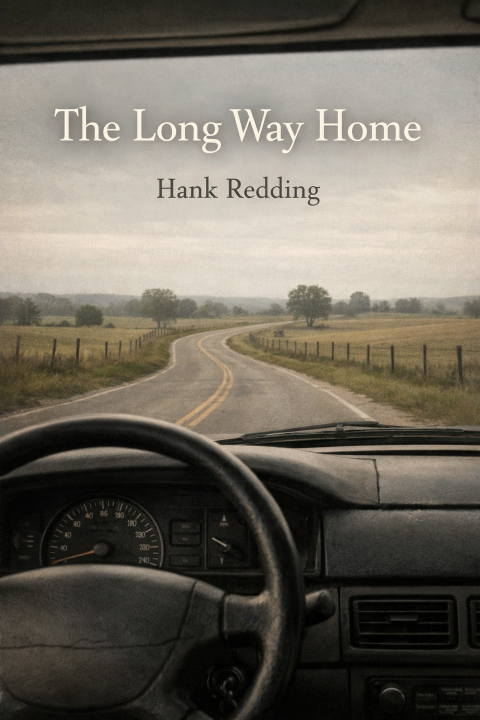
PART I — The Back Seat
They never told him where they were going.
That was the first thing he learned about rides: you got in, you waited, and eventually the world rearranged itself around the windows. He was small enough then that the door felt heavy when it closed, like it needed permission. His legs didn’t reach the floor unless he slid forward, and the seat belt cut across his neck if he didn’t tuck it under his arm. His mother always noticed and fixed it before the car moved.
“Comfortable?” she’d ask.
He never knew what the right answer was, so he said yes.
The car smelled like warm vinyl and whatever his father kept in his coat pockets—oil, metal, something faintly sweet. In the summer the seats burned the backs of his legs if he climbed in too fast. In the winter the heater took its time, breathing out cold air first like it needed to clear its throat.
He learned early that the beginning of a drive was always the same. The key turned. The engine caught. The radio came on too loud and got turned down. His father checked the mirrors, not because he expected anything to be there, but because that was what you did. His mother reached across the seat and set her hand on his father’s arm while they backed out. Not holding. Just touching. Like punctuation.
They didn’t talk much at first. The road out of town didn’t ask for conversation. It was straight and familiar and bordered by fields that looked identical no matter the season. He used to press his forehead to the glass and watch fence posts tick by, counting them until he lost track and had to start over.
Sometimes they went to the river. Sometimes they went nowhere he could name. He learned that places mattered less than the act of leaving. When he asked where they were headed, his father would say, “We’ll see,” and his mother would smile like that was the whole plan.
He believed, for a long time, that the car knew how to get home on its own.
The back seat was its own country. From there, he saw things adults didn’t seem to notice: the way shadows pooled under bridges, how telephone wires dipped and rose like they were breathing, the sudden appearance of a lone mailbox miles from anything that looked like a house. He built stories for the people who might open those doors. He imagined dinners, arguments, dogs asleep on porches. The world felt full even when it was empty.
His parents spoke in fragments he wasn’t meant to assemble. Money came up in tones, not numbers. Work existed as something that happened elsewhere, something that left his father tired but intact. His mother’s silences were never empty. They were full of thought, of attention, of the kind of watching that didn’t interrupt.
When they argued, it was brief and contained. Voices never rose enough to scare him. A sentence would hang unfinished, then fall away. The road absorbed it. By the time they turned back, whatever had sparked it seemed to have burned itself out.
He thought this was how all families were: careful, mobile, quietly together.
On Sundays, especially, the drives stretched. There was no clock pressing against the windshield. Lunch could wait. Homework didn’t exist yet. The afternoon opened itself without asking for anything in return. His father drove with one hand then, elbow propped, fingers loose on the wheel. His mother rolled down her window just enough to let the air move.
The boy believed this was wasted time.
He didn’t dislike it. He just didn’t understand it. The world outside moved slowly, and he wanted motion with purpose. He wanted to arrive somewhere that required explanation. He didn’t know yet that stillness was doing work on him.
At certain points on the road, his parents’ hands found each other again. Not deliberately. It happened the way habits do, the way a body remembers where to rest. Sometimes he saw it in the mirror—two hands joined low, out of the way. Other times he noticed only because the space between them disappeared.
Those moments made him feel safe without knowing why.
Years later, he would struggle to remember conversations from that time. What stayed instead were the textures: the hum of tires, the flash of sunlight through trees, the way his father slowed automatically at intersections that didn’t have signs. The car seemed to float, held in place by routine.
Once, when rain came down hard and sudden, he watched his mother reach for the dashboard when the road slicked. She didn’t say anything. She just rested her palm there, trusting the contact more than the surface. His father didn’t look at her, but he adjusted his speed all the same.
That was how things worked, he learned. You noticed. You adjusted. You didn’t announce it.
As he grew older, the back seat became less forgiving. His knees pressed into the seat in front of him. He started to feel crowded. The questions came more often then—how long, why here, can we stop. His parents answered patiently, but something had shifted. He could feel it. The drives no longer felt infinite. They felt optional.
He started counting time instead of fence posts.
Still, the ritual held. They climbed in. They left. The world lined itself up outside the glass. Sometimes they spoke. Sometimes they didn’t. The boy grew taller. The car aged. A crack appeared in the dashboard and spread slowly, like a fault line.
He didn’t notice when the drives began to mean more to his parents than to him.
That understanding would come later, after he had spent years chasing destinations that never quite satisfied him. After he learned how easy it was to mistake movement for progress. After he found himself, unexpectedly, wanting nothing more than to sit still and let the road do the work.
But for now, he stayed in the back seat, watching the world go by, convinced that whatever mattered most was still ahead of him.
And the car carried them on, steady and unremarkable, exactly where it needed to go.
PART II — The Long Middle
He learned to leave in stages.
First, there were shorter absences—nights away, weekends spent elsewhere, the gradual reorientation of his attention toward places that asked something of him. School became real. Friends gained edges and hierarchies. Time stopped stretching and began to stack.
The drives faded without ceremony.
They didn’t announce their last one. No one thought to mark it. At some point, he simply stopped climbing into the back seat. He drove himself, then later, he didn’t drive much at all. He lived close enough to things that mattered—work, bars, apartments—that motion felt inefficient.
He told himself this was progress.
His parents adjusted the way people do when a room empties. They didn’t ask why he didn’t come along anymore. They asked different questions instead. Was he eating well. Did he need money. Was he sleeping enough. When he came home, they talked across a table instead of through a windshield. The conversations were fine. Practical. Contained.
But the silence was different.
He married in his late twenties, after enough momentum had built that stopping felt dangerous. His wife was efficient, decisive, allergic to idling. She liked plans. She liked knowing where something led. When he mentioned long drives, she asked what for.
“To clear my head,” he said once.
She laughed, not unkindly. “Just sit still, then.”
He didn’t argue. He learned instead to match her pace. Their weekends filled with errands and social obligations. They went places for reasons. Vacations had itineraries. The car became a tool again—something to get through, not something to be inside.
Work expanded to fill the space he’d once left empty. He was good at it. Not brilliant, but reliable. People trusted him with things they didn’t want to think about. He learned how to move through meetings the way his father once moved through intersections—slow when necessary, decisive when expected.
He told himself he was building something.
His parents called on Sundays. He answered when he could. When he couldn’t, he called back later, always meaning to linger longer than he did. They talked about weather, about neighbors, about roads being repaired or not repaired. His mother asked about his wife by name, careful not to pry. His father mentioned projects half-finished and never explained why they stayed that way.
They still drove.
He knew this because his mother would mention something they’d seen. A new fence line. A field left fallow longer than expected. A stretch of road that felt rougher than it used to. He listened, nodded, made the right noises. He didn’t ask where they’d gone.
Years stacked. Promotions came, modest and incremental. His marriage shifted into something functional but thin. They argued about time, about money, about the feeling that they were always preparing for a future that refused to arrive.
When it ended, it did so quietly. No betrayal. No explosion. Just the mutual recognition that they had become efficient strangers.
He moved into an apartment that overlooked a parking lot. He told himself this was temporary. He told himself many things during that period—most of them true in small ways, none of them complete.
It was during this stretch that his parents began to age in ways he couldn’t dismiss.
His father’s voice softened. His mother repeated herself without realizing it. Stories gained loops. Names slipped and returned. When he visited, the house felt the same, but the rhythm was off. The silences lingered longer than they used to. He noticed how often his father sat instead of stood.
They didn’t say anything about it. Neither did he.
Once, after dinner, his father asked if he wanted to take the car out for a bit. Just around. No reason. The offer surprised him enough that he declined automatically. He was tired. He had an early morning. Next time, he said.
There was no next time like that.
Guilt arrived later, as it often does—uninvited and poorly timed. It showed up in flashes: a stretch of road seen from a hotel window, a familiar turn signal sound in traffic, the smell of warm vinyl on a summer afternoon. He felt it briefly, then set it aside. Life required momentum.
He remarried, later this time, to someone gentler but equally forward-facing. They built a life that worked. It was quieter, more careful. They did not have children. It wasn’t a decision so much as a drift.
Through all of it, the drives remained unspoken. They sat behind him, patient, waiting for relevance.
The call came on an ordinary afternoon. His mother, measured and calm, telling him that his father had slowed. That the doctor had said words they didn’t like. That nothing was urgent yet, but some things were changing.
He drove home that weekend without stopping, hands steady, radio off. The road felt narrower than he remembered. The landmarks arrived sooner. When he pulled into the driveway, his parents stood side by side, smaller somehow, but unmistakably themselves.
His father smiled. “Long drive.”
He nodded. “Yeah.”
They didn’t go anywhere that visit. They sat. They talked. They watched the light move across the floor. It was fine. It was enough.
But something had shifted again, and this time he felt it.
The long middle, he would realize much later, wasn’t about building or losing. It was about forgetting the value of being carried.
That night, lying awake in his childhood room, he listened to the quiet house settle. He thought about motion without destination. About how much of his life had been spent arriving.
He slept poorly. In the morning, his mother suggested they take the car out. Just a short drive. Nothing planned.
He hesitated—then said yes.
PART III — The Fracture
The first drive back felt wrong.
He took the passenger seat out of habit, then hesitated, unsure where his body belonged. His father waved him off gently and slid in behind the wheel. The motion took longer than it used to. Not enough to comment on. Enough to register.
The engine turned over the same way it always had. That steadied him more than he expected.
They didn’t go far. Just out past the edge of town, where the road loosened and the fields opened up. His mother sat in the front, hands folded, looking out instead of ahead. The back seat remained empty, a presence in itself.
Conversation arrived in pieces.
His father mentioned the weather. His mother pointed out a field that hadn’t been planted this year. Someone laughed at something small. Silence filled the rest without strain.
But the drive no longer absorbed things the way it once had. It revealed them.
He watched his father’s hands more than the road. The grip was still sure, but the pauses between movements had lengthened. At intersections, there was a moment—brief, but unmistakable—where decision took effort. His father covered it well. He always had.
The car made a new sound going over rough patches. A faint rattle that hadn’t been there before. Or maybe it had, and he’d just stopped listening.
They turned back earlier than expected.
“That enough?” his father asked.
“Yeah,” he said, meaning something else entirely.
Over the next year, the drives became shorter and more frequent. Not scheduled. Just available. Sometimes they didn’t leave the neighborhood. Sometimes they went nowhere he could identify later. The destination never came up.
His mother talked more during these stretches. Not about anything urgent. About people he barely remembered. About a store that used to sit where a gas station now stood. About a dog they’d had before he was born. Her voice carried a lightness that surprised him, as if the motion loosened something she didn’t reach for otherwise.
His father spoke less. When he did, it was precise. Observational. He commented on the road, the way traffic patterns had changed, the timing of lights that no longer made sense. He seemed most himself while moving.
Outside the car, decline continued quietly.
Appointments multiplied. Notes appeared on the refrigerator. The house acquired the faint smell of medicine. Nothing dramatic. Nothing that demanded an ending. Just the steady narrowing of options.
The fracture wasn’t a single moment. It was cumulative.
It showed up the first time his father handed him the keys without explanation.
They stood in the driveway, the afternoon already thinning. His father held the keys out between them, casual as ever.
“Why don’t you drive,” he said.
The sentence landed harder than it should have.
He took the keys. He didn’t argue. He didn’t ask if everything was okay. He unlocked the car and slid into the driver’s seat, aware of his parents behind him, their weight settling differently than his own once had.
The mirrors caught them in fragments. His mother adjusting her purse. His father folding his hands in his lap.
He pulled out slowly.
The road felt narrower from this side. The angles were different. He was conscious of every movement, every decision. The car did not know how to get home on its own. That belief evaporated immediately.
They didn’t correct him. They didn’t offer directions. When he hesitated at a turn, his mother said gently, “Whichever you like.”
That was the moment something broke open.
Not loudly. Not all at once. Just enough for him to feel the weight shift.
He drove more after that. Sometimes with them. Sometimes alone. The routes repeated. Familiarity returned, altered but intact. He learned how to carry silence without filling it. How to let stories repeat without trimming them down. How to drive at a speed that allowed memory to keep up.
Loss came later, as it always does—unavoidable, poorly timed, resistant to narrative. His father went first. Not in the car. Not on a drive. In a bed, quietly, with his hand resting in his mother’s like it had rested on the console all those years.
Afterward, the car sat untouched for weeks.
When his mother finally suggested a drive, her voice was steady but thin. He didn’t hesitate this time. He took the keys, helped her into the passenger seat, and waited until she nodded.
They drove.
The road had not changed. The fields remained indifferent. Fence posts still ticked by, impossible to count.
She watched the world through the window, her face open in a way he hadn’t seen since he was a boy. At one point, she reached across the space where his father’s arm used to be and rested her hand on the console instead.
He noticed. He adjusted. He didn’t announce it.
The fracture, he understood then, wasn’t about loss.
It was about transfer.
PART IV — The Driver’s Seat
Driving her became ordinary.
Not immediately. At first, every trip felt ceremonial, weighted with intention. He paid attention to every detail—the way she stepped into the car, the pause before she reached for the door handle, the careful arrangement of her coat across her lap. He drove too carefully, braking early, accelerating slowly, as if smoothness itself could protect them.
She noticed.
“You don’t have to be so gentle,” she said once, not unkindly. “I’m still here.”
He smiled and adjusted, embarrassed. She was right. Care that announced itself had a way of becoming heavy.
So he learned a new rhythm.
They went out in the afternoons most often. Morning light felt too sharp. Evening made her tired. The afternoons belonged to them in a way nothing else did. They drove without agenda. Sometimes they turned back almost immediately. Sometimes they stayed out long enough for the sun to lower and flatten the fields.
She talked when she felt like it. He listened without prompting.
Her stories no longer followed straight lines. They looped, paused, picked up again somewhere nearby. He stopped tracking accuracy and started tracking tone. When she laughed, it was genuine. When she grew quiet, it wasn’t emptiness—it was thought settling.
He realized how much of his life had been spent preparing responses instead of receiving things.
The car aged alongside them. A door latch stuck in cold weather. The radio lost one station entirely. A new rattle joined the old one. He fixed what he could. He left the rest alone.
The mirrors told him things he didn’t want to know yet. Her posture folding inward slightly. The way her hands rested more often than they moved. He adjusted the seat farther forward without comment. She didn’t mention it.
They passed places he remembered only dimly now. Roads he’d driven a thousand times as a child returned with softened edges. He saw them differently from this seat—less infinite, more precise. The work of staying on them felt clearer.
Sometimes she reached for the console and rested her hand there, exactly where his father’s arm had once been. The first time it happened, his breath caught. He kept his eyes on the road. After that, it became another habit—quiet, unremarkable, sustaining.
Grief showed itself sideways.
Not in tears, not in declarations. It appeared in the way she watched passing houses longer than necessary. In the way she pointed out small changes—new paint, missing trees—as if accounting for them mattered. He didn’t rush her through it. The road held the pace.
On days when she was tired, they drove less. On days when she was restless, they stayed out longer. He learned how to read her without asking. He learned that care was not about fixing, but about maintaining the conditions that allowed things to keep moving.
Once, she asked him where they were going.
He answered without thinking. “We’ll see.”
She smiled and looked out the window.
That answer felt like inheritance.
The back seat stayed empty. It didn’t feel vacant. It felt complete.
He thought occasionally about his own life—about the years spent chasing clarity, about the marriage that had worked until it hadn’t, about the rooms he’d occupied without fully arriving in them. Those thoughts came and went. The road did not require reckoning. It required attention.
Driving her, he understood something he hadn’t been able to articulate before: that love was not urgency. It was repetition. It was showing up without spectacle. It was learning how to carry someone else’s weight without letting them feel the strain.
Eventually, she stopped suggesting the drives. He took that on too. He watched the weather. He noticed when the light shifted. He asked at the right times. Sometimes she said no. He accepted that easily now.
When the end came, it did not announce itself.
There was no final drive that felt distinct from the others. No moment that asked to be remembered. Just the gradual narrowing of the world until motion no longer made sense.
After, the car sat again.
This time, not untouched. Just waiting.
PART V — The Return
He waited longer than he meant to.
Not out of avoidance. Not out of grief, exactly. The days simply arranged themselves without asking whether the car was part of the arrangement anymore. He walked more. He stayed in. He learned how quiet a house could be when there was no one left inside it but him.
When he finally took the car out, it wasn’t because he missed driving.
It was because the afternoon opened up the way it used to—wide, unclaimed, uninterested in productivity. The light flattened the fields. The air moved without urgency. The moment felt available.
He took the keys.
The car started without complaint. The engine caught the same way it always had, steady and unremarkable. That steadied him. He adjusted the mirrors, though there was no one to check for. Old habits held their shape.
He drove.
The road accepted him without recognition. Fence posts ticked by. Shadows pooled and shifted. The world arranged itself outside the windows just as it always had. He did not look for landmarks. He let them arrive on their own.
At first, the silence pressed in. Then it loosened.
He noticed things he hadn’t in years. The way the steering wheel vibrated faintly at certain speeds. The sound the tires made when the pavement changed texture. The way the horizon rose and fell, subtle but insistent.
There was no one in the back seat.
There was no one beside him.
And still, the space felt full.
He passed the turn where his father used to slow without thinking. He slowed too. Not because he needed to—but because that was how the road had been taught to be driven. He passed the stretch where his mother used to point out the fields that never seemed to change. They were still there. Some altered. Some stubborn.
Time had done its work. Not cleanly. Not dramatically. Just enough.
He drove until the road curved back toward town. He did not fight it. The car didn’t need instruction. Neither did he. Home was not a destination so much as a direction that eventually asserted itself.
When he pulled into the driveway, he didn’t turn the engine off right away.
He sat with his hands on the wheel. He watched the light thin and slip away. He let the car idle, a small act of resistance against the idea that things had to end simply because they paused.
He understood now what he hadn’t then.
That the drive had never been about where they were going.
That it had never been about passing time.
That it was an act of trust—placed quietly, repeated often, misunderstood until it could no longer be practiced the same way.
He shut the engine off.
Later—months later, maybe years—he would drive again with someone else. Not a child, necessarily. Not a replacement. Just another presence. Another body learning the shape of the seat. He would not explain the route. He would not announce the purpose.
He would simply go.
And the road, patient as ever, would take them where it always had.
Not forward.
Not back.
Just through.