Chapter One — The Gallows
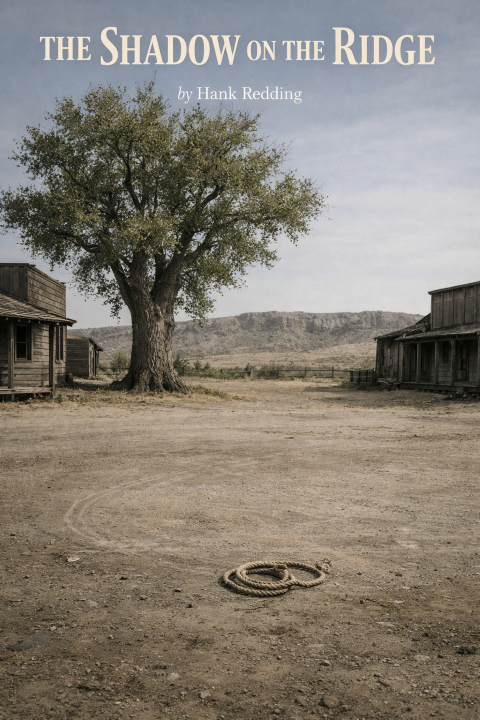
The cottonwood gallows stood on the edge of the town square like a patient sentinel, its shadow stretching long across the packed dirt as the sun climbed toward noon. Someone had swept the ground beneath it that morning. The broom marks were still visible—faint arcs pressed into dust and grit—as if order itself needed a place to land.
Rowan Calder sat on the edge of his cell cot, back straight, hands resting loose on his knees. The cell door stood open—had been since dawn—because no one believed the sheriff would run. Not Rowan Calder.
The jail smelled of old wood and iron and the soap someone had used too much of when they cleaned the floor. Outside, the town was already awake. Wagons lined the street. Horses shifted and stamped. Women gathered beneath awnings, their voices low. Children darted between legs, sensing importance without understanding it.
Calder listened without moving. He could tell the time by the sounds: the hitching posts filling, the saloon door opening early, the murmur thickening as people arrived who did not usually come to town on a weekday. Justice, when announced, had a way of drawing witnesses.
He reached into his coat pocket and drew out the small pocketknife he’d been allowed to keep. The blade opened with a soft, familiar click. In his hands was a piece of cottonwood, already shaped into the beginnings of a horse. The legs were rough, splayed wide as if running. He worked the mane with careful strokes, shaving thin curls that fell to the floor and stayed there.
Outside, someone laughed.
It was a quick sound, unguarded, and it carried farther than it should have. Calder paused, thumb resting against the knife’s worn handle, then resumed carving. The laugh dissolved into conversation. Someone called out a greeting. A wagon creaked to a stop.
For four years, Calder had kept the peace in Iron Springs. He’d broken up saloon fights with a word spoken low enough that only the angry man heard it. He’d tracked rustlers through a blizzard and brought every rider home. Once, he’d stood between a grieving father and the drunk who’d run down his son, talking until the man’s hands stopped shaking and the gun lowered on its own.
He never raised his voice. Never drew first. People said he carried the war in his eyes. He did not correct them.
Now they said he’d murdered Silas Drayton in cold blood.
The evidence had been simple. Drayton found dead in his own yard, shot through the heart. Calder’s revolver beside the body, still warm. Three witnesses who swore they’d seen the sheriff ride up at dusk, argue about water, then draw and fire. The circuit judge had listened, nodded, and written it down.
No one mentioned the boy who had gone missing from the ridge three days earlier. No one mentioned the canyon. No one mentioned the smell of burned powder that did not match a service revolver.
Calder set the knife down and turned the horse in his hands, judging the balance. Outside, the murmur shifted again—thicker now, expectant. Boots crossed the square. Someone tested the rope.
He did not look up.
When footsteps approached the jail, they were measured and familiar. Calder knew the weight of them, the slight hesitation before the threshold.
He kept carving.
Outside, the cottonwood’s shadow crept another inch across the dirt, long and narrow, pointing back toward the ridge where the spring still ran clear.
Chapter Two — Before the Badge
Rowan Calder learned early that loud men were usually afraid of something they could not name.
The war taught him that much, if nothing else. Shiloh was mud and smoke and noise that did not stop when men fell. Orders dissolved into shouting. Lines collapsed into knots of bodies trying not to die alone. His brother went down near the peach orchard, calling Rowan’s name once—only once—before the sound was swallowed by the rest.
Rowan did not remember firing his rifle after that. He remembered voices instead. A boy from Indiana crying for his mother. A sergeant repeating the same command until it meant nothing. A Confederate no older than sixteen begging for water with a hole through his thigh. Rowan knelt beside him and spoke the way his father used to speak to horses gone wild in the traces—low, steady, unafraid. The boy stopped screaming. He lived long enough for the stretcher bearers to find him.
Afterward, Rowan noticed something that stayed with him: men calmed faster when someone refused to rise to their panic. Violence still came, but it hesitated when it met steadiness. Sometimes that hesitation was enough.
He carried that knowledge out of the war like a wound that had healed wrong but still worked.
Missouri had no use for it. Neither did Illinois. Towns wanted declarations—who you’d been, who you’d lost, which side you’d claim now that the fighting was over. Rowan learned to leave rooms before questions finished forming. He worked freight. He slept outdoors. He learned the sound of his own breathing in wide places where no one asked him to explain it.
Iron Springs came into view by accident. A scatter of buildings pressed against a rise, the spring threading down from the ridge like a promise not yet tested. Water was thin there. So was authority. Disputes were settled by neighbors who still remembered one another’s fathers.
Rowan stayed because nothing demanded him.
At first, he did small things. He walked a drunk home instead of letting him fall. He stood between two men arguing over a fence line until the argument ran out of words. When a horse went missing, he followed the tracks because no one else would and brought the animal back without asking for payment.
People began to look for him when tempers ran hot.
He noticed it last. Authority had never announced itself to him; it arrived as expectation. When the old sheriff fled after a winter raid went bad—left town with a mule and did not look back—the council asked Rowan to take the badge until they found someone permanent.
Rowan said no.
They asked again. No speeches. No appeal to duty. Just a simple truth spoken by a man who did not raise his voice: You already do the work.
Rowan took the badge because refusing it would have changed nothing. If violence came—and it always did, eventually—better it land on the man already standing between.
He did not wear the badge as a warning. He wore it as a promise.
For four years, it held.
He learned every bend in the ridge road, every draw that hid water, every man whose temper rose with drink and fell with time. He learned which disputes required witnesses and which required privacy. He learned that fairness was less about rules than about timing—intervening early enough that no one felt cornered.
When the railroad announced its spur, Rowan felt the shift before he saw it. Strangers arrived with confidence already formed. Money moved faster than custom. Men who had never drunk from the spring began to speak of controlling it.
Rowan rode the ridge more often then. He watched. He listened.
By the time Silas Drayton’s name became common in town, Rowan already knew the cost of speaking too soon. Power noticed resistance faster than it noticed harm.
So he waited. He intervened quietly. He believed there was still time.
In the jail cell, the cottonwood horse rested warm in his hands. Outside, Iron Springs gathered with the certainty of people who believed the work was already done.
Rowan Calder did not look at the door.
He had learned long ago that violence did not announce itself. It waited for men to convince themselves there was no other choice.
Chapter Three — Iron Springs, Before Drayton
Iron Springs had grown the way many towns did—by accident, then by habit.
The spring itself ran out of a cleft in the ridge, clear and cold even in late summer. Before there were buildings, men camped near it. Before there were streets, wagons cut the dirt into something resembling intention. People stayed because water stayed. What followed came slowly: a store, a livery, a church that doubled as a meeting hall when weather pressed.
Justice was informal then. Men argued, neighbors listened, and most disputes ended where they began. Land was marked by memory more than survey. Everyone knew who had come first and who had arrived desperate.
Rowan Calder fit into that rhythm without changing it.
He did not patrol. He walked. He listened more than he spoke. When tempers rose, he did not hurry them down. He waited until the anger ran out of language, then stepped in while there was still space for it. People came to trust that if Calder was present, no one would leave with blood on their hands.
It was not heroism. It was timing.
The badge came later, and when it did, it altered little at first. Calder wore it plainly, as if it were another tool handed to him rather than a symbol earned. He did not stand taller for it. He did not remind men it existed.
Iron Springs liked that.
The council liked it more. A sheriff who did not ask for more men, more money, or more authority was a convenience. Problems resolved quietly did not ripple outward. They did not draw attention from the territory, or from interests farther east.
The spring continued to run. Homesteads dotted the lower valley. Families came and stayed because they could calculate the cost of staying. The town was not rich, but it was legible. You could look at it and understand where you stood.
That changed the year the railroad announced its spur.
Iron Springs did not get the rails themselves—just close enough to feel the tremor. Freight wagons doubled. New faces arrived who did not linger at the spring or ask who had come first. They spoke in terms of acreage and throughput, words that did not belong to the land but expected it to comply.
Rowan noticed the change in how men spoke when money preceded them. The pauses vanished. Assumptions arrived whole.
He also noticed who stopped speaking altogether.
Nothing broke at once. The town adjusted. It always had. Men took work they had not before. The store stocked items no one remembered asking for. The council reassured itself that growth was inevitable and restraint unnecessary.
Rowan rode the ridge more often.
He saw stakes driven where there had been none. He heard about water plans secondhand—dams proposed, diversions measured. He spoke to men individually, not as a sheriff but as a neighbor, and sometimes that was enough. A supply wagon turned back. A survey was postponed.
He learned which conversations were repeated, and which were denied having happened at all.
Iron Springs began to rely on him in a new way then—not just to stop violence, but to absorb tension before it reached the square. He became a place disputes went to quiet down. That quiet felt like order. It felt like success.
No one noticed how much it depended on him.
When Silas Drayton’s name entered the town, it came with confidence already attached. He did not introduce himself. His foreman did that work, riding ahead, speaking of cattle numbers and improvements. Drayton arrived later, clean and unhurried, as if confirming what had already been decided.
The town did not resist. It recalculated.
Rowan watched the recalculation in small ways: a councilman who stopped meeting his eye, a hand who spoke too quickly when asked simple questions, a wagon rerouted without explanation. He rode the ridge and saw fresh measurements taken near the spring.
He spoke to a foreman once, quietly. The man smiled and said nothing would change.
That was when Rowan knew time had thinned.
In the jail cell, the cottonwood horse took shape under his hands. Outside, Iron Springs gathered itself for what it believed was a necessary act.
The town had not turned cruel.
It had turned efficient.
Chapter Four — Silas Drayton Arrives
Silas Drayton did not arrive in Iron Springs the way men usually did.
There was no wagon piled with household goods, no family riding close behind. He did not stop at the spring to drink or ask who owned what. When he came, it was in the company of men already working on his behalf—foremen who knew the land by numbers and the town by leverage.
Drayton stayed at the hotel his first week, then moved into a rented house on the west edge of town, close enough to the ridge road that water could be discussed as theory rather than inconvenience. He attended church once. He spoke politely to the minister. He left before the final hymn.
Rowan Calder met him the second day.
It was not an introduction. Rowan rode past the yard where Drayton’s cattle stood thick and restless, the grass already pressed thin beneath them. Drayton watched from the porch, one hand resting on the rail, as if assessing weight and distance. He nodded once. Rowan returned it and kept riding.
That was the extent of it.
What followed came through others. A homesteader approached Rowan near dusk, voice lowered, asking whether damming the upper draw required a filing. A storekeeper mentioned delayed payments and new credit terms offered by a man who did not yet shop there. A hand complained—then corrected himself—about longer hours on the ridge.
Rowan listened.
He rode the ridge more often then, stopping to watch men measure water flow where none had been measured before. Stakes appeared and vanished. Conversations ended when he approached and resumed once he left.
When Rowan spoke, he did so privately.
He reminded a foreman that spring water fed more than cattle. He asked another man where permits had been filed. He mentioned, to no one in particular, that Iron Springs had a habit of settling disputes before they hardened into claims.
Sometimes the words worked. A supply wagon turned back. A survey was postponed. Drayton’s men smiled and assured him there would be no trouble.
Rowan learned the shape of that smile.
Drayton himself remained distant. When they crossed paths again, it was brief—a comment on the weather, a remark about the town’s potential. Drayton spoke as if Iron Springs were already behind him, something evaluated and accepted in passing.
Rowan recognized the tone. He had heard it during the war, men who spoke of ground and men in the same breath. It was the sound of a decision already made.
The first true conflict came quietly. A dam wall rose partway across the draw above the spring, just enough to slow the flow. No one admitted ordering it. No one claimed responsibility. The foreman said it was temporary.
Rowan rode up alone and asked for it to be taken down.
The men refused.
Rowan did not argue. He told them he would return in the morning.
When he did, the wall was gone.
That night, Rowan rode the ridge twice.
He did not believe Drayton expected resistance. He believed Drayton expected accommodation—small concessions folded into habit until ownership followed.
Power did not announce itself in Iron Springs. It adjusted the math and waited for agreement to catch up.
Rowan suspected then that waiting was no longer enough.
When Finn Harlow disappeared three days later, Rowan did not need to ask where to look.
The canyon camp lay out of sight of town, tucked into a fold of land that swallowed sound. Drayton’s men had used it before for cattle drives. Rowan had ridden past it once, long ago, when it had been empty.
He turned his horse toward the ridge at dusk.
In the jail cell, the cottonwood horse rested unfinished, its legs still rough beneath his hands.
Rowan Calder had spent years intervening early.
As he rode, he understood that this time he was already late.
Chapter Five — Clara and the Ridge
Clara Henshaw learned early that land did not care why you needed it.
Her husband had died of fever in Ohio, the kind that moved faster than prayer and left nothing useful behind. What remained—debts, a boy not yet old enough to work the way men expected—had made the choice for her. West was cheaper than safety. Dirt could be worked. Silence could be endured.
Iron Springs suited her because it was legible. The ridge marked the weather. The spring marked survival. People kept their word because it cost less than breaking it.
Finn learned the place by watching his mother.
He learned where water gathered after rain, where snakes hid when the ground warmed, which men to avoid without being told. He learned that some questions were answered by looking away and some by standing still until the answer changed its mind.
They lived in a small cabin off the ridge road, close enough to the spring that Clara could hear it at night if the wind was right. Finn fetched water in the mornings. Clara tended a narrow plot that grew enough to keep them fed and little more.
Rowan Calder rode past often.
He never stopped unless spoken to. He tipped his hat. He asked after the ground when he did speak, not the boy. Clara noticed that. Men who wanted something from her asked about Finn first.
Once, when a stranger lingered too long near the cabin, Rowan appeared at the bend in the road without explanation. He did not speak to the man. He waited.
The man left.
Clara did not thank him. Gratitude could be mistaken for invitation.
She understood Rowan’s work the way women did who had learned to measure safety in increments. He did not rescue. He positioned himself so rescue was unnecessary.
When talk of dams and water rights began circulating, Clara listened carefully. She did not speak at meetings. She watched who spoke for her instead. She noticed how often Rowan rode the ridge then, how often he returned alone.
Finn noticed too.
He asked once why the sheriff kept riding up there.
“Because that’s where the trouble starts,” Clara said.
“And ends?”
“Sometimes,” she said. “If it’s caught early.”
The day Finn disappeared began like the others.
Clara sent him to check the snare line. He carried a stick and the button she had sewn back onto his coat twice already. The ridge lay quiet. The spring ran thinner than usual.
When he did not return by noon, Clara walked the road herself.
By evening, Rowan was riding the draw below the cabin, slow and methodical. He asked when Finn had last been seen. Clara answered plainly. She did not ask him to find her son. She trusted that he already would.
Rowan nodded once and turned his horse toward the canyon.
Clara waited through the night with a lamp lit and a rifle she hoped she would not have to use. She did not pray. Prayer had never returned anything she lost.
Finn came home after dark, shaken and dusty, smelling of fear and smoke. He would not eat. He would not speak. He slept only when exhaustion overtook him, waking with small sounds caught in his throat.
Clara did not ask what had happened.
She understood survival math. The fewer people who knew a thing, the longer it stayed alive.
She watched Rowan ride past the next morning, his arm bound beneath his sleeve. He did not look toward the cabin.
That was when she knew something had already broken.
By the time the men came asking questions—polite, careful, pretending concern—Clara had decided what silence would buy and what it would cost.
She chose time.
It was a thin purchase, but it was all she had.
From the ridge, the spring continued to run, and Iron Springs went on believing nothing had yet been decided.
Chapter Six — The Taking
Finn did not hear the men until they were close.
The ridge swallowed sound in strange ways. Wind carried some things far and dropped others at your feet. He heard the horse first—leather creak, a hoof striking stone where it should not have. By the time he turned, the men were already stepping down from the draw.
They spoke his name like it was nothing.
He ran because running was the only thing that had ever worked before. He cut toward the brush, the ground falling away faster than he expected. A hand caught his collar and wrenched him backward. He hit the dirt hard enough to lose his breath, the sky flashing white above him.
“Easy,” one of them said—not to him, but to the others. “We just need him for a bit.”
They put him on a horse between them, his legs dangling, his hands gripping mane because there was nothing else. Dust filled his mouth. His stomach hurt with a sharp, hollow fear. The men talked as they rode, not about him, not about anything that mattered. One complained about water. Another laughed about a meal he had missed.
No one said his mother’s name.
They reached the canyon after the light had shifted enough to make everything the same color. The fire there was small and mean, burning low as if it knew better than to announce itself. Finn was set down and told to sit. He sat. Sitting was easier than standing.
He learned then that men could be close without seeing you.
They spoke around him. Land. Timing. How some folks needed encouragement to understand their place in things. Someone mentioned the spring. Someone else said Drayton would handle it.
Finn watched their boots. He counted cracks in the rock. He pressed his fingers into the dirt until his nails hurt, trying to remember the way home.
When the horse arrived, he knew before he looked.
The sound was wrong—measured, unhurried. The men noticed it too. Their voices shifted. Someone straightened. Someone reached for something at his belt and stopped.
Rowan Calder rode into the edge of the firelight and halted.
He did not dismount.
“Let the boy go,” he said.
The words were calm. They did not rise. They did not argue.
The argument ended anyway.
Silas Drayton stepped forward last.
He was smaller than Finn expected. Clean. Unmarked. He smiled the way men did when they believed they were explaining something simple to someone slow.
Rowan listened.
Drayton’s hand moved.
The pistol was small. Finn saw the flash before he understood it. The sound was sharp and wrong in the narrow space, louder than it should have been.
Rowan fired once.
The men stepped back as if pushed. Someone cursed. The fire spat.
Rowan was suddenly beside Finn, a hand on his shoulder—solid, steady.
“Go home to your ma,” Rowan said. “Run straight. Don’t look back.”
Finn ran.
He ran until his lungs burned and the dark broke open into the ridge road he knew. He ran until the cabin light was a promise and then a fact. He did not look back. He did not stop.
Later, much later, he would remember the smell of burned powder, the way Rowan’s sleeve darkened, the echo of the shot lingering longer than it should have.
That night, all he knew was that he was alive.
And that someone else had decided the cost.
Chapter Seven — The Trial
The trial lasted less than a morning.
Iron Springs gathered in the church because it was the only room large enough to hold certainty. Benches were pulled close. Windows stood open to let the heat out, though it did little good. The circuit judge sat beneath the pulpit with his papers aligned, his coat already unbuttoned.
Rowan Calder stood where he was told.
He did not wear his badge. No one asked him to.
Silas Drayton’s body had been found at dawn in his own yard, laid out as if the night had not known what to do with it. The bullet had passed cleanly through the heart. There was no sign of struggle worth recording. Calder’s revolver lay beside the body, its grip dusty, the metal still warm when it was lifted.
That fact carried more weight than anything else.
The witnesses spoke in order.
The foreman first. He said the sheriff rode up at dusk, angry about water, saying things that could not be taken back. He said Drayton tried to reason with him. He said the shot came without warning.
A rail hand followed. He placed himself close enough to see faces, far enough not to be questioned. He repeated the foreman’s account with small differences, careful not to sound practiced.
The stable boy spoke last. He was young enough that his certainty passed for honesty. He said he saw the sheriff fire.
The judge asked where he had been standing.
“By the fence,” the boy said. He paused, then added, “Or near it. It was getting dark.”
The judge nodded and wrote it down. The scratch of the pen sounded louder than it should have. Somewhere behind Rowan, a bench creaked as a man shifted his weight and stilled again.
“I ran after,” the boy said. “Right away.”
No one asked how far the fence stood from the yard.
No one asked what could be seen at dusk from where he stood.
No one asked why all three men had been in Drayton’s yard at the same hour.
The jurors, drawn from the benches and already familiar with the witnesses, conferred in low voices for less than ten minutes before turning back to the judge. No one spoke aloud. Their agreement arrived as posture, not words.
No one asked about the canyon.
The judge looked down at his papers, then up.
“Sheriff Calder,” he said, as if weighing the title. “Do you have anything to say in your defense?”
Rowan shook his head once.
The room exhaled. A cough was swallowed somewhere in the back rows. Silence settled as agreement often did.
The judge did not linger. There was law to follow, procedure to honor. The evidence, as presented, allowed little space. He pronounced the sentence with care, as if precision might soften consequence.
Death by hanging. To be carried out at noon the following day.
Rowan did not react.
Deputy Tate stood near the wall, hat in his hands, eyes fixed on the floorboards. He waited for Rowan to speak—to explain, to slow the moment. Nothing came.
The gavel struck once.
Outside, the cottonwood cast its shadow across the square, long and thin. Someone was already measuring rope.
By the time Rowan was led back to the jail, the trial was being spoken of in the past tense.
Only the ridge remained unchanged, holding what it knew without offering it.
Chapter Eight — Doc Grant
Doc Elias Grant did not attend the trial.
He knew how it would go. Once a room decided what it needed, testimony became decoration. His work had taught him the limits of interruption.
Grant stayed in his office, cleaning instruments that did not need it. He boiled water twice. He folded bandages he would not use. Outside, Iron Springs moved toward conclusion with a speed that made careful men uneasy.
He had come west after the war with hands that would not keep still.
Field hospitals had done that to him—days where he cut and stitched without pause, nights where he lay awake listening to men die for reasons he could not name. He learned to work despite it, learned to brace his wrists against bone and table until the shaking subsided enough to matter.
Iron Springs suited him. The injuries were simpler. Fever. Falls. A crushed hand. Births that ended in cries instead of silence. He could be useful there without being tested beyond endurance.
The miner had been the exception.
It happened three winters back, after a cave-in at the north cut. Grant arrived to find company men blocking the bunkhouse door. They said the man was already gone. They said there was no sense in making a mess.
Grant believed them because he wanted to.
By the time he saw the body, it was clear the man had bled out slowly, pressure that might have saved him never applied. Grant said nothing then. He told himself there would be other chances to do right.
Rowan Calder had not said anything either. He had looked at Grant once, a question without accusation, and then turned away.
Grant had not forgiven himself for that.
When Rowan was brought in after the canyon, Grant treated the wound without asking where it came from. The graze was shallow and unmistakable. Powder burn at the edge. The kind of injury that told its story without words.
Later that night, Clara brought Finn.
The boy burned with fever, words spilling out of him as Grant worked. Grant listened while he stitched, steadying his hands the way he always did when things mattered most.
“The sheriff came,” Finn said. “He told them to let me go. Mr. Drayton shot first.”
Grant did not answer. He finished his work. He set the boy to rest. When the fever broke, Finn did not repeat the story. He slept and woke and slept again, emptied by it.
Grant wrote everything down.
He wrote the time. The wound. The words as best he could remember them. He did not know who would read it or when. He knew only that if it was not written, it would be as if it had never happened.
The day after the sentence was handed down, Grant went to the jail.
Rowan sat on the cot with the door open, carving a small piece of wood. The smell of fresh shavings mixed with iron and soap.
“You could tell them,” Grant said, though he already knew the answer.
“And put the boy in the crosshairs again?” Rowan said. “No.”
Grant understood then that silence could be a form of care, even when it looked like surrender.
“I took an oath,” Grant said.
Rowan met his eyes. “So did I.”
Grant left the jail with the weight of it settling into his chest. Outside, men were fitting the rope, oiling it so it would not catch. Someone asked Grant if the knot was right.
He did not answer.
That night, Grant sat at his desk and recopied his notes in a careful hand. He signed his name at the bottom. He folded the paper and set it aside.
If the law would not hear it, history might.
For the first time since the miner, Grant did not feel the shaking in his hands.
Chapter Nine — The Hanging
Noon came hot and slow.
The square filled the way it always did for things people believed they needed to witness. Wagons lined the street. Horses stood with reins looped, heads low. The cottonwood’s leaves barely stirred, its shadow stretched long across the dirt, thin as a blade.
Deputy Tate checked the rope twice.
He told himself it was professionalism. The knot sat where the book said it should, the hemp new and oiled so it would not catch. He ran his fingers along it once more, then stepped back.
Rowan Calder was led out of the jail in irons.
He walked steadily, hat on, coat buttoned despite the heat. He did not look toward the crowd. He did not look at the gallows. His eyes fixed on the ridge beyond town, where the land rose just enough to break the wind and the spring still cut its quiet path through stone.
Someone in the crowd caught their breath wrong. A woman began to cry and stopped herself.
Calder mounted the steps without prompting. The box beneath his boots was scarred from use, though no one remembered the last time it had been needed. Iron Springs had always believed itself better than this.
Tate stood close enough to smell dust and leather. He wanted Calder to speak—to say something that would make this a different kind of duty, one that could be remembered as necessary rather than empty.
“Do you have any last words?” Tate asked.
Rowan looked at the sky once, then lowered his gaze to the edge of the crowd.
Clara Henshaw stood there with Finn pressed against her side, her hand tight on his shoulder. The boy’s face was pale, his eyes too wide for the heat.
“Take care of your ma, Finn,” Rowan said. His voice carried, calm and even. “And keep that horse running.”
A murmur moved through the square. Some frowned. Others glanced toward the ridge, following the line of his sight.
Tate swallowed and stepped behind him. He set the noose, settling it where it belonged, just behind the left ear. His hands did not shake, though he waited for them to.
He kicked the box.
The rope snapped taut. Rowan’s body dropped and swung once, slow, then settled. His boots hung a foot above the ground, still.
A sharp sound broke the silence—someone’s breath caught. A child began to speak and was pulled back. The town stood as if waiting for something else to happen.
Nothing did.
After a long minute, people began to drift away. Wagons rolled. Horses were led off. The square emptied not in anger or relief, but in the way people leave a room that has grown too warm.
Tate remained where he was, eyes fixed on the body. No one thanked him. No one met his gaze. The work he had done belonged to everyone and no one at once.
When at last the body was taken down, the shadow of the cottonwood had shifted.
It no longer pointed toward the ridge.
Chapter Ten — That Night
The dream came back the way it always did—without warning.
Finn was running the canyon again, his feet slipping on stone that would not hold. The men’s voices pressed in from every direction, close enough to touch. When he turned, the fire leapt and the sound of the shot split the dark, louder than it should have been.
He woke screaming.
Clara was already there, the lamp lit in one smooth motion, her hand on his chest before he knew where he was. The cabin smelled of oil and dust and the cornbread she had left on the table untouched.
“It’s all right,” she said, though her voice shook. “You’re home.”
Finn sat up, breathing hard, his fingers closing around the small button he kept tied in a scrap of cloth beneath his shirt. The walls creaked as the cabin cooled. Outside, the ridge lay dark and unmoving.
“They hanged him,” Finn said.
Clara nodded. She did not trust her voice yet.
“He told me to run,” Finn said. “He told me not to look back.”
Clara sat beside him and pulled him close. He felt how tight she was holding herself together, how carefully.
“I didn’t say anything,” he said. “I should have.”
Clara closed her eyes. Silence had bought them time. Time had passed.
“I know,” she said. “You were afraid.”
“They’ll come back,” Finn said. “They won’t stop.”
She thought of the men who had already come asking questions, polite and careful. She thought of the square filling without hesitation that morning.
“They won’t,” she said. Then, after a moment, “Not if we tell the truth.”
The words settled between them, heavier than anything she had spoken aloud before. Breaking silence meant inviting consequence. It meant trusting a system that had already failed once.
Finn looked at her. “I have to tell.”
Clara nodded. Tears ran down her face unchecked. “All right,” she said. “We’ll do it right.”
They did not sleep again.
Before dawn, Clara wrapped Finn in his coat and took the road toward town. The air was cold enough to sting. The spring whispered as they passed, unchanged.
At the jail, a light was already on.
Doc Grant sat at his desk, his coat still on, papers spread before him. He looked up when he heard footsteps and stood without speaking.
Finn stepped forward first.
“I know what happened,” he said.
Grant reached out and took the boy’s hand, steady as stone.
“Then we’ll write it down,” he said.
Chapter Eleven — The Testimony
Doc Grant closed the office door and set the latch without comment.
The room was small and familiar—desk worn smooth at the edges, shelves crowded with jars and ledgers, the smell of antiseptic clinging to everything. Grant pulled a chair close to the desk and motioned for Finn to sit. Clara remained standing, one hand resting on the boy’s shoulder as if he might slip away if she let go.
Grant dipped his pen and waited.
“Start where you remember,” he said. “Not where you think it should start.”
Finn swallowed. His voice came out thin at first, then steadied as the words found order.
He told them about the ridge. About the men calling his name like they knew him. About the horse and the dust and the way the canyon swallowed sound. Grant wrote without looking up, his hand moving in a careful, practiced line.
Finn described the camp, the fire burning low, the talk about water and land that did not include him. He spoke of counting cracks in the rock, of pressing his fingers into dirt to remember the way home.
When he reached the moment Rowan arrived, his voice faltered.
Grant waited.
“He told them to let me go,” Finn said. “He didn’t yell. He just said it.”
Grant wrote that down exactly as spoken.
Finn described Drayton stepping forward, the small pistol flashing. He described the sound—sharp and wrong—and Rowan firing once. He showed Grant where Rowan’s sleeve had darkened, where the blood had soaked through.
“He told me to run,” Finn said. “He said to go straight home.”
Grant’s pen paused only once, then continued.
When Finn finished, the room felt smaller, as if the walls had leaned in to listen. Grant read back what he’d written, slow and precise, correcting nothing unless Finn corrected him first.
Clara closed her eyes as the words were spoken aloud. Hearing them set down like that—clean, undeniable—made the cost of silence feel sharper than fear ever had.
Grant signed his name at the bottom and dated the page. Then he took a second sheet and copied the testimony again, just as carefully.
“We’ll take this to the judge,” he said. “And to the newspaper in Cheyenne if we have to.”
Clara nodded. “They’ll come after us.”
Grant met her eyes. “They already did.”
He folded the pages and slipped them into his coat. As he stood, his gaze fell on the desk behind him—the sheriff’s old desk, untouched since the hanging.
Calder’s pocketknife lay there. Beside it, the small wooden horse, finished now, its legs smoothed and set in motion that would never end.
Clara reached out and touched it lightly. “He finished it.”
Grant nodded. “He did.”
Outside, the first sounds of morning began to rise. Iron Springs was waking to a day it believed would be ordinary.
Grant opened the door.
“This doesn’t fix what’s been done,” he said quietly. “But it puts the truth where it belongs.”
They stepped into the street together.
Chapter Twelve — Corrections
The Cheyenne paper ran the story on the third day.
It did not lead with Iron Springs. It led with the railroad, the water rights dispute, the name Silas Drayton already familiar to men who read markets before news. Rowan Calder’s name appeared halfway down the column, described as the late sheriff, the phrasing careful and insufficient.
By the time the paper reached Iron Springs, the town had already begun to change its story.
The foreman was arrested at dawn while saddling his horse. He did not resist. He said he had errands to run and would return by evening. No one believed him. The stable boy recanted before noon, his certainty dissolving under questions he had not been asked before. The rail hand followed, swearing confusion, poor light, bad memory.
The judge ordered an inquiry.
The inquiry moved slower than the trial had. Papers were requested. Statements were copied. Dates were compared. Someone found the derringer casing Finn had carried wrapped in cloth, small and undeniable.
No one spoke of intent. No one spoke of guilt.
They spoke of procedure.
The council met twice and adjourned both times without conclusion. The railroad representative left town quietly. Drayton’s cattle were moved off the ridge in stages, as if retreat might draw attention to itself if done too quickly.
Iron Springs did not gather in the square again.
People avoided the cottonwood. Children were steered away from it with a pressure so subtle it passed for habit. When the decision was made to dismantle the gallows, it was done in winter, when fewer eyes were watching.
The wood was burned behind the livery. No one kept a piece.
The town did not apologize to Clara Henshaw. It did not compensate her for the nights she slept light, listening for riders. It did not speak Rowan Calder’s name aloud unless necessary.
Corrections were made where they could be measured.
Everything else was allowed to settle.
Chapter Thirteen — What Remained
Years later, Finn Harlow rode into Iron Springs alone.
He came in the late afternoon, when the light softened the ridge and the spring caught it just right. The town looked smaller than he remembered, its edges worn down by use and neglect. Some buildings were gone. Others leaned as if waiting for permission to fall.
He dismounted near where the jail had stood. The building was gone too, replaced by nothing at all. He stood there a moment, listening to the space where it had been.
Finn wore a badge now.
He had learned the work differently than Rowan Calder had. He kept records. He protected witnesses. He asked questions that slowed rooms instead of settling them. He did not trust certainty that arrived too quickly.
The wooden horse rode in his saddlebag, its surface worn smooth from years of handling. It was not a comfort. It was a reminder.
Finn walked the ridge road until he reached the spring. The water still ran clear, threading its way through stone as it always had. He set the horse on a flat rock overlooking the valley, its legs forever caught in motion.
He stood there for a long time, hat in his hands, the wind moving around him without ceremony.
When he mounted again, he did not look back.
The shadow on the ridge had moved, but it never quite lifted.