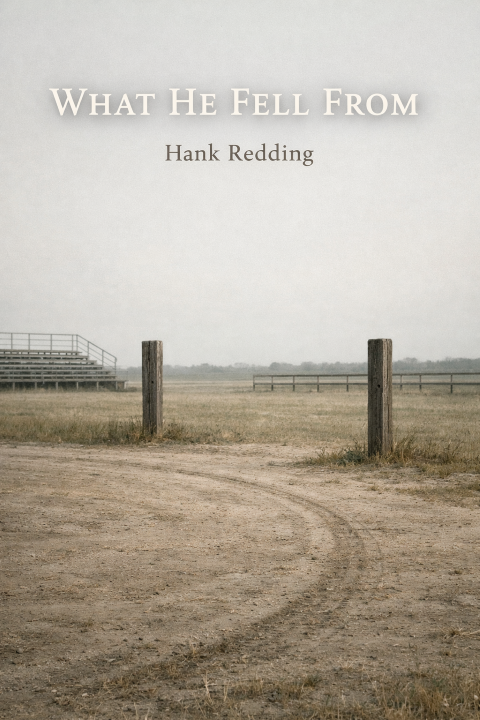
Chapter One
He parked farther out than he needed to, though there was no one to inconvenience. Old habit. He shut the truck off and sat with his hands on the wheel until the engine ticked itself quiet.
The place hadn’t changed the way people said places did. It hadn’t gone sentimental or been reclaimed by weeds. It had simply thinned. Fewer rails. Fewer signs. The paint on the outbuildings had faded to a color that didn’t try to be anything anymore. Functional once. Neutral now.
He stepped out and shut the door softly, as if sound still mattered here.
The ground was packed hard, dust pressed into itself by years of use. He could tell where the main track had been by the way the earth still held a curve—subtle but undeniable, like a body remembering a motion long after it stopped making it. He walked it without meaning to, boots finding the line on their own.
There was a time when he’d known this place by the hour—when the light hit the far fence, when the wind cut through the low spots, where the footing went soft after rain. He hadn’t thought of it as memory then. It was just information. The kind you gathered because it kept you upright.
Now it carried weight.
He stopped near the center and looked around. No crowd. No noise. No reason to stand where he was standing except that he always had. He let himself imagine the sound that used to live here—the short roar, the sudden quiet, the way everything waited for what came next.
Nothing came.
A new sign had been bolted to the far post. Smaller than the old ones. No sponsors listed. Just rules. Just hours. Just liability spelled out cleanly and without apology. He didn’t walk over to read it. He knew what it would say.
What struck him instead was what wasn’t there.
The gate on the east side had been removed entirely. Not broken. Not leaning. Gone. The posts still stood, squared off at the top like something had been lifted away carefully. He stood there longer than he needed to, looking at the absence.
That gate had mattered once.
He turned away from it and walked toward the low bleachers, their metal seats dulled by sun and weather. He sat halfway up—not for the view, but because that was where he’d always sat when he needed to see the whole thing at once. The bench creaked under his weight, surprised but willing.
From there, the place looked smaller.
He felt no rush to explain himself. Not to the place, and not to whatever version of himself still remembered standing here with something to prove. He’d learned, over time, that explanations were usually a way of asking to be forgiven without saying so.
He wasn’t here for that.
He stayed seated until the wind shifted and brought with it the faint smell of oil and old dust—nothing dramatic, just enough to remind him that things once happened here and had not been erased simply because they were finished.
When he stood, it was slow and deliberate. His knees complained the way they always did, but he ignored it. Pain like that was honest. It didn’t ask questions.
He walked back toward the truck without looking behind him.
There was nothing left to measure.
Chapter Two — The Cost
He didn’t plan to go into town, but the road carried him there the way roads sometimes did when you stopped arguing with them.
It wasn’t much of a town anymore. Two gas stations where there used to be three. A diner that had shortened its hours and stopped pretending it hadn’t. The feed store still stood, though the windows had been replaced with something cheaper and clearer, like it had decided to be honest about what it was now.
He parked along the curb and sat for a moment, watching a pickup idle across the street. The driver stayed inside, window down, arm resting out the side. They nodded to each other without recognition—men acknowledging that the day was happening.
Inside the store, the bell over the door rang too loud.
The place smelled the same. Grain dust and oil. A faint sweetness underneath it all, like something meant for animals had always been closer to sugar than anyone admitted. He walked the aisles slowly, not looking for anything in particular, hands clasped behind his back the way he did when he didn’t trust himself not to touch things.
A young man stood at the counter flipping through invoices. He looked up, then away, then back again.
“Can I help you?” the kid asked.
“No,” he said. Then, after a pause, “I don’t think so.”
The kid nodded, relieved, and went back to his papers.
He stopped near the rack of work gloves. The good kind—thick palms, stiff fingers that took time to break in. He picked one up, felt the weight, then set it back exactly where it had been. There were things he didn’t need anymore, even if his hands still remembered them.
At the far end of the store, a bulletin board hung crooked, layered with years of notices. Lost dogs. Equipment for sale. Phone numbers curling at the edges. In the lower corner, partially covered by a newer flyer, he saw a familiar name.
It took him a moment to place it.
Not because he’d forgotten it—because he hadn’t used it in a long time.
The card was old. The ink had faded. Someone had tacked it up years ago and never bothered to take it down. The paper had yellowed, corners soft from handling.
He didn’t step closer.
He didn’t need to read the details. He knew the handwriting. Knew the way the letters leaned slightly forward, like the person who’d written them always expected to be moving on before anyone caught up.
The kid at the counter cleared his throat. “You okay?”
“Yeah,” he said. “Just passing through.”
He left without buying anything.
Outside, the sun had shifted, pulling the shadows longer across the street. He stood on the sidewalk and watched a woman load feed bags into the back of a truck. She moved carefully—not weak, but deliberate—adjusting her stance each time before lifting. A child waited nearby, swinging a length of twine, counting something only they could see.
The woman caught him looking and smiled politely. Not recognition. Not curiosity. Just courtesy.
He nodded back and turned away.
As he walked, the old reflex rose—the urge to justify himself, to shape the story in a way that landed softer. He could have told it a hundred ways. Could have framed it as necessity, ambition, timing. Could have said he didn’t know then what he knew now.
All of it would have been true.
None of it would have changed what stood where something else used to be.
He reached the edge of town and stopped again, this time without a reason. The road ahead was empty, stretching out into heat and distance. The road behind him led back past the store, past the board, past the card that hadn’t been taken down because no one had asked for it to be.
He stood there until the choice stopped feeling like one.
Then he got back in the truck and drove on.
Chapter Three — The Fall
He didn’t turn off at the first road. Or the second.
The third took him past a stand of cottonwoods and down toward the river. The pavement narrowed there, its edges crumbling back into dirt. He slowed without meaning to, the way you did when the land stopped pretending it was meant to be passed through quickly.
The house was gone.
Not burned.
Not collapsed.
Removed.
In its place stood a rectangle of different grass, greener and more stubborn, like the ground hadn’t yet accepted what it had been told to forget. A mailbox leaned at the edge of the drive, door hanging open, numbers faded but still legible if you knew what you were looking for.
He pulled over and shut the engine off.
The quiet here was different than the quiet at the grounds. That had been an absence of noise. This was an absence of permission. He stayed in the truck, hands resting on his thighs, eyes fixed on the stretch of earth where the porch had once been.
He could still see it.
The boards slanted slightly toward the steps. The place where the railing always came loose in winter. The chair she liked to sit in, angled just enough to catch the breeze. None of it was there now, but his body remembered the spacing. Memory didn’t need structures to keep its shape.
He told himself he wouldn’t get out.
Then he did.
The grass near the river was damp, cool through the soles of his boots. He walked the edge of the old foundation without stepping into it, tracing the outline the way a man might trace a scar he didn’t want to reopen. He stopped where the door had been.
That was the part he couldn’t stand in.
He had left in a hurry that morning. Not running—just certain. Certain that what he was doing made sense. Certain that time would smooth whatever he didn’t have words for yet. Certain that leaving then was better than staying and saying something that couldn’t be taken back.
He had not come back the way he said he would.
Not that night.
Not the next one.
Not when the weather turned.
Not when the calls stopped.
He hadn’t meant for it to become permanent. He just hadn’t done anything to stop it.
Down by the water, a length of old rope lay half-buried in silt, fibers darkened from years of wet and sun. He picked it up without thinking, tested it once between his hands. It held. Some things did, even after being left where they shouldn’t have been.
He set it back down.
There was no one here to witness him standing in the wrong place too late. No one to hear an explanation he wouldn’t have offered anyway. The river moved on, indifferent, carrying small debris past his boots without slowing.
He stayed until the light shifted and the shadows pulled long across the clearing. When he turned away, he didn’t look back.
Not because it was too painful.
Because there was nothing there that still belonged to him.
Chapter Four — The Question
He stopped for gas just outside a town he’d never learned the name of. One of those places that existed because a road cut through it and people needed somewhere to pause. The buildings sat back from the highway, sun-bleached and low, as if they’d learned not to expect attention.
The station had one pump working and a handwritten sign taped to the door explaining why the other one didn’t. The paper had curled at the corners, the ink run slightly where someone’s thumb had brushed it too often. He paid inside, nodded to the man behind the counter, and stepped back out into the heat.
The air smelled like fuel and dust and something faintly sweet coming from the ice chest near the wall.
A boy stood there kicking at gravel. Not a child, not grown. All elbows and hesitation, his boots scuffed white at the toes. He watched the pump with interest that wasn’t about gasoline, eyes following the numbers as they climbed.
“You come from the fairgrounds?” the boy asked.
He looked up, shielding his eyes from the glare. “Used to.”
The boy nodded, satisfied by that much. “My uncle ran barrels,” he said. “Said it was the best thing he ever quit.”
He smiled at that. Not wide. Just enough to acknowledge the truth hiding in it.
The pump clicked off with a hollow sound. He hung the nozzle back and screwed the cap on tight, the threads catching once before settling. He wiped his hands on his jeans and turned, already stepping away, expecting the moment to be over.
It wasn’t.
The boy shifted his weight, gravel crunching under his heel. “You ever wish you’d stayed?”
The question wasn’t aimed like an accusation. It didn’t carry expectation. It was the kind of thing people asked when they were trying to decide who they might become, and wanted to know how much it would cost.
He didn’t answer right away.
A truck passed on the highway, wind buffeting the station, rattling the sign on the door. The boy waited. Patient. Curious, but not pressing.
“I stayed longer than I should have,” he said finally.
The boy thought about that, eyes dropping to the ground. “But you’d do it again?”
It wasn’t a challenge. It was a genuine inquiry—the kind that came before a life decided what it was willing to trade.
He looked past the boy, down the road where heat shimmered and the pavement ran straight into distance, offering nothing and promising less.
He didn’t answer.
The boy took the silence as an answer anyway.
“Yeah,” he said, nodding to himself. “I figured.”
He grabbed a bag of ice from the chest and carried it inside, the plastic crackling against his leg. The bell rang again when the door closed, sharp and final.
He stood alone by the pump, the smell of fuel thick in the air, the numbers still glowing faintly on the face of the machine.
The question hung there with him, unfinished, and he did not try to move it.
Chapter Five — The Answer
He drove until the light thinned and the land went flat again. He drove until the day stopped asking anything of him. The sky faded from blue to something paler, the edges of things softening as if the world were loosening its grip.
When he finally pulled over, it wasn’t because he was tired. It was because the road had opened up in a way that felt familiar—wide shoulders, no fences close enough to lean on—and he trusted that instinct more than he trusted destinations.
He shut the engine off and sat with the quiet.
It settled slowly. Wind moving through grass. The faint tick of cooling metal. Somewhere far off, a bird calling once and then not again. The road lay empty in both directions, the surface still warm enough to hold the day.
The question followed him. Not the words of it, but the shape. The idea that a life could be weighed not by what it spared, but by what it demanded—and whether the man living it would still accept the terms.
He thought of the river, moving on without pause.
The empty ground where the house had been, green and stubborn.
The card still pinned to the board, ink fading but legible.
The rope that held when it shouldn’t have.
He thought of the things that hadn’t survived him.
He also thought of the things that had.
He rested his hands on the wheel and felt the familiar ache there—not pain, exactly, but the knowledge of use. Callus memory. Grip worn into muscle. The kind that didn’t fade just because the work was done.
He did not tell himself a story that made it easier.
He did not soften the cost.
He did not pretend he had been misunderstood.
He understood himself clearly now. That was the difference.
When he started the truck again, it was without ceremony. The engine caught on the first turn. Dust lifted behind the tires and settled back where it had been.
He didn’t say yes.
He didn’t say no.
He drove.
And in the way he did not turn back, did not slow, did not stop to imagine another version of himself living more gently—
the answer was already complete.